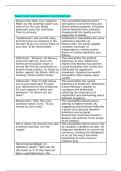
Rosencrantz and Guildenstern and Voltemand
Rosencrantz: Both your majesties This exemplifies Rosencrantz’s
Might, by the sovereign power you willingness to serve the King and
have of us, Put your dread Queen without question. He places
pleasures more into command himself beneath their authority,
Than to entreaty.” showing both his loyalty and his
eagerness to please.
“Guildenstern. But we both obey, Guildenstern exemplifies the same
And here give up ourselves in the submissive devotion as
full bent To lay our service freely at Rosencrantz. His words suggest
your feet, To be commanded.” complete surrender of
independence, reinforcing the
theme of courtly obedience and
flattery.
Voltemand: “Whereon old Norway, This exemplifies the political
overcome with joy, Gives him diplomacy at play. Voltemand
threescore thousand crowns in reports that Norway has pacified
annual fee And his commission to young Fortinbras with money and
employ those soldiers, So levied as redirected his aggression
before, against the Polack, With an elsewhere, showing how wealth
entreaty, herein further shown,” and politics often replace open
conflict.
Voltemand: “That it might please This exemplifies the careful
you to give quiet pass Through diplomacy of statecraft. Voltemand
your dominions for this enterprise, frames Norway’s request as
On such regards of safety and courteous and deferential,
allowance° As therein are set reflecting the importance of
down.” negotiation and maintaining peace
between kingdoms.
Rozencrantz: “Why then your This exemplifies Rosencrantz’s
ambition makes it one. ’Tis too attempt to flatter Hamlet. By
narrow for your mind.” suggesting that Denmark feels like
a prison only because Hamlet’s
ambitions are too great,
Rosencrantz minimises Hamlet’s
despair and redirects it into praise
of his intellect.
Tell us where ‘tis, that we may take This exemplifies Rosencrantz’s role
it thence/ And bear it to the as Claudius’s obedient servant. He
chapel” disguises obedience as concern for
ceremony, showing his willingness
to act as the king’s tool while
pretending to serve moral or
religious duty.
Second gravedigger on
Ophelia’s death: “Will you ha’
the truth on ’t? If this had not
been a gentlewoman, she
Rosencrantz: Both your majesties This exemplifies Rosencrantz’s
Might, by the sovereign power you willingness to serve the King and
have of us, Put your dread Queen without question. He places
pleasures more into command himself beneath their authority,
Than to entreaty.” showing both his loyalty and his
eagerness to please.
“Guildenstern. But we both obey, Guildenstern exemplifies the same
And here give up ourselves in the submissive devotion as
full bent To lay our service freely at Rosencrantz. His words suggest
your feet, To be commanded.” complete surrender of
independence, reinforcing the
theme of courtly obedience and
flattery.
Voltemand: “Whereon old Norway, This exemplifies the political
overcome with joy, Gives him diplomacy at play. Voltemand
threescore thousand crowns in reports that Norway has pacified
annual fee And his commission to young Fortinbras with money and
employ those soldiers, So levied as redirected his aggression
before, against the Polack, With an elsewhere, showing how wealth
entreaty, herein further shown,” and politics often replace open
conflict.
Voltemand: “That it might please This exemplifies the careful
you to give quiet pass Through diplomacy of statecraft. Voltemand
your dominions for this enterprise, frames Norway’s request as
On such regards of safety and courteous and deferential,
allowance° As therein are set reflecting the importance of
down.” negotiation and maintaining peace
between kingdoms.
Rozencrantz: “Why then your This exemplifies Rosencrantz’s
ambition makes it one. ’Tis too attempt to flatter Hamlet. By
narrow for your mind.” suggesting that Denmark feels like
a prison only because Hamlet’s
ambitions are too great,
Rosencrantz minimises Hamlet’s
despair and redirects it into praise
of his intellect.
Tell us where ‘tis, that we may take This exemplifies Rosencrantz’s role
it thence/ And bear it to the as Claudius’s obedient servant. He
chapel” disguises obedience as concern for
ceremony, showing his willingness
to act as the king’s tool while
pretending to serve moral or
religious duty.
Second gravedigger on
Ophelia’s death: “Will you ha’
the truth on ’t? If this had not
been a gentlewoman, she