

Ontario Skilled Trades
ELITE Locksmith
Licensing Exam Test
Bank | S-Tier Master
Keying, Access Control &
Life Safety Codes
Table of Contents
● PART I: THE PREVIEW
○ The Mission Profile
○ The Critical Axioms Matrix
● PART II: THE ELITE TEST BANK
○ Tier 1 (Questions 1–18) - Foundational Syntax & Application
○ Tier 2 (Questions 19–37) - Complex Application & Simulation
○ Tier 3 (Questions 38–55) - Grandmaster Synthesis
PART I: THE PREVIEW
The Mission Profile
Mastering this test bank translates directly to elite operational competence, ensuring immediate
compliance with absolute life safety mandates and advanced master keying architectures.
These precise cognitive simulations forge the distinction between a standard technician and an
undisputed industry authority.
The Critical Axioms Matrix
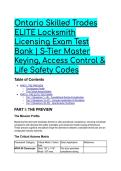
Framework Category Critical Metric / Axiom Direct Application Reference
Rule
NFPA 80 Clearances Steel: 1/8" ± 1/16". Fire door perimeter
Wood: 1/8" max. compliance during
,Framework Category Critical Metric / Axiom Direct Application Reference
Rule
Bottom: 3/4" max. annual inspections.
OBC 3.4.6.16 Egress Maglocks release on Fail-safe life safety
power drop, fire alarm, integration for egress
or pull station ≤ 600 doors.
mm.
SFIC Mathematics A2=23, A3=16, A4=14. Combinating small
Build-Up = Control + 10 format interchangeable
- Plug Total. cores.
Electrified Hardware Fire-rated doors Maintaining positive
mandate fail-secure latching during facility
strikes. blackouts.
CAN/ULC-S319 Class Minimum 30 minutes Access control power
I standby battery supply sizing and
capacity. deployment.
PART II: THE ELITE TEST BANK
Tier 1 (Questions 1–18) - Foundational Syntax & Application
Q1: An access control technician is installing an electromagnetic lock on a designated exit door.
According to Ontario Building Code Article 3.4.6.16, where is the REQUIRED location for the
manual pull station that drops power to the lock? A) Within 1200 mm of the door, mounted at
1050 mm above the finished floor. B) In the central alarm and control facility exclusively. C)
Located on the wall not more than 600 mm from the door. D) Within 1500 mm of the door,
directly tied to a delayed egress timer.
● Answer: C (Located on the wall not more than 600 mm from the door.)
● Distractor Analysis:
○ A is incorrect: 1200 mm exceeds the strict maximum distance mandated by the
provincial building code .
○ B is incorrect: While a release in the central facility is permitted, a local pull station
remains a primary requirement for standard egress doors .
○ D is incorrect: Delayed egress operates under different code parameters and does
not extend the physical pull station distance limit.
The Mentor's Analysis: OBC 3.4.6.16 dictates that electromagnetic locks must fail-safe upon
activation of a local manual pull station . By utilizing the 600 mm physical override mandate, the
technician ensures immediate, unassisted escape routes. Professional Intuition: 600 mm is
the absolute hard deck for maglock pull stations; any further compromises life safety.
Q2: During an annual fire door inspection, an auditor measures the clearances of a 90-minute
rated hollow metal door. Which measurement represents a CODE-COMPLIANT gap at the
jambs according to NFPA 80? A) 3/16 inch B) 1/4 inch C) 1/8 inch D) 3/8 inch
● Answer: C (1/8 inch)
● Distractor Analysis:
○ A is incorrect: 3/16 inch exceeds the standard limit, though older code proposals
attempted to allow it for wood doors.
○ B is incorrect: 1/4 inch is a gross violation of NFPA 80 perimeter limits.
○ D is incorrect: 3/8 inch is an allowable tolerance for the bottom undercut of smoke
, doors, not the jambs .
The Mentor's Analysis: NFPA 80 sets the strict maximum perimeter clearance for hollow metal
doors at 1/8 inch ± 1/16 inch . By utilizing exact gap gauges, the inspector bypasses the
common trap of passing non-compliant doors that will fail during positive pressure testing.
Professional Intuition: Jambs and heads receive 1/8 inch; bottoms receive 3/4 inch.
Q3: When calculating pin segments for a Best A2 Small Format Interchangeable Core (SFIC),
which calculation determines the CORRECT dimension for the Build-Up Pin? A) 23 - (Control
Cut + Master Pin) B) Control Cut + 10 - (Bottom Pin + Master Pin) C) Control Cut + 10 - Top Pin
D) 16 - (Bottom Pin + Master Pin)
● Answer: B (Control Cut + 10 - (Bottom Pin + Master Pin))
● Distractor Analysis:
○ A is incorrect: Subtracting from 23 is the formula for the Top Pin, not the Build-Up
Pin.
○ C is incorrect: The Top Pin is never used to calculate the Build-Up Pin; the
calculation operates from the plug shear upward.
○ D is incorrect: 16 is the system constant for an A3 system, not an A2 system.
The Mentor's Analysis: The A2 system relies on establishing a secondary shear line for the
control sleeve. By utilizing the algebraic sequence of adding 10 to the Control Cut and
subtracting the Plug Total, the locksmith bypasses the common trap of misaligning the control
lug. Professional Intuition: Always add 10 to the Control Cut before subtracting the Plug Total
to account for the control sleeve thickness.
Q4: A facility specifies a new mortise lock for a high-traffic hospital corridor. To meet
ANSI/BHMA A156.13 Grade 1 standards, the lock must be tested to withstand a MINIMUM of
how many operational cycles? A) 250,000 cycles B) 500,000 cycles C) 800,000 cycles D)
1,000,000 cycles
● Answer: D (1,000,000 cycles)
● Distractor Analysis:
○ A is incorrect: 250,000 cycles is the baseline for Grade 3 or lighter tubular locks.
○ B is incorrect: 500,000 cycles is the Grade 1 standard for Exit Devices (A156.3), not
mortise locks.
○ C is incorrect: 800,000 cycles represents a Grade 2 mortise lock under current
testing regimes.
The Mentor's Analysis: ANSI/BHMA A156.13 dictates the structural and operational endurance
of mortise locks. By utilizing a 1-million-cycle certified chassis, the specifier bypasses the
common trap of premature mechanical failure in heavy-duty commercial zones. Professional
Intuition: True commercial Grade 1 mortise hardware requires a proven 1,000,000-cycle
threshold.
Q5: An integrator is installing an access control system compliant with CAN/ULC-S319 Class I.
In the event of a primary AC power failure, the standby battery must sustain system operations
for a MINIMUM of what duration? A) 15 minutes B) 30 minutes C) 4 hours D) 24 hours
● Answer: B (30 minutes)
● Distractor Analysis:
○ A is incorrect: 15 minutes is insufficient for any recognized ULC access control
classification.
○ C is incorrect: 4 hours is the requirement for a higher performance level (Level IV
under UL 294).
○ D is incorrect: 24 hours applies to proprietary burglar alarm units, not standard
Class I access control.
ELITE Locksmith
Licensing Exam Test
Bank | S-Tier Master
Keying, Access Control &
Life Safety Codes
Table of Contents
● PART I: THE PREVIEW
○ The Mission Profile
○ The Critical Axioms Matrix
● PART II: THE ELITE TEST BANK
○ Tier 1 (Questions 1–18) - Foundational Syntax & Application
○ Tier 2 (Questions 19–37) - Complex Application & Simulation
○ Tier 3 (Questions 38–55) - Grandmaster Synthesis
PART I: THE PREVIEW
The Mission Profile
Mastering this test bank translates directly to elite operational competence, ensuring immediate
compliance with absolute life safety mandates and advanced master keying architectures.
These precise cognitive simulations forge the distinction between a standard technician and an
undisputed industry authority.
The Critical Axioms Matrix
Framework Category Critical Metric / Axiom Direct Application Reference
Rule
NFPA 80 Clearances Steel: 1/8" ± 1/16". Fire door perimeter
Wood: 1/8" max. compliance during
,Framework Category Critical Metric / Axiom Direct Application Reference
Rule
Bottom: 3/4" max. annual inspections.
OBC 3.4.6.16 Egress Maglocks release on Fail-safe life safety
power drop, fire alarm, integration for egress
or pull station ≤ 600 doors.
mm.
SFIC Mathematics A2=23, A3=16, A4=14. Combinating small
Build-Up = Control + 10 format interchangeable
- Plug Total. cores.
Electrified Hardware Fire-rated doors Maintaining positive
mandate fail-secure latching during facility
strikes. blackouts.
CAN/ULC-S319 Class Minimum 30 minutes Access control power
I standby battery supply sizing and
capacity. deployment.
PART II: THE ELITE TEST BANK
Tier 1 (Questions 1–18) - Foundational Syntax & Application
Q1: An access control technician is installing an electromagnetic lock on a designated exit door.
According to Ontario Building Code Article 3.4.6.16, where is the REQUIRED location for the
manual pull station that drops power to the lock? A) Within 1200 mm of the door, mounted at
1050 mm above the finished floor. B) In the central alarm and control facility exclusively. C)
Located on the wall not more than 600 mm from the door. D) Within 1500 mm of the door,
directly tied to a delayed egress timer.
● Answer: C (Located on the wall not more than 600 mm from the door.)
● Distractor Analysis:
○ A is incorrect: 1200 mm exceeds the strict maximum distance mandated by the
provincial building code .
○ B is incorrect: While a release in the central facility is permitted, a local pull station
remains a primary requirement for standard egress doors .
○ D is incorrect: Delayed egress operates under different code parameters and does
not extend the physical pull station distance limit.
The Mentor's Analysis: OBC 3.4.6.16 dictates that electromagnetic locks must fail-safe upon
activation of a local manual pull station . By utilizing the 600 mm physical override mandate, the
technician ensures immediate, unassisted escape routes. Professional Intuition: 600 mm is
the absolute hard deck for maglock pull stations; any further compromises life safety.
Q2: During an annual fire door inspection, an auditor measures the clearances of a 90-minute
rated hollow metal door. Which measurement represents a CODE-COMPLIANT gap at the
jambs according to NFPA 80? A) 3/16 inch B) 1/4 inch C) 1/8 inch D) 3/8 inch
● Answer: C (1/8 inch)
● Distractor Analysis:
○ A is incorrect: 3/16 inch exceeds the standard limit, though older code proposals
attempted to allow it for wood doors.
○ B is incorrect: 1/4 inch is a gross violation of NFPA 80 perimeter limits.
○ D is incorrect: 3/8 inch is an allowable tolerance for the bottom undercut of smoke
, doors, not the jambs .
The Mentor's Analysis: NFPA 80 sets the strict maximum perimeter clearance for hollow metal
doors at 1/8 inch ± 1/16 inch . By utilizing exact gap gauges, the inspector bypasses the
common trap of passing non-compliant doors that will fail during positive pressure testing.
Professional Intuition: Jambs and heads receive 1/8 inch; bottoms receive 3/4 inch.
Q3: When calculating pin segments for a Best A2 Small Format Interchangeable Core (SFIC),
which calculation determines the CORRECT dimension for the Build-Up Pin? A) 23 - (Control
Cut + Master Pin) B) Control Cut + 10 - (Bottom Pin + Master Pin) C) Control Cut + 10 - Top Pin
D) 16 - (Bottom Pin + Master Pin)
● Answer: B (Control Cut + 10 - (Bottom Pin + Master Pin))
● Distractor Analysis:
○ A is incorrect: Subtracting from 23 is the formula for the Top Pin, not the Build-Up
Pin.
○ C is incorrect: The Top Pin is never used to calculate the Build-Up Pin; the
calculation operates from the plug shear upward.
○ D is incorrect: 16 is the system constant for an A3 system, not an A2 system.
The Mentor's Analysis: The A2 system relies on establishing a secondary shear line for the
control sleeve. By utilizing the algebraic sequence of adding 10 to the Control Cut and
subtracting the Plug Total, the locksmith bypasses the common trap of misaligning the control
lug. Professional Intuition: Always add 10 to the Control Cut before subtracting the Plug Total
to account for the control sleeve thickness.
Q4: A facility specifies a new mortise lock for a high-traffic hospital corridor. To meet
ANSI/BHMA A156.13 Grade 1 standards, the lock must be tested to withstand a MINIMUM of
how many operational cycles? A) 250,000 cycles B) 500,000 cycles C) 800,000 cycles D)
1,000,000 cycles
● Answer: D (1,000,000 cycles)
● Distractor Analysis:
○ A is incorrect: 250,000 cycles is the baseline for Grade 3 or lighter tubular locks.
○ B is incorrect: 500,000 cycles is the Grade 1 standard for Exit Devices (A156.3), not
mortise locks.
○ C is incorrect: 800,000 cycles represents a Grade 2 mortise lock under current
testing regimes.
The Mentor's Analysis: ANSI/BHMA A156.13 dictates the structural and operational endurance
of mortise locks. By utilizing a 1-million-cycle certified chassis, the specifier bypasses the
common trap of premature mechanical failure in heavy-duty commercial zones. Professional
Intuition: True commercial Grade 1 mortise hardware requires a proven 1,000,000-cycle
threshold.
Q5: An integrator is installing an access control system compliant with CAN/ULC-S319 Class I.
In the event of a primary AC power failure, the standby battery must sustain system operations
for a MINIMUM of what duration? A) 15 minutes B) 30 minutes C) 4 hours D) 24 hours
● Answer: B (30 minutes)
● Distractor Analysis:
○ A is incorrect: 15 minutes is insufficient for any recognized ULC access control
classification.
○ C is incorrect: 4 hours is the requirement for a higher performance level (Level IV
under UL 294).
○ D is incorrect: 24 hours applies to proprietary burglar alarm units, not standard
Class I access control.


