

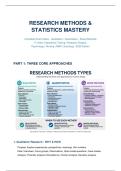
RESEARCH METHODS &
STATISTICS MASTERY
Complete Exam Notes - Qualitative • Quantitative • Mixed Methods
P-Value, Hypothesis Testing, Research Designs
Psychology | Nursing | MBA | Sociology | 2026 Edition
PART 1: THREE CORE APPROACHES
1. Qualitative Research - WHY & HOW
Purpose: Explore experiences, perspectives, meanings. Not numbers.
Data: Interviews, Focus groups, Observations, Open-ended questions, Case studies.
Analysis: Thematic analysis (find patterns), Content analysis, Narrative analysis.
, Sample: Small (5-30), purposive sampling.
When to use: New topic, human behavior, theory building.
Example: 'What is it like to live with chronic pain?' - Interview 10 patients.
Strength: Deep understanding. Weakness: Not generalizable, researcher bias.
2. Quantitative Research - WHAT, WHERE, HOW MANY
Purpose: Measure, test hypothesis, quantify, generalize to population.
Data: Surveys, Experiments, Structured observations, Standardized tests, Secondary data.
Analysis: Statistics - Mean, SD, T-test, ANOVA, Correlation, Regression.
Sample: Large (100+), random sampling for generalizability.
When to use: Testing cause-effect, measuring outcomes, large populations.
Example: 'Does Drug A lower BP more than Placebo?' - RCT 200 patients.
Strength: Generalizable, objective. Weakness: Misses context.
3. Mixed Methods - BEST OF BOTH
Purpose: Combine qualitative + quantitative for holistic understanding. Triangulation =
validation.
Designs: Sequential (QUAN → QUAL or QUAL → QUAN) or Concurrent (both same time).
Example: First survey 300 nurses about burnout (QUAN), then interview 15 nurses about
why (QUAL).
Exam Trap: Mixed methods = pragmatism philosophy.
STATISTICS MASTERY
Complete Exam Notes - Qualitative • Quantitative • Mixed Methods
P-Value, Hypothesis Testing, Research Designs
Psychology | Nursing | MBA | Sociology | 2026 Edition
PART 1: THREE CORE APPROACHES
1. Qualitative Research - WHY & HOW
Purpose: Explore experiences, perspectives, meanings. Not numbers.
Data: Interviews, Focus groups, Observations, Open-ended questions, Case studies.
Analysis: Thematic analysis (find patterns), Content analysis, Narrative analysis.
, Sample: Small (5-30), purposive sampling.
When to use: New topic, human behavior, theory building.
Example: 'What is it like to live with chronic pain?' - Interview 10 patients.
Strength: Deep understanding. Weakness: Not generalizable, researcher bias.
2. Quantitative Research - WHAT, WHERE, HOW MANY
Purpose: Measure, test hypothesis, quantify, generalize to population.
Data: Surveys, Experiments, Structured observations, Standardized tests, Secondary data.
Analysis: Statistics - Mean, SD, T-test, ANOVA, Correlation, Regression.
Sample: Large (100+), random sampling for generalizability.
When to use: Testing cause-effect, measuring outcomes, large populations.
Example: 'Does Drug A lower BP more than Placebo?' - RCT 200 patients.
Strength: Generalizable, objective. Weakness: Misses context.
3. Mixed Methods - BEST OF BOTH
Purpose: Combine qualitative + quantitative for holistic understanding. Triangulation =
validation.
Designs: Sequential (QUAN → QUAL or QUAL → QUAN) or Concurrent (both same time).
Example: First survey 300 nurses about burnout (QUAN), then interview 15 nurses about
why (QUAL).
Exam Trap: Mixed methods = pragmatism philosophy.



