

National Identity in Russia from 1961 : Traditions and Deterritorialisation
Newsletter No. 3
(May 2009)
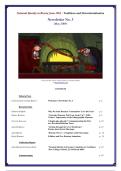
Scene from the cartoon ‘Little Vasilisa’ by Darina Schmidt
© http://melnitsa.com/
CONTENTS
Editorial Note
Catriona Kelly & Andy Byford Welcome to Newsletter No. 3 p. 2
Research Notes
Edmund Griffiths Why Do Some Russian ‘Communists’ Love the Tsar? p. 2
Dmitry Baranov ‘Comrade Museum, Pull Your Socks Up!’: 1930s p. 5
Visitors’ Impressions of the Ethnographic Museum
Victoria Donovan Vologda-gde-gde-gde?: Commemorating the Past p. 10
in a Provincial Russian Town
Anna Kushkova ‘Getting through the Grey Membrane’: p. 12
Stories about Soviet Shortages
Andy Byford ‘Russian Wives’: A Snapshot of the Stereotype p. 14
Birgit Beumers Folklore and New Russian Animation p. 15
Conference Report
Andy Byford & Catriona Kelly ‘National Identity in Eurasia I: Identities & Traditions’ p. 19
(New College, Oxford, 22-24 March 2009)
Announcements p. 22
, National Identity in Russia from 1961 : Traditions and Deterritorialisation
Newsletter No. 3 (May 2009)
EDITORIAL NOTE
A mass of corroborating evidence would be both
Welcome to Newsletter No. 3 tedious and redundant. We all know Ziuganov says
these things. We all know that many of his
Catriona Kelly & Andy Byford
associates in and around the Communist Party of
the Russian Federation (C.P.R.F.) are at least
Dear newsletter subscribers and network members, equally given to hymning what they see as Russia’s
We are glad to introduce the third issue of our project national and imperial heritage. It’s the communists
newsletter. The contributions this time include a piece by praising Tsarism again, move along, nothing to see
Edmund Griffiths, a Research Fellow at Wolfson College, here.
Oxford, working on the culture and ideology of the
But this is really all very strange. The party of
Russian imperial-patriotic movement, as well as research Lenin has undergone several twists and turns since
notes by several members of our core research group. its classical period; but the innocent observer could
Alongside these materials, we also include a report on our be forgiven for assuming that hostility to Tsarism
project’s recent major international conference on National would be a legacy that Russian communism would
Identity in Eurasia, which took place in Oxford in March. find it difficult to shed. Things would be more
straightforward if the C.P.R.F. were, as it is
We are grateful to all the authors for their stimulating occasionally taken to be, an uncomplicatedly
contributions and invite responses, and further research conservative and nationalist outfit that simply
notes, conference reports, reviews, etc., for the fourth issue traded under the name of a communist party: then
of the newsletter, which we shall publish in the autumn of the only problem would be to unravel why a right-
2009. If you have any suggestions or specific proposals, wing organization would use such an unsuitable
contact us at: . label, and the answer (presumably in terms of
communism’s association with the unity and
RESEARCH NOTES greatness of the Soviet Union) would not be hard to
find. It does look like that, much of the time. But
Why Do Some Russian ‘Communists’ Love the Tsar? Ziuganov and his supporters cannot be dismissed so
easily as a Tory party in disguise. A party of the
Edmund Griffiths right would have been unlikely to devote so much
energy to opposing benefit cuts, resisting the
[A]ll trace of the religion of our fathers was stripped from introduction of a new Labour Code [КЗоТ], and
government and the law. And so it comes about that condemning privatization (often in the most
working men are now left isolated and helpless, betrayed hyperbolic terms—‘repression’, ‘genocide’). There
to the inhumanity of employers and the unbridled greed of is every bit as much anti-capitalism (or, at least,
competitors. POPE LEO XIII1 anti-neoliberalism) in the C.P.R.F.’s repertory as
One drawback of any kind of sustained familiarity with a there is nationalism. Unless one strand or the other
particular ideological scene is that its characteristic is to be explained away as pure manoeuvre (a
oddities can come to seem routine without having been desperate last resort in any such situation), the
properly explained. No-one acclimatized to Russian uncertainty over how to describe the C.P.R.F.’s
opposition politics would have had cause even to blink in ideology remains.
late 2007, when Gennadii Ziuganov responded to the kind It is reasonable to begin by glancing at the
of question politicians must dream about (‘You are the organization’s social base. Despite its active
leader of the Russian Communist party: please tell me campaigns on labour issues, the C.P.R.F.—which
what communism means for you’) with an appeal not to has added a stylized book to the familiar hammer
the politics of class but to Russian culture’s supposedly and sickle in much the same spirit as Kim Il Sung
innate collectivism—a collectivism exemplified by the added a writing brush—has found it difficult to
Tsar. speak with authority as the voice of Russia’s
[E]ven the Tsar had a family council [sovet] of all the adult workers and peasants. At the high point of its post-
members of the imperial dynasty […] he was a big Soviet influence it was the party of the ‘relatively
landowner, but he couldn’t sell a single dessiatine on his deprived’, increasingly representing managers, the
own, without the council deciding it collectively. That’s Military Industrial Complex (MIC), educational
the way life is typically organized in our society. 2 and white-collar workers who had all experienced a
status decline since the Soviet era, but some of
1
Rerum Novarum. Encyclical letter of Pope Leo XIII on the condition of
the working classes. Centenary Study Edition: with introduction and «Коммунизм — это очень широкое понятие»’ is available on
notes by Joseph Kirwan, London: Catholic Truth Society, 1991, p. 2. the Electorat.ru website, at
2
Interview with G. Il’ichev and V. Dymarskii, broadcast on Ekho Moskvy <http://electorat.info/blog/suzheti/24571-0-gennadii-zuganov-
on 15 October 2007. A transcript under the title ‘Геннадий Зюганов: kommunizm-eto-ochen-shirokoe-ponyatie.html>.
2
, National Identity in Russia from 1961 : Traditions and Deterritorialisation
Newsletter No. 3 (May 2009)
whom were slowly adapting to post-Soviet conditions. In living standards of these millions deteriorated in the
1996 its membership composition was reputed to be 20 per post-Soviet years at least in proportion to the
cent workers or collective farmers, 23 per cent engineering precipitate decline in the country’s overall
and technical personnel, and 31 per cent cultural, economic output. Their loss of relative status will
scientific, health, education and military personnel. 3 also have been severe, as a new set of classes and
stratifications took shape; and it will have been
If these figures are accurate, the majority of the C.P.R.F.’s
notably extreme for technicians and specialists in
membership at the time of its greatest electoral successes
particularly prestigious fields like space exploration
consisted of people engaged in mental labour,
and the military, with the cancellation of the Soviet
predominantly in the state sector. (It is likely that the
space shuttle Buran and the rapid downgrading of
party’s electorate, as opposed to its membership, contained
Russia’s post-Soviet armed forces.6
and continues to contain a larger proportion of peasants
and manual workers.) In itself this is interesting but not Many people in this position look back on the
conclusive: the social positioning of an ideology cannot be Soviet order with bitter nostalgia; nothing could be
established with any certainty from a sociological more natural. Assaulted both in their material living
breakdown of its convinced adherents, and the conditions and in their self-esteem, they remember
composition of the C.P.R.F. is probably not too far (give the Brezhnev period not in Marxian categories (as a
or take the military element) from that of many social stage in the transition to communism) but as a time
democratic parties in other countries. when there was social calm, a tolerable degree of
comfort, job security, and a stable currency to
The picture becomes more eloquent if we recall the status
protect one’s savings, and when educated
these technocratic strata of the population enjoyed under
professionals enjoyed official and public respect.
the Soviet system. The economist Albert Szymanski
They tend to recall the U.S.S.R. not in the terms of
found, on the basis of a number of sociological studies,
its own self-presentation, but as having been
that while there is no social class corresponding to the
something approaching the old Fabian dream or
wealthy corporate owning and managerial class in the
nightmare, the class Utopia in which the ruling
Western countries (i.e. the Soviet power elite does not
class now takes the form of a permanent,
form a distinctive social class), there does tend to be a
intellectual, trained bureaucracy, wielding the
significant differentiation in life style, marriage patterns
powers of State for the ‘good’ of the proletariat. 7
and inheritance of position, roughly comparable to the
differences between the petty bourgeoisie and the manual The ideologists of the C.P.R.F. and the wider
working class in the U.S. The most distinctive tendencies ‘patriotic’ or ‘red–brown’ movement8 show little
toward social class formation occur within the scientific- interest in Marxist theses like internationalism and
technical section of the intelligentsia who appear to have the withering away of the state. Despite the
the most distinctive life styles and inter-marriage patterns occasional sloganistic assertion that socialism ‘is
and the highest probability of passing on intelligentsia not behind us, it’s in front of us’ [не за нами, а
status.4 перед нами], Ziuganov and others have
constructed a politics that is fundamentally
The Soviet intelligentsia’s social prestige was not
backward-looking, oriented in the first instance
necessarily reflected in any great material privilege. Isaac
towards the paternalistic and technocratic Soviet
Deutscher, criticizing as over-simplified the Djilasian
state of the 1970s—and precisely towards its
hypothesis of a bureaucratic ‘new class’, observed that
paternalistic and technocratic features.
about one-third of the total number of specialists are
poorly paid teachers—the Soviet press has recently voiced This is an ideology that has clear past parallels.
many complaints about their living conditions. The same is There is nothing new about seeking to resist
true about most of half a million doctors. Many of the two capitalism in the name of a supposedly just and
million engineers, agronomists, and statisticians earn less humane social order that preceded it, from John
than the wage of a highly skilled worker. Their standard of Ruskin basing his anti-capitalist ethic on a
living is comparable to that of our lower middle class. 5 consideration of Gothic architecture9 to the
With individual exceptions, such as the former
corresponding member of the U.S.S.R. Academy of
Sciences Boris Berezovskii, it can be assumed that the 6
See William E. Odom: The Collapse of the Soviet Military,
New Haven, Connecticut and London: Yale University Press,
1998.
3 7
Luke March: The Communist Party in post-Soviet Russia, Manchester Christopher Caudwell: Studies in a Dying Culture, London:
and New York: Manchester University Press, 2002, p. 140. It should be The Bodley Head, 1957, p. 9.
noted that these categories (except ‘collective farmers’) refer not to class 8
Several of the most creative ‘patriotic’ ideologists are outside
as such, but to the division between mental and manual labour. the C.P.R.F.; but ‘red–brown’ thinkers can reasonably be seen as
4
Albert Szymanski: Is the Red Flag Flying? The Political Economy of grouped around the main ‘red–brown’ organization, just as
the Soviet Union, London: Zed, 1983, p. 76. ecological thinkers and propagandists in various countries tend
5
Isaac Deutscher: The Unfinished Revolution. Russia 1917–1967. The to be grouped around each country’s Green Party.
George Macaulay Trevelyan Lectures delivered in the University of 9
See John Ruskin: ‘The Nature of Gothic’ (The Stones of
Cambridge, January–March 1967, London: Oxford University Press, Venice, vol. II, chapter 6), in The Genius of John Ruskin.
1967, p. 54. Selections from His Writings (ed. John D. Rosenberg),
3
Newsletter No. 3
(May 2009)
Scene from the cartoon ‘Little Vasilisa’ by Darina Schmidt
© http://melnitsa.com/
CONTENTS
Editorial Note
Catriona Kelly & Andy Byford Welcome to Newsletter No. 3 p. 2
Research Notes
Edmund Griffiths Why Do Some Russian ‘Communists’ Love the Tsar? p. 2
Dmitry Baranov ‘Comrade Museum, Pull Your Socks Up!’: 1930s p. 5
Visitors’ Impressions of the Ethnographic Museum
Victoria Donovan Vologda-gde-gde-gde?: Commemorating the Past p. 10
in a Provincial Russian Town
Anna Kushkova ‘Getting through the Grey Membrane’: p. 12
Stories about Soviet Shortages
Andy Byford ‘Russian Wives’: A Snapshot of the Stereotype p. 14
Birgit Beumers Folklore and New Russian Animation p. 15
Conference Report
Andy Byford & Catriona Kelly ‘National Identity in Eurasia I: Identities & Traditions’ p. 19
(New College, Oxford, 22-24 March 2009)
Announcements p. 22
, National Identity in Russia from 1961 : Traditions and Deterritorialisation
Newsletter No. 3 (May 2009)
EDITORIAL NOTE
A mass of corroborating evidence would be both
Welcome to Newsletter No. 3 tedious and redundant. We all know Ziuganov says
these things. We all know that many of his
Catriona Kelly & Andy Byford
associates in and around the Communist Party of
the Russian Federation (C.P.R.F.) are at least
Dear newsletter subscribers and network members, equally given to hymning what they see as Russia’s
We are glad to introduce the third issue of our project national and imperial heritage. It’s the communists
newsletter. The contributions this time include a piece by praising Tsarism again, move along, nothing to see
Edmund Griffiths, a Research Fellow at Wolfson College, here.
Oxford, working on the culture and ideology of the
But this is really all very strange. The party of
Russian imperial-patriotic movement, as well as research Lenin has undergone several twists and turns since
notes by several members of our core research group. its classical period; but the innocent observer could
Alongside these materials, we also include a report on our be forgiven for assuming that hostility to Tsarism
project’s recent major international conference on National would be a legacy that Russian communism would
Identity in Eurasia, which took place in Oxford in March. find it difficult to shed. Things would be more
straightforward if the C.P.R.F. were, as it is
We are grateful to all the authors for their stimulating occasionally taken to be, an uncomplicatedly
contributions and invite responses, and further research conservative and nationalist outfit that simply
notes, conference reports, reviews, etc., for the fourth issue traded under the name of a communist party: then
of the newsletter, which we shall publish in the autumn of the only problem would be to unravel why a right-
2009. If you have any suggestions or specific proposals, wing organization would use such an unsuitable
contact us at: . label, and the answer (presumably in terms of
communism’s association with the unity and
RESEARCH NOTES greatness of the Soviet Union) would not be hard to
find. It does look like that, much of the time. But
Why Do Some Russian ‘Communists’ Love the Tsar? Ziuganov and his supporters cannot be dismissed so
easily as a Tory party in disguise. A party of the
Edmund Griffiths right would have been unlikely to devote so much
energy to opposing benefit cuts, resisting the
[A]ll trace of the religion of our fathers was stripped from introduction of a new Labour Code [КЗоТ], and
government and the law. And so it comes about that condemning privatization (often in the most
working men are now left isolated and helpless, betrayed hyperbolic terms—‘repression’, ‘genocide’). There
to the inhumanity of employers and the unbridled greed of is every bit as much anti-capitalism (or, at least,
competitors. POPE LEO XIII1 anti-neoliberalism) in the C.P.R.F.’s repertory as
One drawback of any kind of sustained familiarity with a there is nationalism. Unless one strand or the other
particular ideological scene is that its characteristic is to be explained away as pure manoeuvre (a
oddities can come to seem routine without having been desperate last resort in any such situation), the
properly explained. No-one acclimatized to Russian uncertainty over how to describe the C.P.R.F.’s
opposition politics would have had cause even to blink in ideology remains.
late 2007, when Gennadii Ziuganov responded to the kind It is reasonable to begin by glancing at the
of question politicians must dream about (‘You are the organization’s social base. Despite its active
leader of the Russian Communist party: please tell me campaigns on labour issues, the C.P.R.F.—which
what communism means for you’) with an appeal not to has added a stylized book to the familiar hammer
the politics of class but to Russian culture’s supposedly and sickle in much the same spirit as Kim Il Sung
innate collectivism—a collectivism exemplified by the added a writing brush—has found it difficult to
Tsar. speak with authority as the voice of Russia’s
[E]ven the Tsar had a family council [sovet] of all the adult workers and peasants. At the high point of its post-
members of the imperial dynasty […] he was a big Soviet influence it was the party of the ‘relatively
landowner, but he couldn’t sell a single dessiatine on his deprived’, increasingly representing managers, the
own, without the council deciding it collectively. That’s Military Industrial Complex (MIC), educational
the way life is typically organized in our society. 2 and white-collar workers who had all experienced a
status decline since the Soviet era, but some of
1
Rerum Novarum. Encyclical letter of Pope Leo XIII on the condition of
the working classes. Centenary Study Edition: with introduction and «Коммунизм — это очень широкое понятие»’ is available on
notes by Joseph Kirwan, London: Catholic Truth Society, 1991, p. 2. the Electorat.ru website, at
2
Interview with G. Il’ichev and V. Dymarskii, broadcast on Ekho Moskvy <http://electorat.info/blog/suzheti/24571-0-gennadii-zuganov-
on 15 October 2007. A transcript under the title ‘Геннадий Зюганов: kommunizm-eto-ochen-shirokoe-ponyatie.html>.
2
, National Identity in Russia from 1961 : Traditions and Deterritorialisation
Newsletter No. 3 (May 2009)
whom were slowly adapting to post-Soviet conditions. In living standards of these millions deteriorated in the
1996 its membership composition was reputed to be 20 per post-Soviet years at least in proportion to the
cent workers or collective farmers, 23 per cent engineering precipitate decline in the country’s overall
and technical personnel, and 31 per cent cultural, economic output. Their loss of relative status will
scientific, health, education and military personnel. 3 also have been severe, as a new set of classes and
stratifications took shape; and it will have been
If these figures are accurate, the majority of the C.P.R.F.’s
notably extreme for technicians and specialists in
membership at the time of its greatest electoral successes
particularly prestigious fields like space exploration
consisted of people engaged in mental labour,
and the military, with the cancellation of the Soviet
predominantly in the state sector. (It is likely that the
space shuttle Buran and the rapid downgrading of
party’s electorate, as opposed to its membership, contained
Russia’s post-Soviet armed forces.6
and continues to contain a larger proportion of peasants
and manual workers.) In itself this is interesting but not Many people in this position look back on the
conclusive: the social positioning of an ideology cannot be Soviet order with bitter nostalgia; nothing could be
established with any certainty from a sociological more natural. Assaulted both in their material living
breakdown of its convinced adherents, and the conditions and in their self-esteem, they remember
composition of the C.P.R.F. is probably not too far (give the Brezhnev period not in Marxian categories (as a
or take the military element) from that of many social stage in the transition to communism) but as a time
democratic parties in other countries. when there was social calm, a tolerable degree of
comfort, job security, and a stable currency to
The picture becomes more eloquent if we recall the status
protect one’s savings, and when educated
these technocratic strata of the population enjoyed under
professionals enjoyed official and public respect.
the Soviet system. The economist Albert Szymanski
They tend to recall the U.S.S.R. not in the terms of
found, on the basis of a number of sociological studies,
its own self-presentation, but as having been
that while there is no social class corresponding to the
something approaching the old Fabian dream or
wealthy corporate owning and managerial class in the
nightmare, the class Utopia in which the ruling
Western countries (i.e. the Soviet power elite does not
class now takes the form of a permanent,
form a distinctive social class), there does tend to be a
intellectual, trained bureaucracy, wielding the
significant differentiation in life style, marriage patterns
powers of State for the ‘good’ of the proletariat. 7
and inheritance of position, roughly comparable to the
differences between the petty bourgeoisie and the manual The ideologists of the C.P.R.F. and the wider
working class in the U.S. The most distinctive tendencies ‘patriotic’ or ‘red–brown’ movement8 show little
toward social class formation occur within the scientific- interest in Marxist theses like internationalism and
technical section of the intelligentsia who appear to have the withering away of the state. Despite the
the most distinctive life styles and inter-marriage patterns occasional sloganistic assertion that socialism ‘is
and the highest probability of passing on intelligentsia not behind us, it’s in front of us’ [не за нами, а
status.4 перед нами], Ziuganov and others have
constructed a politics that is fundamentally
The Soviet intelligentsia’s social prestige was not
backward-looking, oriented in the first instance
necessarily reflected in any great material privilege. Isaac
towards the paternalistic and technocratic Soviet
Deutscher, criticizing as over-simplified the Djilasian
state of the 1970s—and precisely towards its
hypothesis of a bureaucratic ‘new class’, observed that
paternalistic and technocratic features.
about one-third of the total number of specialists are
poorly paid teachers—the Soviet press has recently voiced This is an ideology that has clear past parallels.
many complaints about their living conditions. The same is There is nothing new about seeking to resist
true about most of half a million doctors. Many of the two capitalism in the name of a supposedly just and
million engineers, agronomists, and statisticians earn less humane social order that preceded it, from John
than the wage of a highly skilled worker. Their standard of Ruskin basing his anti-capitalist ethic on a
living is comparable to that of our lower middle class. 5 consideration of Gothic architecture9 to the
With individual exceptions, such as the former
corresponding member of the U.S.S.R. Academy of
Sciences Boris Berezovskii, it can be assumed that the 6
See William E. Odom: The Collapse of the Soviet Military,
New Haven, Connecticut and London: Yale University Press,
1998.
3 7
Luke March: The Communist Party in post-Soviet Russia, Manchester Christopher Caudwell: Studies in a Dying Culture, London:
and New York: Manchester University Press, 2002, p. 140. It should be The Bodley Head, 1957, p. 9.
noted that these categories (except ‘collective farmers’) refer not to class 8
Several of the most creative ‘patriotic’ ideologists are outside
as such, but to the division between mental and manual labour. the C.P.R.F.; but ‘red–brown’ thinkers can reasonably be seen as
4
Albert Szymanski: Is the Red Flag Flying? The Political Economy of grouped around the main ‘red–brown’ organization, just as
the Soviet Union, London: Zed, 1983, p. 76. ecological thinkers and propagandists in various countries tend
5
Isaac Deutscher: The Unfinished Revolution. Russia 1917–1967. The to be grouped around each country’s Green Party.
George Macaulay Trevelyan Lectures delivered in the University of 9
See John Ruskin: ‘The Nature of Gothic’ (The Stones of
Cambridge, January–March 1967, London: Oxford University Press, Venice, vol. II, chapter 6), in The Genius of John Ruskin.
1967, p. 54. Selections from His Writings (ed. John D. Rosenberg),
3


