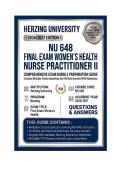
,NU 648 Final Exam Women's Health Nurse Practitioner II Questions
And Answers 2026/2027 Herzing University
Q1. A 46-year-old with obesity and years of irregular anovulatory
cycles develops persistent heavy bleeding. Pregnancy testing is
negative. Which diagnostic step is particularly important?
A) Obtain endometrial tissue to evaluate for hyperplasia or malignancy
B) Order annual CA-125 testing
C) Treat empirically for cervicitis
D) Observe until menopause
Correct Answer: A) Obtain endometrial tissue to evaluate for hyperplasia or
malignancy
Rationale: Persistent abnormal bleeding in a patient with prolonged
unopposed estrogen exposure warrants evaluation of the endometrium for
hyperplasia and malignancy.
Q2. A postmenopausal patient has a complex adnexal mass with
papillary projections, ascites, and increasing abdominal symptoms.
What is the most appropriate next step?
A) Repeat ultrasound in one year
B) Arrange evaluation by a gynecologic oncologist
C) Begin combined hormonal contraception
D) Treat with antibiotics
Correct Answer: B) Arrange evaluation by a gynecologic oncologist
Rationale: A complex adnexal mass with suspicious morphologic and
clinical findings requires oncologic evaluation because specialized surgical
management may affect outcome.
Q3. A patient who is current with cervical screening has persistent
postcoital bleeding and a visibly irregular cervical lesion. What
should occur?
A) Repeat routine screening at the usual interval
B) Perform diagnostic evaluation with tissue assessment when indicated
C) Reassure her because screening was current
D) Treat empirically for candidiasis
Correct Answer: B) Perform diagnostic evaluation with tissue assessment
when indicated
, Rationale: Screening is intended for asymptomatic patients; a suspicious
lesion or persistent symptom requires diagnostic assessment regardless of
screening history.
Q4. A younger patient with endometrial intraepithelial neoplasia
strongly desires future fertility and has no evidence of invasive
carcinoma. Which management approach may be appropriate in
carefully selected circumstances?
A) Observation without follow-up
B) Estrogen-only therapy
C) Progestin-based fertility-sparing management with close endometrial
surveillance
D) Routine antibiotics
Correct Answer: C) Progestin-based fertility-sparing management with close
endometrial surveillance
Rationale: Fertility-sparing treatment can sometimes be considered for
selected patients, but intensive surveillance is required because
premalignant disease can persist or progress.
Q5. A patient with treated vulvar lichen sclerosus develops a new
persistent ulcerated area. What is the best next step?
A) Increase vaginal estrogen
B) Continue routine follow-up only
C) Treat with antifungal medication
D) Biopsy the new suspicious lesion
Correct Answer: D) Biopsy the new suspicious lesion
Rationale: New ulceration or other focal change in chronic vulvar disease
requires histologic evaluation to exclude neoplasia.
Q6. Deep dyspareunia is accompanied by marked pelvic-floor muscle
tenderness and increased muscle tone. Which intervention should
be considered?
A) Pelvic floor physical therapy
B) Hysterectomy
C) Chronic antibiotic therapy
D) Bed rest
Correct Answer: A) Pelvic floor physical therapy
And Answers 2026/2027 Herzing University
Q1. A 46-year-old with obesity and years of irregular anovulatory
cycles develops persistent heavy bleeding. Pregnancy testing is
negative. Which diagnostic step is particularly important?
A) Obtain endometrial tissue to evaluate for hyperplasia or malignancy
B) Order annual CA-125 testing
C) Treat empirically for cervicitis
D) Observe until menopause
Correct Answer: A) Obtain endometrial tissue to evaluate for hyperplasia or
malignancy
Rationale: Persistent abnormal bleeding in a patient with prolonged
unopposed estrogen exposure warrants evaluation of the endometrium for
hyperplasia and malignancy.
Q2. A postmenopausal patient has a complex adnexal mass with
papillary projections, ascites, and increasing abdominal symptoms.
What is the most appropriate next step?
A) Repeat ultrasound in one year
B) Arrange evaluation by a gynecologic oncologist
C) Begin combined hormonal contraception
D) Treat with antibiotics
Correct Answer: B) Arrange evaluation by a gynecologic oncologist
Rationale: A complex adnexal mass with suspicious morphologic and
clinical findings requires oncologic evaluation because specialized surgical
management may affect outcome.
Q3. A patient who is current with cervical screening has persistent
postcoital bleeding and a visibly irregular cervical lesion. What
should occur?
A) Repeat routine screening at the usual interval
B) Perform diagnostic evaluation with tissue assessment when indicated
C) Reassure her because screening was current
D) Treat empirically for candidiasis
Correct Answer: B) Perform diagnostic evaluation with tissue assessment
when indicated
, Rationale: Screening is intended for asymptomatic patients; a suspicious
lesion or persistent symptom requires diagnostic assessment regardless of
screening history.
Q4. A younger patient with endometrial intraepithelial neoplasia
strongly desires future fertility and has no evidence of invasive
carcinoma. Which management approach may be appropriate in
carefully selected circumstances?
A) Observation without follow-up
B) Estrogen-only therapy
C) Progestin-based fertility-sparing management with close endometrial
surveillance
D) Routine antibiotics
Correct Answer: C) Progestin-based fertility-sparing management with close
endometrial surveillance
Rationale: Fertility-sparing treatment can sometimes be considered for
selected patients, but intensive surveillance is required because
premalignant disease can persist or progress.
Q5. A patient with treated vulvar lichen sclerosus develops a new
persistent ulcerated area. What is the best next step?
A) Increase vaginal estrogen
B) Continue routine follow-up only
C) Treat with antifungal medication
D) Biopsy the new suspicious lesion
Correct Answer: D) Biopsy the new suspicious lesion
Rationale: New ulceration or other focal change in chronic vulvar disease
requires histologic evaluation to exclude neoplasia.
Q6. Deep dyspareunia is accompanied by marked pelvic-floor muscle
tenderness and increased muscle tone. Which intervention should
be considered?
A) Pelvic floor physical therapy
B) Hysterectomy
C) Chronic antibiotic therapy
D) Bed rest
Correct Answer: A) Pelvic floor physical therapy