
A+ VERIFIED
BUSINESS · OBJECTIVE ASSESSMENT
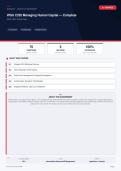
WGU C202 Managing Human Capital — Complete
Official Exam
70 Questions Full Rationales Verified Answers
70 5 100%
QUESTIONS SECTIONS RATIONALES
Complete coverage Core exam domains Every answer explained
WHAT THIS COVERS
01 Strategic HR & Workforce Planning
02 Talent Acquisition & Recruitment
03 Performance Management & Employee Development
04 Compensation, Benefits & Total Rewards
05 Employee Relations, Labor Law & Retention
ABOUT THIS ASSESSMENT
Build mastery in managing human capital — from strategic HR and workforce planning to talent acquisition, performance management, employee development,
compensation and benefits, employee relations, labor law, and retention. This original study bank targets application and analysis skills for WGU C202, with full
rationales for every answer. For review use only; not an institutional proctored assessment.
PASSING SCORE LEVEL FORMAT
80% Intermediate (Business/HR Management) Application / Analysis
STUVIA ACTUAL EXAM Page 1
, SECTION 1: Strategic HR & Workforce Planning
Q1. A mid-sized manufacturing firm is preparing a three-year growth plan that will require 40 additional skilled technicians. The HR
director is asked to align staffing with the business strategy. Which first step best supports strategic workforce planning?
A. Outsource the entire technical function without internal analysis
B. Immediately post all 40 openings on external job boards
C. Conduct a gap analysis comparing current competencies and headcount with projected future requirements
D. Freeze all current hiring until the plan is finalized
Correct Answer: C
Rationale: Strategic workforce planning begins with understanding the gap between current talent and future needs so that sourcing, development, and
retention strategies can be targeted.
Q2. An organization discovers that its turnover among high-potential employees is twice the industry average. Which HR metric would
best help leadership quantify the strategic cost of this problem?
A. Percentage of employees who completed mandatory compliance training
B. Cost-per-hire combined with estimated replacement and lost-productivity costs for key roles
C. Number of résumés received per opening only
D. Average time-to-fill for entry-level positions
Correct Answer: B
Rationale: Calculating the full cost of turnover for critical talent demonstrates the strategic impact of retention failures and supports investment in targeted
retention programs.
Q3. A company is shifting from a product-focused to a solutions-focused business model. Which HR practice most directly supports this
strategic change?
A. Reducing the learning-and-development budget
B. Maintaining existing job descriptions without revision
C. Eliminating performance reviews during the transition
D. Updating job designs, competency models, and training so employees can deliver consultative solutions
Correct Answer: D
Rationale: Strategic HR ensures that work design, skills, and development systems enable the new business model rather than reinforcing the old one.
Q4. During a merger, leadership asks HR to identify redundant roles and critical talent to retain. Which approach best balances efficiency
and knowledge retention?
A. Implement an across-the-board headcount reduction of 20 percent
B. Map critical knowledge holders and high performers first, then design retention incentives and selective reductions
C. Delay all workforce decisions for two years
D. Retain only the acquiring company’s employees
Correct Answer: B
Rationale: Identifying and protecting critical talent and knowledge reduces the risk of capability loss while still achieving necessary efficiencies.
Q5. A retail chain wants to improve its ability to staff stores during seasonal peaks. Which workforce-planning tool is most useful?
A. Hiring only permanent full-time staff year-round
B. Ignoring historical data and staffing reactively
C. Eliminating part-time and temporary roles
D. Demand forecasting based on historical sales patterns and planned promotions, combined with flexible staffing options
Correct Answer: D
Rationale: Accurate demand forecasting plus flexible labor sources (part-time, temporary, cross-trained staff) allows the organization to match supply to
seasonal demand.
BUSINESS · OBJECTIVE ASSESSMENT
WGU C202 Managing Human Capital — Complete
Official Exam
70 Questions Full Rationales Verified Answers
70 5 100%
QUESTIONS SECTIONS RATIONALES
Complete coverage Core exam domains Every answer explained
WHAT THIS COVERS
01 Strategic HR & Workforce Planning
02 Talent Acquisition & Recruitment
03 Performance Management & Employee Development
04 Compensation, Benefits & Total Rewards
05 Employee Relations, Labor Law & Retention
ABOUT THIS ASSESSMENT
Build mastery in managing human capital — from strategic HR and workforce planning to talent acquisition, performance management, employee development,
compensation and benefits, employee relations, labor law, and retention. This original study bank targets application and analysis skills for WGU C202, with full
rationales for every answer. For review use only; not an institutional proctored assessment.
PASSING SCORE LEVEL FORMAT
80% Intermediate (Business/HR Management) Application / Analysis
STUVIA ACTUAL EXAM Page 1
, SECTION 1: Strategic HR & Workforce Planning
Q1. A mid-sized manufacturing firm is preparing a three-year growth plan that will require 40 additional skilled technicians. The HR
director is asked to align staffing with the business strategy. Which first step best supports strategic workforce planning?
A. Outsource the entire technical function without internal analysis
B. Immediately post all 40 openings on external job boards
C. Conduct a gap analysis comparing current competencies and headcount with projected future requirements
D. Freeze all current hiring until the plan is finalized
Correct Answer: C
Rationale: Strategic workforce planning begins with understanding the gap between current talent and future needs so that sourcing, development, and
retention strategies can be targeted.
Q2. An organization discovers that its turnover among high-potential employees is twice the industry average. Which HR metric would
best help leadership quantify the strategic cost of this problem?
A. Percentage of employees who completed mandatory compliance training
B. Cost-per-hire combined with estimated replacement and lost-productivity costs for key roles
C. Number of résumés received per opening only
D. Average time-to-fill for entry-level positions
Correct Answer: B
Rationale: Calculating the full cost of turnover for critical talent demonstrates the strategic impact of retention failures and supports investment in targeted
retention programs.
Q3. A company is shifting from a product-focused to a solutions-focused business model. Which HR practice most directly supports this
strategic change?
A. Reducing the learning-and-development budget
B. Maintaining existing job descriptions without revision
C. Eliminating performance reviews during the transition
D. Updating job designs, competency models, and training so employees can deliver consultative solutions
Correct Answer: D
Rationale: Strategic HR ensures that work design, skills, and development systems enable the new business model rather than reinforcing the old one.
Q4. During a merger, leadership asks HR to identify redundant roles and critical talent to retain. Which approach best balances efficiency
and knowledge retention?
A. Implement an across-the-board headcount reduction of 20 percent
B. Map critical knowledge holders and high performers first, then design retention incentives and selective reductions
C. Delay all workforce decisions for two years
D. Retain only the acquiring company’s employees
Correct Answer: B
Rationale: Identifying and protecting critical talent and knowledge reduces the risk of capability loss while still achieving necessary efficiencies.
Q5. A retail chain wants to improve its ability to staff stores during seasonal peaks. Which workforce-planning tool is most useful?
A. Hiring only permanent full-time staff year-round
B. Ignoring historical data and staffing reactively
C. Eliminating part-time and temporary roles
D. Demand forecasting based on historical sales patterns and planned promotions, combined with flexible staffing options
Correct Answer: D
Rationale: Accurate demand forecasting plus flexible labor sources (part-time, temporary, cross-trained staff) allows the organization to match supply to
seasonal demand.


