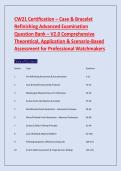
CW21 Certification – Case & Bracelet
Refinishing Advanced Examination
Question Bank – V2.0 Comprehensive
Theoretical, Application & Scenario-Based
Assessment for Professional Watchmakers
Section Topic Questions
1 Pre-Refinishing Assessment & Documentation 1–12
2 Case & Bracelet Disassembly Protocols 13–24
3 Metallurgy & Material Science for Refinishers 25–36
4 Surface Finish Identification & Analysis 37–48
5 Satin/Brushed Finish Restoration – Advanced Techniques 49–64
6 Mirror/Polished Finish Restoration – Advanced Techniques 65–80
7 Zaratsu & Sallaz Polishing Principles 81–90
8 Laser Welding & Material Addition 91–108
9 Polishing Equipment, Wheels & Compounds 109–124
10 Scratch Depth Assessment & Triage Decision-Making 125–136
,Section Topic Questions
11 Crystal Assessment & Protection 137–144
12 Quality Control, Final Inspection & Documentation 145–150
A. The current market value of the watch
B. Whether the case has been previously over-polished, which would determine if further material
removal would compromise case geometry
C. The customer's willingness to pay for laser welding
D. The condition of the bracelet clasp
Evaluating prior over-polishing is the most critical factor because it determines whether
further material removal during refinishing would irreversibly compromise case geometry, particularly
the crown guards and lug profiles. A previously over-polished case may have insufficient material
remaining to safely remove current scratches without laser welding to add material back.
A. Written notes describing scratches and dents
B. Photographs taken under controlled lighting from multiple angles, supplemented by written
measurements of case dimensions
C. A verbal agreement with the customer
D. Only the watchmaker's memory
, Comprehensive documentation requires photographs under controlled lighting from
multiple angles to capture existing damage, complemented by written measurements of critical case
dimensions (lug width, case thickness, crown guard profile). This creates an objective, verifiable record
protecting both watchmaker and customer.
A. The measurement was incorrect before refinishing
B. Approximately 0.3mm of material was removed from the lugs, which may affect spring bar fit and
bracelet compatibility
C. The case was made of a different material than expected
D. The calipers are out of calibration
A reduction from 20.0mm to 19.7mm indicates approximately 0.3mm of material
removal from the lugs. This is significant because it can affect spring bar fit (requiring thicker spring bars)
and may cause bracelet end links to fit loosely or rattle. This measurement should be documented and
discussed with the customer.
A. Proceed with a light polish using a soft wheel and rouge, as requested
B. Explain that polishing a satin finish with polishing compounds will alter the finish, and that proper
restoration requires satin refinishing techniques
C. Refuse the job entirely
D. Apply masking tape to all surfaces and polish only the case back
A "light polish" with polishing compounds on a satin finish will produce a semi-gloss or
polished appearance, destroying the original finish. The professional response is to educate the
customer about the difference between polishing and satin refinishing and recommend the appropriate
technique to restore the original appearance.
, A. The case back has been replaced with an aftermarket component
B. The case back retains its original factory finish and requires circular graining techniques to refinish
C. The case back was hand-polished by a previous watchmaker
D. The case back is made of a different material
Circular graining (perlage) is a factory-applied finish commonly found on case backs,
movement plates, and bridges. Its presence indicates the case back retains its original finish and
requires specialized circular graining techniques to restore, not standard satin or polished finishing.
A. Gold plating is harder than solid gold
B. The gold plating layer is extremely thin and aggressive polishing can remove it entirely, exposing the
base metal
C. Gold-plated cases cannot be refinished
D. Gold plating is unaffected by polishing compounds
Gold plating is typically only a few microns thick. Aggressive polishing or excessive
material removal will cut through the plating, exposing the base metal (usually brass or steel) and
creating a two-tone appearance that is cosmetically unacceptable and requires re-plating to correct.
A. To identify the watch brand
B. To document each surface's finish type (polished, satin, circular grained, etc.) and its precise location,
guiding the refinishing process
C. To calculate the cost of the job
D. To determine the watch's age
Refinishing Advanced Examination
Question Bank – V2.0 Comprehensive
Theoretical, Application & Scenario-Based
Assessment for Professional Watchmakers
Section Topic Questions
1 Pre-Refinishing Assessment & Documentation 1–12
2 Case & Bracelet Disassembly Protocols 13–24
3 Metallurgy & Material Science for Refinishers 25–36
4 Surface Finish Identification & Analysis 37–48
5 Satin/Brushed Finish Restoration – Advanced Techniques 49–64
6 Mirror/Polished Finish Restoration – Advanced Techniques 65–80
7 Zaratsu & Sallaz Polishing Principles 81–90
8 Laser Welding & Material Addition 91–108
9 Polishing Equipment, Wheels & Compounds 109–124
10 Scratch Depth Assessment & Triage Decision-Making 125–136
,Section Topic Questions
11 Crystal Assessment & Protection 137–144
12 Quality Control, Final Inspection & Documentation 145–150
A. The current market value of the watch
B. Whether the case has been previously over-polished, which would determine if further material
removal would compromise case geometry
C. The customer's willingness to pay for laser welding
D. The condition of the bracelet clasp
Evaluating prior over-polishing is the most critical factor because it determines whether
further material removal during refinishing would irreversibly compromise case geometry, particularly
the crown guards and lug profiles. A previously over-polished case may have insufficient material
remaining to safely remove current scratches without laser welding to add material back.
A. Written notes describing scratches and dents
B. Photographs taken under controlled lighting from multiple angles, supplemented by written
measurements of case dimensions
C. A verbal agreement with the customer
D. Only the watchmaker's memory
, Comprehensive documentation requires photographs under controlled lighting from
multiple angles to capture existing damage, complemented by written measurements of critical case
dimensions (lug width, case thickness, crown guard profile). This creates an objective, verifiable record
protecting both watchmaker and customer.
A. The measurement was incorrect before refinishing
B. Approximately 0.3mm of material was removed from the lugs, which may affect spring bar fit and
bracelet compatibility
C. The case was made of a different material than expected
D. The calipers are out of calibration
A reduction from 20.0mm to 19.7mm indicates approximately 0.3mm of material
removal from the lugs. This is significant because it can affect spring bar fit (requiring thicker spring bars)
and may cause bracelet end links to fit loosely or rattle. This measurement should be documented and
discussed with the customer.
A. Proceed with a light polish using a soft wheel and rouge, as requested
B. Explain that polishing a satin finish with polishing compounds will alter the finish, and that proper
restoration requires satin refinishing techniques
C. Refuse the job entirely
D. Apply masking tape to all surfaces and polish only the case back
A "light polish" with polishing compounds on a satin finish will produce a semi-gloss or
polished appearance, destroying the original finish. The professional response is to educate the
customer about the difference between polishing and satin refinishing and recommend the appropriate
technique to restore the original appearance.
, A. The case back has been replaced with an aftermarket component
B. The case back retains its original factory finish and requires circular graining techniques to refinish
C. The case back was hand-polished by a previous watchmaker
D. The case back is made of a different material
Circular graining (perlage) is a factory-applied finish commonly found on case backs,
movement plates, and bridges. Its presence indicates the case back retains its original finish and
requires specialized circular graining techniques to restore, not standard satin or polished finishing.
A. Gold plating is harder than solid gold
B. The gold plating layer is extremely thin and aggressive polishing can remove it entirely, exposing the
base metal
C. Gold-plated cases cannot be refinished
D. Gold plating is unaffected by polishing compounds
Gold plating is typically only a few microns thick. Aggressive polishing or excessive
material removal will cut through the plating, exposing the base metal (usually brass or steel) and
creating a two-tone appearance that is cosmetically unacceptable and requires re-plating to correct.
A. To identify the watch brand
B. To document each surface's finish type (polished, satin, circular grained, etc.) and its precise location,
guiding the refinishing process
C. To calculate the cost of the job
D. To determine the watch's age