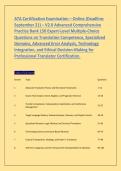
ATA Certification Examination – Online (Deadline:
September 21) – V2.0 Advanced Comprehensive
Practice Bank 150 Expert-Level Multiple-Choice
Questions on Translation Competence, Specialized
Domains, Advanced Error Analysis, Technology
Integration, and Ethical Decision-Making for
Professional Translator Certification.
Section Topic Questions
1 Advanced Translation Theory and Normative Frameworks 1–12
2 Source Text Analysis: Genre, Register, and Pragmatic Inference 13–24
Transfer Competence: Compensation, Explicitation, and Interference
3 25–37
Management
4 Target Language Mastery: Advanced Syntax, Cohesion, and Stylistic Control 38–50
5 Specialized Domains: Legal, Medical, and Technical Translation 51–63
6 Terminology Science and Corpus-Based Research 64–76
7 Cultural Transposition, Ideology, and Power in Translation 77–89
8 ATA Error Categories and the Framework for Standardized Error Marking 90–103
,Section Topic Questions
9 Online Exam Technology, Proctoring, and the Allow List 104–117
10 Revision, Quality Assurance, and Back-Translation Protocols 118–131
11 Professional Ethics, Confidentiality, and Competence Boundaries 132–141
12 Exam Strategy, Time Management, and Passage Selection 142–150
In Toury’s descriptive translation studies, what is a “translation norm”?
A. A grammatical rule that governs sentence structure in the target language
B. A performance instruction shared by a community regarding what is considered appropriate
translational behavior
C. A legal requirement imposed by a regulatory body on translators
D. A universal principle that applies identically across all cultures
Toury defines norms as performance instructions that are internalized
by translators and reflect the values and expectations of a community at a given time; they are neither
universal nor purely legal.
Which of the following best characterizes Chesterman’s “expectancy norms”?
A. Norms that govern the translation process itself
B. Norms that reflect what target readers expect a translation to look like
C. Norms that dictate the translator’s professional conduct
D. Norms that are imposed by the source-text author
Expectancy norms concern the target audience’s expectations regarding
textual form, style, and register of a translation, which vary by genre and culture.
In relevance theory (Sperber & Wilson), what is the “principle of relevance” and how does it
apply to translation?
A. Translators should always translate the most relevant lexical items first
B. Human communication seeks maximum cognitive effect for minimum processing effort; translations
,should make the intended meaning optimally recoverable
C. Translators should ignore contextual clues and translate literally
D. The most frequent word in the source text is always the most relevant
Relevance theory holds that communication aims at optimal relevance;
in translation, the translator must ensure that the target audience can recover the intended meaning
with minimal unnecessary processing effort.
What does “thick translation” mean in postcolonial translation theory?
A. A translation that uses extensive footnotes and explanatory material to embed the source text in its
cultural context
B. A translation that omits all cultural references
C. A translation that prioritizes speed over accuracy
D. A translation that is longer than the source text for no contextual reason
Appiah’s concept of “thick translation” involves annotating and
contextualizing the source text to make its cultural and historical situatedness visible to the target
reader.
In Vermeer’s Skopos theory, what is the relationship between the source text and the
translation?
A. The source text is the sole determinant of translation strategy
B. The source text is an “offer of information” from which the translator selects elements according to
the target purpose
C. The source text must always be translated literally
D. The source text should be ignored entirely
In Skopos theory, the source text is dethroned from its position as the
sole authority; it is an information offer, and the translation brief (Skopos) determines what is relevant.
What is “translatorial action” in Holz-Mänttäri’s model?
A. A theory that reduces translation to a purely linguistic operation
B. A model that treats translation as a purposeful, cooperative action involving multiple agents (initiator,
commissioner, translator, user)
C. A method for translating action verbs
D. A legal framework for translator contracts
Holz-Mänttäri’s translatorial action theory conceptualizes translation as
a communicative, goal-oriented process involving a network of participants, not merely text production.
, What is “normative equivalence” and why is it problematic as a translation criterion?
A. Equivalence based on target-culture norms; it is problematic because norms vary across cultures and
genres
B. Equivalence based on source-language grammar; it is always achievable
C. Equivalence based on word count; it is easily measurable
D. Equivalence based on phonetic similarity; it is irrelevant to translation
Normative equivalence relies on culturally specific expectations of what
a translation should be; because norms differ across target cultures, no single standard of equivalence
can be universally applied.
In Gutt’s application of relevance theory to translation, what replaces the traditional notion of
“equivalence”?
A. “Resemblance” in interpretive use
B. “Identity” of propositional content
C. “Literalness” of expression
D. “Fidelity” to the source author’s intention
Gutt argues that translation is an instance of interpretive use, where the
target text should resemble the source text in relevant respects rather than achieve equivalence in a
fixed sense.
What is “semantic translation” in Newmark’s framework?
A. A translation that prioritizes the source text’s semantic content and form, often at the expense of
target-language naturalness
B. A translation that prioritizes the target reader’s effect
C. A translation that ignores meaning entirely
D. A translation that is always literal
Semantic translation, in Newmark’s dichotomy, stays close to the source
text’s semantic and syntactic structure, whereas communicative translation prioritizes the target
reader’s response.
What is the “cultural turn” in translation studies?
A. A shift in the 1990s toward examining translation as a cultural and ideological practice rather than a
purely linguistic transfer
B. A turn toward translating only cultural texts
September 21) – V2.0 Advanced Comprehensive
Practice Bank 150 Expert-Level Multiple-Choice
Questions on Translation Competence, Specialized
Domains, Advanced Error Analysis, Technology
Integration, and Ethical Decision-Making for
Professional Translator Certification.
Section Topic Questions
1 Advanced Translation Theory and Normative Frameworks 1–12
2 Source Text Analysis: Genre, Register, and Pragmatic Inference 13–24
Transfer Competence: Compensation, Explicitation, and Interference
3 25–37
Management
4 Target Language Mastery: Advanced Syntax, Cohesion, and Stylistic Control 38–50
5 Specialized Domains: Legal, Medical, and Technical Translation 51–63
6 Terminology Science and Corpus-Based Research 64–76
7 Cultural Transposition, Ideology, and Power in Translation 77–89
8 ATA Error Categories and the Framework for Standardized Error Marking 90–103
,Section Topic Questions
9 Online Exam Technology, Proctoring, and the Allow List 104–117
10 Revision, Quality Assurance, and Back-Translation Protocols 118–131
11 Professional Ethics, Confidentiality, and Competence Boundaries 132–141
12 Exam Strategy, Time Management, and Passage Selection 142–150
In Toury’s descriptive translation studies, what is a “translation norm”?
A. A grammatical rule that governs sentence structure in the target language
B. A performance instruction shared by a community regarding what is considered appropriate
translational behavior
C. A legal requirement imposed by a regulatory body on translators
D. A universal principle that applies identically across all cultures
Toury defines norms as performance instructions that are internalized
by translators and reflect the values and expectations of a community at a given time; they are neither
universal nor purely legal.
Which of the following best characterizes Chesterman’s “expectancy norms”?
A. Norms that govern the translation process itself
B. Norms that reflect what target readers expect a translation to look like
C. Norms that dictate the translator’s professional conduct
D. Norms that are imposed by the source-text author
Expectancy norms concern the target audience’s expectations regarding
textual form, style, and register of a translation, which vary by genre and culture.
In relevance theory (Sperber & Wilson), what is the “principle of relevance” and how does it
apply to translation?
A. Translators should always translate the most relevant lexical items first
B. Human communication seeks maximum cognitive effect for minimum processing effort; translations
,should make the intended meaning optimally recoverable
C. Translators should ignore contextual clues and translate literally
D. The most frequent word in the source text is always the most relevant
Relevance theory holds that communication aims at optimal relevance;
in translation, the translator must ensure that the target audience can recover the intended meaning
with minimal unnecessary processing effort.
What does “thick translation” mean in postcolonial translation theory?
A. A translation that uses extensive footnotes and explanatory material to embed the source text in its
cultural context
B. A translation that omits all cultural references
C. A translation that prioritizes speed over accuracy
D. A translation that is longer than the source text for no contextual reason
Appiah’s concept of “thick translation” involves annotating and
contextualizing the source text to make its cultural and historical situatedness visible to the target
reader.
In Vermeer’s Skopos theory, what is the relationship between the source text and the
translation?
A. The source text is the sole determinant of translation strategy
B. The source text is an “offer of information” from which the translator selects elements according to
the target purpose
C. The source text must always be translated literally
D. The source text should be ignored entirely
In Skopos theory, the source text is dethroned from its position as the
sole authority; it is an information offer, and the translation brief (Skopos) determines what is relevant.
What is “translatorial action” in Holz-Mänttäri’s model?
A. A theory that reduces translation to a purely linguistic operation
B. A model that treats translation as a purposeful, cooperative action involving multiple agents (initiator,
commissioner, translator, user)
C. A method for translating action verbs
D. A legal framework for translator contracts
Holz-Mänttäri’s translatorial action theory conceptualizes translation as
a communicative, goal-oriented process involving a network of participants, not merely text production.
, What is “normative equivalence” and why is it problematic as a translation criterion?
A. Equivalence based on target-culture norms; it is problematic because norms vary across cultures and
genres
B. Equivalence based on source-language grammar; it is always achievable
C. Equivalence based on word count; it is easily measurable
D. Equivalence based on phonetic similarity; it is irrelevant to translation
Normative equivalence relies on culturally specific expectations of what
a translation should be; because norms differ across target cultures, no single standard of equivalence
can be universally applied.
In Gutt’s application of relevance theory to translation, what replaces the traditional notion of
“equivalence”?
A. “Resemblance” in interpretive use
B. “Identity” of propositional content
C. “Literalness” of expression
D. “Fidelity” to the source author’s intention
Gutt argues that translation is an instance of interpretive use, where the
target text should resemble the source text in relevant respects rather than achieve equivalence in a
fixed sense.
What is “semantic translation” in Newmark’s framework?
A. A translation that prioritizes the source text’s semantic content and form, often at the expense of
target-language naturalness
B. A translation that prioritizes the target reader’s effect
C. A translation that ignores meaning entirely
D. A translation that is always literal
Semantic translation, in Newmark’s dichotomy, stays close to the source
text’s semantic and syntactic structure, whereas communicative translation prioritizes the target
reader’s response.
What is the “cultural turn” in translation studies?
A. A shift in the 1990s toward examining translation as a cultural and ideological practice rather than a
purely linguistic transfer
B. A turn toward translating only cultural texts