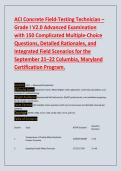
ACI Concrete Field-Testing Technician –
Grade I V2.0 Advanced Examination
with 150 Complicated Multiple-Choice
Questions, Detailed Rationales, and
Integrated Field Scenarios for the
September 21–22 Columbia, Maryland
Certification Program.
V2.0 — Advanced/Complicated
Advanced / Hard / Mixed (Higher-order application, multi-step calculations, and
procedural troubleshooting)
Experienced field technicians, QA/QC professionals, and candidates preparing
for ACI Grade I certification
150 multiple-choice questions with one correct answer and detailed rationale per
question
ASTM C1064, C172, C143, C138, C231, C173, and C31
Question
Section Topic ASTM Standard
Numbers
Temperature of Freshly Mixed Hydraulic-
1 C1064/C1064M 1–20
Cement Concrete
2 Sampling Freshly Mixed Concrete C172/C172M 21–40
, Question
Section Topic ASTM Standard
Numbers
3 Slump of Hydraulic-Cement Concrete C143/C143M 41–60
Density (Unit Weight), Yield, and Air Content
4 C138/C138M 61–80
(Gravimetric)
5 Air Content by the Pressure Method C231/C231M 81–100
6 Air Content by the Volumetric Method C173/C173M 101–120
Making and Curing Concrete Test Specimens in
7 C31/C31M 121–140
the Field
Integrated Field Scenarios, Multi-Step
8 Multiple 141–150
Calculations, and Troubleshooting
A technician is measuring the temperature of concrete containing aggregate with a nominal
maximum size of 4 in. (100 mm). The thermometer is inserted and the reading continues to rise slowly
after 5 minutes. According to ASTM C1064, what is the maximum time the technician should wait for the
reading to stabilize?
A. 5 minutes
B. 10 minutes
C. 15 minutes
D. Up to 20 minutes
For concrete containing aggregate with a nominal maximum size greater than 3 in. (75
mm), up to 20 minutes may be required for the transfer of heat from the aggregate to the mortar to
obtain a stable temperature reading.
A technician measures concrete temperature using a thermometer with a range of 40°F to 110°F.
Is this thermometer compliant with ASTM C1064?
,A. Yes, the range is sufficient for fresh concrete.
B. Yes, as long as it reads to the nearest 1°F.
C. No, the thermometer must have a range of at least 30°F to 120°F.
D. No, the thermometer must have a range of at least 50°F to 150°F.
ASTM C1064 requires the temperature measuring device to have a range of at least 30°F
to 120°F (0°C to 50°C).
A technician inserts a thermometer into a wheelbarrow of concrete. The sensing portion is
submerged 2.5 in. (63 mm). Is this acceptable?
A. Yes, 2 in. is the minimum submersion depth.
B. No, the minimum submersion depth is 3 in. (75 mm).
C. Yes, as long as the concrete is at least 6 in. deep.
D. No, the minimum submersion depth is 4 in. (100 mm).
ASTM C1064 requires the temperature sensing portion to be submerged a minimum of 3
in. (75 mm) into the concrete.
A technician is measuring the temperature of concrete at a job site where the ambient
temperature is 95°F (35°C). The concrete temperature reads 102°F (39°C). The specification limits
concrete temperature to a maximum of 95°F (35°C). What should the technician do?
A. Record the temperature and proceed with placement.
B. Add ice to the concrete to lower the temperature.
C. Immediately notify the responsible party; the concrete exceeds specification limits.
D. Wait 30 minutes for the concrete to cool before placing.
When the temperature exceeds specification limits, the technician must notify the
responsible party. The concrete may not meet specification requirements for strength, durability, or
setting time.
A technician uses an infrared thermometer to measure concrete temperature. The reading is
78°F (26°C). Is this measurement compliant with ASTM C1064?
A. Yes, infrared thermometers are approved for field use.
B. Yes, but only for concrete below 80°F.
C. No, ASTM C1064 requires a thermometric device with a sensing portion submerged in the
concrete.
D. Yes, if calibrated within the last 24 hours.
, Infrared thermometers measure surface temperature and do not comply with ASTM
C1064, which requires the sensing portion to be submerged in the concrete.
A technician measures the temperature of concrete in a truck chute. The reading is 82°F (28°C).
What is the primary concern with this practice?
A. The chute is too shallow for proper submersion.
B. The concrete in the chute is a thin layer that may be affected by ambient conditions, not
representative of the concrete mass.
C. The chute must be cleaned before measurement.
D. The thermometer must be inserted at a 45-degree angle.
Measuring temperature in a thin layer on the chute may not be representative due to
ambient temperature effects. Temperature should be measured in a sufficient mass of concrete with
proper submersion.
After inserting the thermometer into the concrete, the technician should:
A. Immediately read the temperature.
B. Read the temperature after 30 seconds.
C. Wait a minimum of 2 minutes for the reading to stabilize, but not more than 5 minutes.
D. Wait exactly 10 minutes regardless of stabilization.
ASTM C1064 requires the thermometer to remain in the concrete for at least 2 minutes
but not more than 5 minutes before the reading is recorded.
A technician is measuring the temperature of concrete containing 2 in. (50 mm) nominal
maximum size aggregate. After inserting the thermometer, the reading stabilizes in 3 minutes. Is this
acceptable?
A. No, the reading must stabilize in exactly 2 minutes.
B. Yes, the reading stabilized within the required 2-to-5-minute window.
C. No, the reading must stabilize in 5 minutes.
D. Yes, but only if the concrete is below 80°F.
ASTM C1064 requires the thermometer to remain in the concrete for at least 2 minutes
but not more than 5 minutes. A stabilization time of 3 minutes is acceptable.
The temperature measuring device must be accurate to:
Grade I V2.0 Advanced Examination
with 150 Complicated Multiple-Choice
Questions, Detailed Rationales, and
Integrated Field Scenarios for the
September 21–22 Columbia, Maryland
Certification Program.
V2.0 — Advanced/Complicated
Advanced / Hard / Mixed (Higher-order application, multi-step calculations, and
procedural troubleshooting)
Experienced field technicians, QA/QC professionals, and candidates preparing
for ACI Grade I certification
150 multiple-choice questions with one correct answer and detailed rationale per
question
ASTM C1064, C172, C143, C138, C231, C173, and C31
Question
Section Topic ASTM Standard
Numbers
Temperature of Freshly Mixed Hydraulic-
1 C1064/C1064M 1–20
Cement Concrete
2 Sampling Freshly Mixed Concrete C172/C172M 21–40
, Question
Section Topic ASTM Standard
Numbers
3 Slump of Hydraulic-Cement Concrete C143/C143M 41–60
Density (Unit Weight), Yield, and Air Content
4 C138/C138M 61–80
(Gravimetric)
5 Air Content by the Pressure Method C231/C231M 81–100
6 Air Content by the Volumetric Method C173/C173M 101–120
Making and Curing Concrete Test Specimens in
7 C31/C31M 121–140
the Field
Integrated Field Scenarios, Multi-Step
8 Multiple 141–150
Calculations, and Troubleshooting
A technician is measuring the temperature of concrete containing aggregate with a nominal
maximum size of 4 in. (100 mm). The thermometer is inserted and the reading continues to rise slowly
after 5 minutes. According to ASTM C1064, what is the maximum time the technician should wait for the
reading to stabilize?
A. 5 minutes
B. 10 minutes
C. 15 minutes
D. Up to 20 minutes
For concrete containing aggregate with a nominal maximum size greater than 3 in. (75
mm), up to 20 minutes may be required for the transfer of heat from the aggregate to the mortar to
obtain a stable temperature reading.
A technician measures concrete temperature using a thermometer with a range of 40°F to 110°F.
Is this thermometer compliant with ASTM C1064?
,A. Yes, the range is sufficient for fresh concrete.
B. Yes, as long as it reads to the nearest 1°F.
C. No, the thermometer must have a range of at least 30°F to 120°F.
D. No, the thermometer must have a range of at least 50°F to 150°F.
ASTM C1064 requires the temperature measuring device to have a range of at least 30°F
to 120°F (0°C to 50°C).
A technician inserts a thermometer into a wheelbarrow of concrete. The sensing portion is
submerged 2.5 in. (63 mm). Is this acceptable?
A. Yes, 2 in. is the minimum submersion depth.
B. No, the minimum submersion depth is 3 in. (75 mm).
C. Yes, as long as the concrete is at least 6 in. deep.
D. No, the minimum submersion depth is 4 in. (100 mm).
ASTM C1064 requires the temperature sensing portion to be submerged a minimum of 3
in. (75 mm) into the concrete.
A technician is measuring the temperature of concrete at a job site where the ambient
temperature is 95°F (35°C). The concrete temperature reads 102°F (39°C). The specification limits
concrete temperature to a maximum of 95°F (35°C). What should the technician do?
A. Record the temperature and proceed with placement.
B. Add ice to the concrete to lower the temperature.
C. Immediately notify the responsible party; the concrete exceeds specification limits.
D. Wait 30 minutes for the concrete to cool before placing.
When the temperature exceeds specification limits, the technician must notify the
responsible party. The concrete may not meet specification requirements for strength, durability, or
setting time.
A technician uses an infrared thermometer to measure concrete temperature. The reading is
78°F (26°C). Is this measurement compliant with ASTM C1064?
A. Yes, infrared thermometers are approved for field use.
B. Yes, but only for concrete below 80°F.
C. No, ASTM C1064 requires a thermometric device with a sensing portion submerged in the
concrete.
D. Yes, if calibrated within the last 24 hours.
, Infrared thermometers measure surface temperature and do not comply with ASTM
C1064, which requires the sensing portion to be submerged in the concrete.
A technician measures the temperature of concrete in a truck chute. The reading is 82°F (28°C).
What is the primary concern with this practice?
A. The chute is too shallow for proper submersion.
B. The concrete in the chute is a thin layer that may be affected by ambient conditions, not
representative of the concrete mass.
C. The chute must be cleaned before measurement.
D. The thermometer must be inserted at a 45-degree angle.
Measuring temperature in a thin layer on the chute may not be representative due to
ambient temperature effects. Temperature should be measured in a sufficient mass of concrete with
proper submersion.
After inserting the thermometer into the concrete, the technician should:
A. Immediately read the temperature.
B. Read the temperature after 30 seconds.
C. Wait a minimum of 2 minutes for the reading to stabilize, but not more than 5 minutes.
D. Wait exactly 10 minutes regardless of stabilization.
ASTM C1064 requires the thermometer to remain in the concrete for at least 2 minutes
but not more than 5 minutes before the reading is recorded.
A technician is measuring the temperature of concrete containing 2 in. (50 mm) nominal
maximum size aggregate. After inserting the thermometer, the reading stabilizes in 3 minutes. Is this
acceptable?
A. No, the reading must stabilize in exactly 2 minutes.
B. Yes, the reading stabilized within the required 2-to-5-minute window.
C. No, the reading must stabilize in 5 minutes.
D. Yes, but only if the concrete is below 80°F.
ASTM C1064 requires the thermometer to remain in the concrete for at least 2 minutes
but not more than 5 minutes. A stabilization time of 3 minutes is acceptable.
The temperature measuring device must be accurate to: