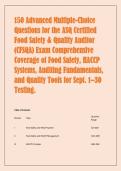
150 Advanced Multiple-Choice
Questions for the ASQ Certified
Food Safety & Quality Auditor
(CFSQA) Exam Comprehensive
Coverage of Food Safety, HACCP
Systems, Auditing Fundamentals,
and Quality Tools for Sept. 1–30
Testing.
Table of Contents
Question
Domain Topic
Range
I Food Safety and HACCP System Q1–Q30
II Food Safety and HACCP Management Q31–Q39
III HACCP Principles Q40–Q61
, Question
Domain Topic
Range
Implementation and Maintenance of Food Safety and HACCP
IV Q62–Q82
System
V Auditing Fundamentals Q83–Q105
VI Auditing Process and Auditor Competencies Q106–Q128
VII Quality Tools and Techniques Q129–Q150
Domain I: Food Safety and HACCP System (Q1–Q30)
Q1. Which term is defined by Codex Alimentarius as “a biological, chemical or physical agent in, or
condition of, food with the potential to cause an adverse health effect”?
A. Risk
B. Hazard
C. Contamination
D. Defect
Rationale: The Codex Alimentarius Commission defines a hazard as a biological, chemical, or physical
agent in food, or a condition of food, with the potential to cause an adverse health effect. This
foundational definition underpins all HACCP hazard analysis activities.
Q2. A HACCP team identifies that a cooking step consistently reduces Salmonella to acceptable
levels. The documented scientific basis demonstrating that the control measure achieves its intended
effect is called:
A. Monitoring
B. Verification
C. Validation
D. Corrective action
Rationale: Validation is the element of verification focused on collecting and evaluating scientific and
technical information to determine whether the HACCP plan, when properly implemented, will
effectively control the hazards. It precedes ongoing verification activities.
Q3. Which prerequisite program specifically addresses the control of wood, metal, glass, brittle
plastic, and ceramic materials in a food facility?
A. Integrated Pest Management
B. Calibration program
,C. Foreign material control
D. Waste management
Rationale: Foreign material control programs are designed to prevent and detect physical hazards such
as wood, metal, glass, brittle plastic, and ceramic materials that could contaminate food products. This is
explicitly listed as a prerequisite program foundation.
Q4. Under FSMA’s Preventive Controls for Human Food rule, which activity is a responsibility of the
Preventive Controls Qualified Individual (PCQI)?
A. Conducting the facility’s annual financial audit
B. Preparation of the Food Safety Plan
C. Approving marketing materials
D. Negotiating supplier contracts
Rationale: The PCQI is responsible for overseeing or performing the preparation of the Food Safety Plan,
validation of preventive controls, records review, and reanalysis of the Food Safety Plan. Financial audit
and marketing activities fall outside this scope.
Q5. A facility implements a program to control temperature, humidity, dust, and water quality in
production areas. This program falls under which prerequisite category?
A. Supplier qualification
B. Environmental control and monitoring
C. Product traceability
D. Crisis management
Rationale: Environmental control and monitoring programs address controls for temperature, humidity,
dust, pathogens, water, air and ice safety, and facility design elements to support proper environmental
conditions.
Q6. Which document provides the internationally recognized framework for HACCP system
application and is referenced by the NACMCF?
A. ISO 9001
B. Codex Alimentarius General Principles of Food Hygiene
C. FDA 21 CFR Part 117
D. GFSI Benchmarking Requirements
Rationale: The Codex Alimentarius Commission’s General Principles of Food Hygiene (CAC/RCP 1-1969)
provides the international framework for HACCP application. Both NACMCF and Codex are explicitly
identified as foundational HACCP terminology sources in the CFSQA BoK.
Q7. A food manufacturer discovers that a supplier has substituted a lower-grade ingredient without
notification. This scenario is best classified as:
A. Food defense breach
B. Food fraud
, C. Crisis management failure
D. Prerequisite program deviation
Rationale: Food fraud involves the intentional or unintentional use of ingredients through substitution,
mislabeling, misbranding, dilution, or counterfeiting that may compromise economic integrity, safety, or
quality of the final product. Supplier substitution without notification is a classic example.
Q8. Which of the following is NOT a component of a Sanitation Standard Operating Procedure
(SSOP)?
A. Frequency of cleaning
B. Employee salary bands
C. Chemical name and dilution
D. Responsibility for cleaning
Rationale: SSOPs must include the responsibility for cleaning, item/area to be cleaned, frequency, safety
precautions, and chemical details (name, dilution, water temperature). Salary information is irrelevant
to sanitation procedures.
Q9. A traceability exercise reveals that a facility can trace a finished product back to its raw material
lot within 2 hours. This activity is an example of:
A. Validation
B. Verification
C. Corrective action
D. Hazard analysis
Rationale: Traceability exercises, including mock recalls, are verification activities that confirm the
system’s ability to identify and trace product through the supply chain. Validation establishes the
scientific basis for control measures, while verification confirms ongoing effectiveness.
Q10. Which of the following best describes the relationship between GMPs and HACCP?
A. HACCP replaces GMPs entirely
B. GMPs are optional if HACCP is implemented
C. GMPs provide the foundation upon which HACCP is built
D. GMPs and HACCP are mutually exclusive systems
Rationale: GMPs and SSOPs are prerequisite programs that establish the operational conditions
necessary for a HACCP system to function effectively. HACCP is built upon this foundation; it does not
replace GMPs.
Q11. A facility’s crisis management plan should include which of the following?
A. Only product recall procedures
B. Business continuity and outbreak management
C. Financial forecasting
D. Marketing crisis response
Questions for the ASQ Certified
Food Safety & Quality Auditor
(CFSQA) Exam Comprehensive
Coverage of Food Safety, HACCP
Systems, Auditing Fundamentals,
and Quality Tools for Sept. 1–30
Testing.
Table of Contents
Question
Domain Topic
Range
I Food Safety and HACCP System Q1–Q30
II Food Safety and HACCP Management Q31–Q39
III HACCP Principles Q40–Q61
, Question
Domain Topic
Range
Implementation and Maintenance of Food Safety and HACCP
IV Q62–Q82
System
V Auditing Fundamentals Q83–Q105
VI Auditing Process and Auditor Competencies Q106–Q128
VII Quality Tools and Techniques Q129–Q150
Domain I: Food Safety and HACCP System (Q1–Q30)
Q1. Which term is defined by Codex Alimentarius as “a biological, chemical or physical agent in, or
condition of, food with the potential to cause an adverse health effect”?
A. Risk
B. Hazard
C. Contamination
D. Defect
Rationale: The Codex Alimentarius Commission defines a hazard as a biological, chemical, or physical
agent in food, or a condition of food, with the potential to cause an adverse health effect. This
foundational definition underpins all HACCP hazard analysis activities.
Q2. A HACCP team identifies that a cooking step consistently reduces Salmonella to acceptable
levels. The documented scientific basis demonstrating that the control measure achieves its intended
effect is called:
A. Monitoring
B. Verification
C. Validation
D. Corrective action
Rationale: Validation is the element of verification focused on collecting and evaluating scientific and
technical information to determine whether the HACCP plan, when properly implemented, will
effectively control the hazards. It precedes ongoing verification activities.
Q3. Which prerequisite program specifically addresses the control of wood, metal, glass, brittle
plastic, and ceramic materials in a food facility?
A. Integrated Pest Management
B. Calibration program
,C. Foreign material control
D. Waste management
Rationale: Foreign material control programs are designed to prevent and detect physical hazards such
as wood, metal, glass, brittle plastic, and ceramic materials that could contaminate food products. This is
explicitly listed as a prerequisite program foundation.
Q4. Under FSMA’s Preventive Controls for Human Food rule, which activity is a responsibility of the
Preventive Controls Qualified Individual (PCQI)?
A. Conducting the facility’s annual financial audit
B. Preparation of the Food Safety Plan
C. Approving marketing materials
D. Negotiating supplier contracts
Rationale: The PCQI is responsible for overseeing or performing the preparation of the Food Safety Plan,
validation of preventive controls, records review, and reanalysis of the Food Safety Plan. Financial audit
and marketing activities fall outside this scope.
Q5. A facility implements a program to control temperature, humidity, dust, and water quality in
production areas. This program falls under which prerequisite category?
A. Supplier qualification
B. Environmental control and monitoring
C. Product traceability
D. Crisis management
Rationale: Environmental control and monitoring programs address controls for temperature, humidity,
dust, pathogens, water, air and ice safety, and facility design elements to support proper environmental
conditions.
Q6. Which document provides the internationally recognized framework for HACCP system
application and is referenced by the NACMCF?
A. ISO 9001
B. Codex Alimentarius General Principles of Food Hygiene
C. FDA 21 CFR Part 117
D. GFSI Benchmarking Requirements
Rationale: The Codex Alimentarius Commission’s General Principles of Food Hygiene (CAC/RCP 1-1969)
provides the international framework for HACCP application. Both NACMCF and Codex are explicitly
identified as foundational HACCP terminology sources in the CFSQA BoK.
Q7. A food manufacturer discovers that a supplier has substituted a lower-grade ingredient without
notification. This scenario is best classified as:
A. Food defense breach
B. Food fraud
, C. Crisis management failure
D. Prerequisite program deviation
Rationale: Food fraud involves the intentional or unintentional use of ingredients through substitution,
mislabeling, misbranding, dilution, or counterfeiting that may compromise economic integrity, safety, or
quality of the final product. Supplier substitution without notification is a classic example.
Q8. Which of the following is NOT a component of a Sanitation Standard Operating Procedure
(SSOP)?
A. Frequency of cleaning
B. Employee salary bands
C. Chemical name and dilution
D. Responsibility for cleaning
Rationale: SSOPs must include the responsibility for cleaning, item/area to be cleaned, frequency, safety
precautions, and chemical details (name, dilution, water temperature). Salary information is irrelevant
to sanitation procedures.
Q9. A traceability exercise reveals that a facility can trace a finished product back to its raw material
lot within 2 hours. This activity is an example of:
A. Validation
B. Verification
C. Corrective action
D. Hazard analysis
Rationale: Traceability exercises, including mock recalls, are verification activities that confirm the
system’s ability to identify and trace product through the supply chain. Validation establishes the
scientific basis for control measures, while verification confirms ongoing effectiveness.
Q10. Which of the following best describes the relationship between GMPs and HACCP?
A. HACCP replaces GMPs entirely
B. GMPs are optional if HACCP is implemented
C. GMPs provide the foundation upon which HACCP is built
D. GMPs and HACCP are mutually exclusive systems
Rationale: GMPs and SSOPs are prerequisite programs that establish the operational conditions
necessary for a HACCP system to function effectively. HACCP is built upon this foundation; it does not
replace GMPs.
Q11. A facility’s crisis management plan should include which of the following?
A. Only product recall procedures
B. Business continuity and outbreak management
C. Financial forecasting
D. Marketing crisis response