
NBOME COMSAE PHASE 1 FORM 114 ACTUAL
EXAM QUESTIONS AND CORRECT ANSWERS
(VERIFIED ANSWERS) PLUS RATIONALES 2026
Q&A | INSTANT DOWNLOAD PDF
Question 1 (Diagram-Based)
Refer to the diagram of the brain below. A 45-year-old male presents
with sudden onset of right-sided weakness and difficulty speaking.
An MRI reveals an infarct in the territory of the middle cerebral
artery. Which area of the brain is most likely affected?
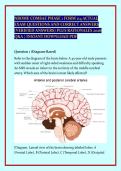
[Diagram: Lateral view of the brain showing labeled lobes: A
(Frontal Lobe), B (Parietal Lobe), C (Temporal Lobe), D (Occipital
,Lobe). The middle cerebral artery territory is shaded over the lateral
convexity, including the lateral frontal, parietal, and superior
temporal lobes.]
A. Frontal Lobe only
B. Parietal Lobe only
C. Lateral frontal, parietal, and superior temporal lobes
D. Occipital Lobe
C. Lateral frontal, parietal, and superior temporal lobes
RATIONALE: The middle cerebral artery (MCA) supplies the
lateral convexity of the cerebral hemisphere, including the lateral
frontal lobe, parietal lobe, and superior temporal lobe. Occlusion of
the MCA typically causes contralateral hemiparesis and
hemisensory loss, with aphasia if the dominant hemisphere is
affected. The occipital lobe is supplied by the posterior cerebral
artery.
,Question 2 (Diagram-Based)
Refer to the diagram of the nephron below. A 32-year-old female
presents with polyuria, polydipsia, and dehydration. Laboratory
studies reveal hypernatremia and low urine osmolality that does not
increase with water deprivation. Which structure of the nephron is
most likely dysfunctional?
, [Diagram: Nephron showing labeled structures: A (Glomerulus), B
(Proximal Convoluted Tubule), C (Loop of Henle), D (Distal
Convoluted Tubule), E (Collecting Duct). The collecting duct is
highlighted with an arrow indicating ADH action.]
A. Glomerulus
B. Proximal Convoluted Tubule
C. Loop of Henle
D. Collecting Duct
D. Collecting Duct
RATIONALE: The collecting duct is the primary site of action
for antidiuretic hormone (ADH). Inability to concentrate urine
despite water deprivation and hypernatremia indicates nephrogenic
diabetes insipidus, which involves dysfunction of the collecting
duct's response to ADH. The glomerulus is involved in filtration, the
proximal tubule in reabsorption of most solutes, and the loop of
Henle in concentration of urine.
EXAM QUESTIONS AND CORRECT ANSWERS
(VERIFIED ANSWERS) PLUS RATIONALES 2026
Q&A | INSTANT DOWNLOAD PDF
Question 1 (Diagram-Based)
Refer to the diagram of the brain below. A 45-year-old male presents
with sudden onset of right-sided weakness and difficulty speaking.
An MRI reveals an infarct in the territory of the middle cerebral
artery. Which area of the brain is most likely affected?
[Diagram: Lateral view of the brain showing labeled lobes: A
(Frontal Lobe), B (Parietal Lobe), C (Temporal Lobe), D (Occipital
,Lobe). The middle cerebral artery territory is shaded over the lateral
convexity, including the lateral frontal, parietal, and superior
temporal lobes.]
A. Frontal Lobe only
B. Parietal Lobe only
C. Lateral frontal, parietal, and superior temporal lobes
D. Occipital Lobe
C. Lateral frontal, parietal, and superior temporal lobes
RATIONALE: The middle cerebral artery (MCA) supplies the
lateral convexity of the cerebral hemisphere, including the lateral
frontal lobe, parietal lobe, and superior temporal lobe. Occlusion of
the MCA typically causes contralateral hemiparesis and
hemisensory loss, with aphasia if the dominant hemisphere is
affected. The occipital lobe is supplied by the posterior cerebral
artery.
,Question 2 (Diagram-Based)
Refer to the diagram of the nephron below. A 32-year-old female
presents with polyuria, polydipsia, and dehydration. Laboratory
studies reveal hypernatremia and low urine osmolality that does not
increase with water deprivation. Which structure of the nephron is
most likely dysfunctional?
, [Diagram: Nephron showing labeled structures: A (Glomerulus), B
(Proximal Convoluted Tubule), C (Loop of Henle), D (Distal
Convoluted Tubule), E (Collecting Duct). The collecting duct is
highlighted with an arrow indicating ADH action.]
A. Glomerulus
B. Proximal Convoluted Tubule
C. Loop of Henle
D. Collecting Duct
D. Collecting Duct
RATIONALE: The collecting duct is the primary site of action
for antidiuretic hormone (ADH). Inability to concentrate urine
despite water deprivation and hypernatremia indicates nephrogenic
diabetes insipidus, which involves dysfunction of the collecting
duct's response to ADH. The glomerulus is involved in filtration, the
proximal tubule in reabsorption of most solutes, and the loop of
Henle in concentration of urine.


