
ATI RN MEDICAL SURGICAL PROCTORED EXAM STUDY
GUIDE PRACTICE QUESTIONS AND CORRECT ANSWERS
(VERIFIED ANSWERS) PLUS RATIONALES 2026/2027 Q&A
| INSTANT DOWNLOAD PDF.
Question 1
System: Cardiovascular Nursing
Topic: Cardiac Conduction & Dysrhythmias
A nurse is reviewing an ECG tracing for a client admitted with
weakness. The client’s telemetry strip reveals a regular rhythm, a heart
rate of 48/min, normal P waves, and normal QRS complexes. Based on
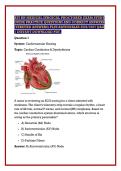
the cardiac conduction system illustrated above, which structure is
acting as the primary pacemaker?
• A) Sinoatrial (SA) Node
• B) Atrioventricular (AV) Node
• C) Bundle of His
• D) Purkinje Fibers
Answer: B) Atrioventricular (AV) Node
,Rationale: The SA node normally fires at 60–100 bpm. When the SA
node fails or slows, the AV node takes over as the secondary pacemaker
at an intrinsic rate of 40–60 bpm. A rate of 48/min with normal
configuration points to a junctional escape rhythm originating at the AV
node.
Question 2
System: Respiratory Nursing
Topic: Chest Tube Drainage System
A nurse is caring for a client with a left pneumothorax who has a chest
tube connected to a traditional water-seal drainage system (pictured
above). During the assessment, the nurse notices continuous, rapid
bubbling in the water-seal chamber. What is the priority nursing action?
, • A) Document this as an expected finding during lung re-
expansion.
• B) Clamp the chest tube near the client’s chest immediately.
• C) Check the tubing connections and dressing site for an air leak.
• D) Increase the suction pressure on the wall regulator.
Answer: C) Check the tubing connections and dressing site for an air
leak.
Rationale: Continuous bubbling in the water-seal chamber indicates an
air leak in the system or around the insertion site. Intermittent bubbling
on exhalation or coughing is normal, but continuous bubbling requires
immediate systematic inspection from the dressing down to the unit.
Clamping is contraindicated without a specific provider order due to
tension pneumothorax risk.
, Question 3
System: Respiratory / Perioperative Nursing
Topic: Airway Management & Tracheostomy Care
A nurse is providing post-procedure care for a client who underwent a
new tracheostomy 12 hours ago (illustrated above). The client suddenly
coughs, and the tracheostomy tube is dislodged. Which of the following
items must be kept at the bedside at all times to address this
emergency? (Select All That Apply)
• A) An obturator of the same size
• B) A spare tracheostomy tube of the same size and one size smaller
• C) A bag-valve mask (BVM)
• D) A pair of sterile surgical scissors
• E) Suction equipment and catheters
Answer: A, B, C, E
Rationale: For a client with a tracheostomy, emergency airway
equipment must remain at the bedside: the obturator (used to guide
reinsertion), a replacement tube of the same size plus one size smaller
GUIDE PRACTICE QUESTIONS AND CORRECT ANSWERS
(VERIFIED ANSWERS) PLUS RATIONALES 2026/2027 Q&A
| INSTANT DOWNLOAD PDF.
Question 1
System: Cardiovascular Nursing
Topic: Cardiac Conduction & Dysrhythmias
A nurse is reviewing an ECG tracing for a client admitted with
weakness. The client’s telemetry strip reveals a regular rhythm, a heart
rate of 48/min, normal P waves, and normal QRS complexes. Based on
the cardiac conduction system illustrated above, which structure is
acting as the primary pacemaker?
• A) Sinoatrial (SA) Node
• B) Atrioventricular (AV) Node
• C) Bundle of His
• D) Purkinje Fibers
Answer: B) Atrioventricular (AV) Node
,Rationale: The SA node normally fires at 60–100 bpm. When the SA
node fails or slows, the AV node takes over as the secondary pacemaker
at an intrinsic rate of 40–60 bpm. A rate of 48/min with normal
configuration points to a junctional escape rhythm originating at the AV
node.
Question 2
System: Respiratory Nursing
Topic: Chest Tube Drainage System
A nurse is caring for a client with a left pneumothorax who has a chest
tube connected to a traditional water-seal drainage system (pictured
above). During the assessment, the nurse notices continuous, rapid
bubbling in the water-seal chamber. What is the priority nursing action?
, • A) Document this as an expected finding during lung re-
expansion.
• B) Clamp the chest tube near the client’s chest immediately.
• C) Check the tubing connections and dressing site for an air leak.
• D) Increase the suction pressure on the wall regulator.
Answer: C) Check the tubing connections and dressing site for an air
leak.
Rationale: Continuous bubbling in the water-seal chamber indicates an
air leak in the system or around the insertion site. Intermittent bubbling
on exhalation or coughing is normal, but continuous bubbling requires
immediate systematic inspection from the dressing down to the unit.
Clamping is contraindicated without a specific provider order due to
tension pneumothorax risk.
, Question 3
System: Respiratory / Perioperative Nursing
Topic: Airway Management & Tracheostomy Care
A nurse is providing post-procedure care for a client who underwent a
new tracheostomy 12 hours ago (illustrated above). The client suddenly
coughs, and the tracheostomy tube is dislodged. Which of the following
items must be kept at the bedside at all times to address this
emergency? (Select All That Apply)
• A) An obturator of the same size
• B) A spare tracheostomy tube of the same size and one size smaller
• C) A bag-valve mask (BVM)
• D) A pair of sterile surgical scissors
• E) Suction equipment and catheters
Answer: A, B, C, E
Rationale: For a client with a tracheostomy, emergency airway
equipment must remain at the bedside: the obturator (used to guide
reinsertion), a replacement tube of the same size plus one size smaller


