
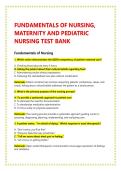
FUNDAMENTALS OF NURSING,
MATERNITY AND PEDIATRIC
NURSING TEST BANK
Fundamentals of Nursing
1. Which action demonstrates the QSEN competency of patient-centered care?
A. Checking blood glucose every 4 hours
B. Asking the patient about their cultural beliefs regarding food
C. Administering insulin without explanation
D. Following the standardized care plan without modification
Rationale: Patient-centered care involves respecting patients' preferences, values, and
needs. Asking about cultural beliefs addresses the patient as a whole person .
2. What is the primary purpose of the nursing process?
A. To provide a systematic approach to patient care
B. To eliminate the need for documentation
C. To standardize medication administration
D. To focus solely on physical assessments
Rationale: The nursing process provides a systematic approach guiding nurses in
assessing, diagnosing, planning, implementing, and evaluating care .
3. A patient states, "I'm afraid of dying." Which response is most therapeutic?
A. "Don't worry, you'll be fine."
B. "Everyone feels that way sometimes."
C. "Tell me more about what you're feeling."
D. "Let's focus on getting better."
Rationale: Open-ended therapeutic communication encourages expression of feelings
and validation .
,4. Which finding in a postoperative patient requires immediate nursing action?
A. Temperature 99.0°F
B. Pain rated 3/10
C. Serosanguinous drainage on dressing
D. Sudden chest pain and shortness of breath
Rationale: Sudden chest pain and dyspnea suggest pulmonary embolism, a life-
threatening complication .
5. Which action by the nurse demonstrates proper hand hygiene?
A. Washing hands for 5 seconds
B. Using hot water during handwashing
C. Rubbing all hand surfaces for at least 20 seconds
D. Drying hands on clothing
Rationale: Effective hand hygiene requires friction on all hand surfaces for at least 20
seconds .
6. A nurse is preparing to insert an indwelling urinary catheter. Which technique is
correct?
A. Clean technique with tap water
B. Sterile technique with sterile gloves and drape
C. Surgical asepsis with clean gloves only
D. Clean technique with sterile gloves
Rationale: Urinary catheter insertion requires sterile technique to prevent infection .
7. Which position promotes lung expansion in a client with dyspnea?
A. Supine position
B. Prone position
C. High-Fowler's position
D. Trendelenburg position
Rationale: High-Fowler's position maximizes chest expansion and eases breathing .
8. A nurse is obtaining informed consent. Which statement is correct?
A. The nurse explains surgical risks in detail
B. The nurse signs as the provider
, C. The nurse witnesses the client's signature
D. The family signs for all adult clients
Rationale: The nurse's role is to witness the signature and ensure the client appears
informed and voluntary .
9. Which patient has the highest risk for falls?
A. 45-year-old post-appendectomy
B. 80-year-old with dementia and history of falls
C. 30-year-old with migraine
D. 55-year-old with gout
Rationale: Advanced age, cognitive impairment, and prior falls are major fall risk factors
.
10. What is the correct method for taking an apical pulse?
A. Using a stethoscope placed at the apex of the heart
B. Counting the pulse on the wrist
C. Using a sphygmomanometer
D. Palpating the carotid artery
Rationale: The apical pulse is taken with a stethoscope at the apex of the heart, typically
at the fifth intercostal space, midclavicular line .
11. A nurse is applying the principles of person-centered care. Which action best
demonstrates this philosophy?
A. Following the standardized hospital clinical pathway without deviation
B. Involving the client and their family in setting daily recovery goals and
preferences
C. Prioritizing institutional routines over personal schedules
D. Limiting communication to direct medical updates
Rationale: Person-centered care focuses on the individual as the center of practice,
respecting their values and expressed needs .
12. Which type of data represents subjective data collected during the interview?
A. Blood pressure reading of 130/82 mm Hg
B. Client statement of "I have a sharp, burning pain in my lower abdomen"
MATERNITY AND PEDIATRIC
NURSING TEST BANK
Fundamentals of Nursing
1. Which action demonstrates the QSEN competency of patient-centered care?
A. Checking blood glucose every 4 hours
B. Asking the patient about their cultural beliefs regarding food
C. Administering insulin without explanation
D. Following the standardized care plan without modification
Rationale: Patient-centered care involves respecting patients' preferences, values, and
needs. Asking about cultural beliefs addresses the patient as a whole person .
2. What is the primary purpose of the nursing process?
A. To provide a systematic approach to patient care
B. To eliminate the need for documentation
C. To standardize medication administration
D. To focus solely on physical assessments
Rationale: The nursing process provides a systematic approach guiding nurses in
assessing, diagnosing, planning, implementing, and evaluating care .
3. A patient states, "I'm afraid of dying." Which response is most therapeutic?
A. "Don't worry, you'll be fine."
B. "Everyone feels that way sometimes."
C. "Tell me more about what you're feeling."
D. "Let's focus on getting better."
Rationale: Open-ended therapeutic communication encourages expression of feelings
and validation .
,4. Which finding in a postoperative patient requires immediate nursing action?
A. Temperature 99.0°F
B. Pain rated 3/10
C. Serosanguinous drainage on dressing
D. Sudden chest pain and shortness of breath
Rationale: Sudden chest pain and dyspnea suggest pulmonary embolism, a life-
threatening complication .
5. Which action by the nurse demonstrates proper hand hygiene?
A. Washing hands for 5 seconds
B. Using hot water during handwashing
C. Rubbing all hand surfaces for at least 20 seconds
D. Drying hands on clothing
Rationale: Effective hand hygiene requires friction on all hand surfaces for at least 20
seconds .
6. A nurse is preparing to insert an indwelling urinary catheter. Which technique is
correct?
A. Clean technique with tap water
B. Sterile technique with sterile gloves and drape
C. Surgical asepsis with clean gloves only
D. Clean technique with sterile gloves
Rationale: Urinary catheter insertion requires sterile technique to prevent infection .
7. Which position promotes lung expansion in a client with dyspnea?
A. Supine position
B. Prone position
C. High-Fowler's position
D. Trendelenburg position
Rationale: High-Fowler's position maximizes chest expansion and eases breathing .
8. A nurse is obtaining informed consent. Which statement is correct?
A. The nurse explains surgical risks in detail
B. The nurse signs as the provider
, C. The nurse witnesses the client's signature
D. The family signs for all adult clients
Rationale: The nurse's role is to witness the signature and ensure the client appears
informed and voluntary .
9. Which patient has the highest risk for falls?
A. 45-year-old post-appendectomy
B. 80-year-old with dementia and history of falls
C. 30-year-old with migraine
D. 55-year-old with gout
Rationale: Advanced age, cognitive impairment, and prior falls are major fall risk factors
.
10. What is the correct method for taking an apical pulse?
A. Using a stethoscope placed at the apex of the heart
B. Counting the pulse on the wrist
C. Using a sphygmomanometer
D. Palpating the carotid artery
Rationale: The apical pulse is taken with a stethoscope at the apex of the heart, typically
at the fifth intercostal space, midclavicular line .
11. A nurse is applying the principles of person-centered care. Which action best
demonstrates this philosophy?
A. Following the standardized hospital clinical pathway without deviation
B. Involving the client and their family in setting daily recovery goals and
preferences
C. Prioritizing institutional routines over personal schedules
D. Limiting communication to direct medical updates
Rationale: Person-centered care focuses on the individual as the center of practice,
respecting their values and expressed needs .
12. Which type of data represents subjective data collected during the interview?
A. Blood pressure reading of 130/82 mm Hg
B. Client statement of "I have a sharp, burning pain in my lower abdomen"


