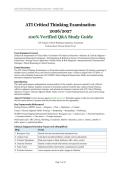
ATI Critical Thinking Examination 2026/2027 – Study Guide
ATI Critical Thinking Examination
2026/2027
100% Verified Q&A Study Guide
ATI Testing | Critical Thinking Competency Assessment
Undergraduate Nursing Student Focus
Core Domains Covered
Analysis & Interpretation of Clinical Data • Evaluation of Evidence & Outcomes • Inference & Clinical Judgment •
Explanation & Rationale Development • Self-Regulation & Reflective Practice • Prioritization & Decision-Making
Frameworks • Nursing Process Application • Patient Safety & Risk Mitigation • Interprofessional Communication
Strategies • Ethical Reasoning in Clinical Scenarios
Exam Structure
The ATI Critical Thinking Examination is a 40-question timed assessment (approximately 40 minutes) consisting of
multiple-choice, multiple-select, and clinical scenario/prioritization items. Content is aligned with ATI Helix of
Success critical thinking frameworks, the NCSBN Clinical Judgment Measurement Model, and standard nursing
education competency expectations.
Introduction
This study guide prepares undergraduate nursing students for the cognitive processes essential to safe, effective
clinical decision-making. Emphasis is placed on systematic analysis of patient data, evidence-based inference,
reflective judgment, prioritization strategies, and rationale development consistent with ATI Critical Thinking
objectives, Tanner’s Clinical Judgment Model, Alfaro-LeFevre’s critical thinking framework, and current nursing
education standards.
Answer Format: Correct answers appear in bold green text. Rationales appear in italic text and explain both
why the correct answer is accurate and why the other options are less appropriate.
Key Frameworks Referenced
Nursing Process (ADPIE): Assess → Diagnose → Plan → Implement → Evaluate
Tanner’s Clinical Judgment Model: Noticing → Interpreting → Responding → Reflecting
NCSBN Clinical Judgment Measurement Model layers: Recognize cues → Analyze cues → Prioritize hypotheses
→ Generate solutions → Take action → Evaluate outcomes
Prioritization aids: ABC (Airway, Breathing, Circulation), Maslow’s hierarchy, acute vs. chronic, unstable vs.
stable, actual vs. potential problems
Clinical Judgment Decision Framework (Simplified)
Step Focus
1. Recognize Cues Identify relevant assessment data and patient cues
2. Analyze Cues Link data to possible problems; consider context and patterns
3. Prioritize Hypotheses Rank most urgent or likely problems (ABC, safety, acuity)
4. Generate Solutions Identify evidence-based interventions and expected outcomes
5. Take Action Implement priority interventions; communicate as needed
6. Evaluate Outcomes Assess response and revise plan; engage in reflection
Page 1 of 10
, ATI Critical Thinking Examination 2026/2027 – Study Guide
1. Analysis & Interpretation of Clinical Data
1. A nurse reviews a patient’s vital signs: BP 88/54 mm Hg, HR 118 bpm, RR 28, SpO₂ 89% on room air,
temperature 38.9°C. Which interpretation is most accurate?
A. The patient is experiencing mild anxiety and should be reassured.
B. These findings suggest possible sepsis or hypovolemic shock and require immediate further assessment and
intervention.
C. The elevated temperature alone explains all other abnormalities.
D. The patient is stable; continue routine monitoring.
Correct Answer: B. These findings suggest possible sepsis or hypovolemic shock and require immediate
further assessment and intervention.
Rationale: The combination of hypotension, tachycardia, tachypnea, hypoxemia, and fever constitutes a pattern of
clinical instability consistent with systemic inflammatory response or shock. Critical thinking requires recognizing
clusters of cues rather than isolated values. Option A underestimates acuity. Option C ignores the multifactorial
nature of the data. Option D is incorrect because the patient is unstable.
2. Laboratory results show serum potassium 2.9 mEq/L, sodium 138 mEq/L, and creatinine 0.9 mg/dL. The nurse’s
priority analysis should focus on:
A. Risk for fluid volume overload
B. Risk for cardiac dysrhythmias and muscle weakness related to hypokalemia
C. Immediate need for dialysis
D. Hyponatremia management
Correct Answer: B. Risk for cardiac dysrhythmias and muscle weakness related to hypokalemia
Rationale: A potassium of 2.9 mEq/L is critically low and predisposes the patient to ventricular dysrhythmias and
neuromuscular effects. Sodium and creatinine are within normal limits, so options A, C, and D are not supported by
the data.
3. A postoperative patient reports pain of 7/10, has a respiratory rate of 10 breaths/min, and is difficult to arouse
after receiving opioid analgesia. The most accurate interpretation is:
A. Expected response to surgery; continue current pain regimen
B. Possible opioid-induced respiratory depression requiring immediate assessment and potential intervention
C. The patient is experiencing anxiety rather than pain
D. Pain is uncontrolled and requires an additional opioid dose without further assessment
Correct Answer: B. Possible opioid-induced respiratory depression requiring immediate assessment and
potential intervention
Rationale: Decreased respiratory rate and decreased level of consciousness after opioids are classic cues of
respiratory depression. Critical thinking prioritizes safety (ABC). Continuing or increasing opioids without
reassessment (A, D) is unsafe. Anxiety (C) does not explain the respiratory findings.
4. Which set of data best supports the inference that a patient is developing acute respiratory failure?
A. SpO₂ 96% on 2 L nasal cannula, RR 16, clear lung sounds
B. SpO₂ 86% on 4 L nasal cannula, RR 32, use of accessory muscles, restlessness
C. BP 130/80, HR 78, temperature 37.2°C
D. Pain score 4/10, smiling, talking with family
Correct Answer: B. SpO₂ 86% on 4 L nasal cannula, RR 32, use of accessory muscles, restlessness
Rationale: Hypoxemia despite supplemental oxygen, tachypnea, accessory muscle use, and restlessness form a
clear pattern of respiratory compromise. The other options describe relatively normal or non-respiratory findings.
2. Evaluation of Evidence & Outcomes
5. After implementing a fall-prevention plan for an older adult, which outcome best indicates the intervention was
effective?
A. The nurse documented the plan in the chart.
B. The patient remained free of falls during the shift and verbalized understanding of call-light use.
C. The family expressed satisfaction with nursing care.
Page 2 of 10
ATI Critical Thinking Examination
2026/2027
100% Verified Q&A Study Guide
ATI Testing | Critical Thinking Competency Assessment
Undergraduate Nursing Student Focus
Core Domains Covered
Analysis & Interpretation of Clinical Data • Evaluation of Evidence & Outcomes • Inference & Clinical Judgment •
Explanation & Rationale Development • Self-Regulation & Reflective Practice • Prioritization & Decision-Making
Frameworks • Nursing Process Application • Patient Safety & Risk Mitigation • Interprofessional Communication
Strategies • Ethical Reasoning in Clinical Scenarios
Exam Structure
The ATI Critical Thinking Examination is a 40-question timed assessment (approximately 40 minutes) consisting of
multiple-choice, multiple-select, and clinical scenario/prioritization items. Content is aligned with ATI Helix of
Success critical thinking frameworks, the NCSBN Clinical Judgment Measurement Model, and standard nursing
education competency expectations.
Introduction
This study guide prepares undergraduate nursing students for the cognitive processes essential to safe, effective
clinical decision-making. Emphasis is placed on systematic analysis of patient data, evidence-based inference,
reflective judgment, prioritization strategies, and rationale development consistent with ATI Critical Thinking
objectives, Tanner’s Clinical Judgment Model, Alfaro-LeFevre’s critical thinking framework, and current nursing
education standards.
Answer Format: Correct answers appear in bold green text. Rationales appear in italic text and explain both
why the correct answer is accurate and why the other options are less appropriate.
Key Frameworks Referenced
Nursing Process (ADPIE): Assess → Diagnose → Plan → Implement → Evaluate
Tanner’s Clinical Judgment Model: Noticing → Interpreting → Responding → Reflecting
NCSBN Clinical Judgment Measurement Model layers: Recognize cues → Analyze cues → Prioritize hypotheses
→ Generate solutions → Take action → Evaluate outcomes
Prioritization aids: ABC (Airway, Breathing, Circulation), Maslow’s hierarchy, acute vs. chronic, unstable vs.
stable, actual vs. potential problems
Clinical Judgment Decision Framework (Simplified)
Step Focus
1. Recognize Cues Identify relevant assessment data and patient cues
2. Analyze Cues Link data to possible problems; consider context and patterns
3. Prioritize Hypotheses Rank most urgent or likely problems (ABC, safety, acuity)
4. Generate Solutions Identify evidence-based interventions and expected outcomes
5. Take Action Implement priority interventions; communicate as needed
6. Evaluate Outcomes Assess response and revise plan; engage in reflection
Page 1 of 10
, ATI Critical Thinking Examination 2026/2027 – Study Guide
1. Analysis & Interpretation of Clinical Data
1. A nurse reviews a patient’s vital signs: BP 88/54 mm Hg, HR 118 bpm, RR 28, SpO₂ 89% on room air,
temperature 38.9°C. Which interpretation is most accurate?
A. The patient is experiencing mild anxiety and should be reassured.
B. These findings suggest possible sepsis or hypovolemic shock and require immediate further assessment and
intervention.
C. The elevated temperature alone explains all other abnormalities.
D. The patient is stable; continue routine monitoring.
Correct Answer: B. These findings suggest possible sepsis or hypovolemic shock and require immediate
further assessment and intervention.
Rationale: The combination of hypotension, tachycardia, tachypnea, hypoxemia, and fever constitutes a pattern of
clinical instability consistent with systemic inflammatory response or shock. Critical thinking requires recognizing
clusters of cues rather than isolated values. Option A underestimates acuity. Option C ignores the multifactorial
nature of the data. Option D is incorrect because the patient is unstable.
2. Laboratory results show serum potassium 2.9 mEq/L, sodium 138 mEq/L, and creatinine 0.9 mg/dL. The nurse’s
priority analysis should focus on:
A. Risk for fluid volume overload
B. Risk for cardiac dysrhythmias and muscle weakness related to hypokalemia
C. Immediate need for dialysis
D. Hyponatremia management
Correct Answer: B. Risk for cardiac dysrhythmias and muscle weakness related to hypokalemia
Rationale: A potassium of 2.9 mEq/L is critically low and predisposes the patient to ventricular dysrhythmias and
neuromuscular effects. Sodium and creatinine are within normal limits, so options A, C, and D are not supported by
the data.
3. A postoperative patient reports pain of 7/10, has a respiratory rate of 10 breaths/min, and is difficult to arouse
after receiving opioid analgesia. The most accurate interpretation is:
A. Expected response to surgery; continue current pain regimen
B. Possible opioid-induced respiratory depression requiring immediate assessment and potential intervention
C. The patient is experiencing anxiety rather than pain
D. Pain is uncontrolled and requires an additional opioid dose without further assessment
Correct Answer: B. Possible opioid-induced respiratory depression requiring immediate assessment and
potential intervention
Rationale: Decreased respiratory rate and decreased level of consciousness after opioids are classic cues of
respiratory depression. Critical thinking prioritizes safety (ABC). Continuing or increasing opioids without
reassessment (A, D) is unsafe. Anxiety (C) does not explain the respiratory findings.
4. Which set of data best supports the inference that a patient is developing acute respiratory failure?
A. SpO₂ 96% on 2 L nasal cannula, RR 16, clear lung sounds
B. SpO₂ 86% on 4 L nasal cannula, RR 32, use of accessory muscles, restlessness
C. BP 130/80, HR 78, temperature 37.2°C
D. Pain score 4/10, smiling, talking with family
Correct Answer: B. SpO₂ 86% on 4 L nasal cannula, RR 32, use of accessory muscles, restlessness
Rationale: Hypoxemia despite supplemental oxygen, tachypnea, accessory muscle use, and restlessness form a
clear pattern of respiratory compromise. The other options describe relatively normal or non-respiratory findings.
2. Evaluation of Evidence & Outcomes
5. After implementing a fall-prevention plan for an older adult, which outcome best indicates the intervention was
effective?
A. The nurse documented the plan in the chart.
B. The patient remained free of falls during the shift and verbalized understanding of call-light use.
C. The family expressed satisfaction with nursing care.
Page 2 of 10