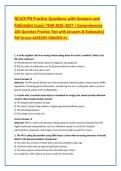
NCLEX-PN Practice Questions with Answers and
Rationales Exam| YEAR 2026–2027 | Comprehensive
100-Question Practice Test with Answers & Rationales|
Pdf Access ALREADY GRADED A+.
1. A client neighbor calls the nursing station asking about the client's condition. What is the
PN's best response?
A) Provide general information about the diagnosis and prognosis
B) Tell the caller no information can be disclosed without written consent
C) Transfer the call to the client room
D) Ask the caller to come to the hospital in person
Correct Answer: B
Rationale: The PN cannot disclose any client information without written consent due to HIPAA
regulations. Providing general information, transferring the call, or asking the caller to come in
person would all violate client confidentiality .
2. A client with a traumatic brain injury is scheduled for surgery but cannot provide informed
consent. Who should provide consent?
A) The hospital administrator on duty
B) The client's closest living relative or legally appointed healthcare proxy
C) The attending physician
D) The charge nurse on the unit
Correct Answer: B
Rationale: When a client lacks decision-making capacity, consent must be obtained from the
legally authorized representative, such as a healthcare proxy or next of kin. Hospital
administrators, physicians, and charge nurses cannot provide consent for a client .
3. The PN is calling the provider using SBAR about a client with increasing shortness of breath.
Which is the Recommendation component?
A) The client has a history of heart failure and was admitted 2 days ago
B) I think the client may be experiencing fluid overload
C) The client reports increased shortness of breath over 2 hours
D) I would like a STAT chest X-ray and an order for furosemide
,Correct Answer: D
Rationale: The Recommendation component of SBAR includes the nurse's suggested actions or
requests from the provider. Suggesting specific diagnostic and treatment orders is the
appropriate use of the R in SBAR. Option A is Situation, B is Assessment, and C is Background .
4. A client falls in the hallway. After ensuring safety, what should the PN do next?
A) Document the fall and complete an incident report per facility policy
B) Blame the client for not using the call light
C) Report the errors only if they result in client harm
D) Transfer to a different unit
Correct Answer: A
Rationale: After a fall, the nurse should ensure client safety, assess for injuries, notify the
provider, and document the fall with an incident report per facility policy. Incident reports are
not placed in the medical record .
5. The PN is developing a discharge plan for an older adult living alone after total hip
replacement. Which referral is most important?
A) A mental health counselor for adjustment disorder
B) A physical therapist for home exercise and mobility training
C) A social worker for financial assistance
D) A dietitian for weight loss counseling
Correct Answer: B
Rationale: After a total hip replacement, the client needs supervised rehabilitation, mobility
training, and home safety evaluation. Physical therapy referral is the highest priority for
functional independence .
6. The LPN is delegating tasks to unlicensed assistive personnel (UAP). Which tasks are
appropriate for the LPN to delegate to UAP?
A) Measuring a client's oral temperature
B) Assisting a client with ambulation using a gait belt
C) Obtaining a fingerstick blood glucose reading
D) Performing a sterile wound dressing change
E) Recording a client's intake and output
Correct Answer: A, B, C, E
Rationale: These tasks are within the scope of UAP when the client is stable and the UAP has
been trained. Sterile wound dressing changes (D) require nursing judgment and sterile
technique, which are not appropriate to delegate to UAP. The LPN must utilize the rights of
delegation .
, 7. The LPN is assisting with the admission of a client who speaks limited English. Which action
is MOST appropriate for obtaining accurate health information?
A) Use a certified medical interpreter via telephone or video
B) Ask the client's adult child to interpret
C) Use a translation application on the nurse's smartphone
D) Communicate using hand gestures and simple written words
Correct Answer: A
Rationale: The LPN should use a certified medical interpreter to ensure accurate, confidential
communication. Family members should not be used as interpreters due to potential errors and
breaches of confidentiality. Personal devices are not acceptable for healthcare communication .
8. The PN is documenting a wound assessment in the EHR. Which documentation is most
appropriate?
A) Wound looks bad and is getting worse
B) Stage 3 pressure injury 4 cm x 3 cm full-thickness tissue loss with visible subcutaneous fat,
moderate serosanguineous drainage
C) Wound is the same as yesterday
D) Large wound on sacrum needs attention
Correct Answer: B
Rationale: Accurate wound documentation includes staging, measurements in centimeters,
tissue characteristics, and drainage description. Subjective or vague terms are not professional
or useful for tracking healing .
9. A client requests a copy of their medical records. What is the PN's best action?
A) Refuse the request because records are confidential
B) Provide the records immediately without any process
C) Follow facility policy for releasing medical records to the client
D) Tell the client to ask the physician for the records
Correct Answer: C
Rationale: Clients have the right to access their medical records. The nurse should follow facility
policy for releasing records, which may include proper identification and a signed release form .
10. A client with terminal cancer states, "I'm ready to die. I've lived a good life." Which
response by the LPN is MOST therapeutic?
A) "You shouldn't talk like that. You have so much to live for."
B) "Tell me more about what you mean by 'ready to die.'"
C) "Are you thinking about harming yourself?"
D) "I understand how you feel. My grandfather died of cancer too."
Rationales Exam| YEAR 2026–2027 | Comprehensive
100-Question Practice Test with Answers & Rationales|
Pdf Access ALREADY GRADED A+.
1. A client neighbor calls the nursing station asking about the client's condition. What is the
PN's best response?
A) Provide general information about the diagnosis and prognosis
B) Tell the caller no information can be disclosed without written consent
C) Transfer the call to the client room
D) Ask the caller to come to the hospital in person
Correct Answer: B
Rationale: The PN cannot disclose any client information without written consent due to HIPAA
regulations. Providing general information, transferring the call, or asking the caller to come in
person would all violate client confidentiality .
2. A client with a traumatic brain injury is scheduled for surgery but cannot provide informed
consent. Who should provide consent?
A) The hospital administrator on duty
B) The client's closest living relative or legally appointed healthcare proxy
C) The attending physician
D) The charge nurse on the unit
Correct Answer: B
Rationale: When a client lacks decision-making capacity, consent must be obtained from the
legally authorized representative, such as a healthcare proxy or next of kin. Hospital
administrators, physicians, and charge nurses cannot provide consent for a client .
3. The PN is calling the provider using SBAR about a client with increasing shortness of breath.
Which is the Recommendation component?
A) The client has a history of heart failure and was admitted 2 days ago
B) I think the client may be experiencing fluid overload
C) The client reports increased shortness of breath over 2 hours
D) I would like a STAT chest X-ray and an order for furosemide
,Correct Answer: D
Rationale: The Recommendation component of SBAR includes the nurse's suggested actions or
requests from the provider. Suggesting specific diagnostic and treatment orders is the
appropriate use of the R in SBAR. Option A is Situation, B is Assessment, and C is Background .
4. A client falls in the hallway. After ensuring safety, what should the PN do next?
A) Document the fall and complete an incident report per facility policy
B) Blame the client for not using the call light
C) Report the errors only if they result in client harm
D) Transfer to a different unit
Correct Answer: A
Rationale: After a fall, the nurse should ensure client safety, assess for injuries, notify the
provider, and document the fall with an incident report per facility policy. Incident reports are
not placed in the medical record .
5. The PN is developing a discharge plan for an older adult living alone after total hip
replacement. Which referral is most important?
A) A mental health counselor for adjustment disorder
B) A physical therapist for home exercise and mobility training
C) A social worker for financial assistance
D) A dietitian for weight loss counseling
Correct Answer: B
Rationale: After a total hip replacement, the client needs supervised rehabilitation, mobility
training, and home safety evaluation. Physical therapy referral is the highest priority for
functional independence .
6. The LPN is delegating tasks to unlicensed assistive personnel (UAP). Which tasks are
appropriate for the LPN to delegate to UAP?
A) Measuring a client's oral temperature
B) Assisting a client with ambulation using a gait belt
C) Obtaining a fingerstick blood glucose reading
D) Performing a sterile wound dressing change
E) Recording a client's intake and output
Correct Answer: A, B, C, E
Rationale: These tasks are within the scope of UAP when the client is stable and the UAP has
been trained. Sterile wound dressing changes (D) require nursing judgment and sterile
technique, which are not appropriate to delegate to UAP. The LPN must utilize the rights of
delegation .
, 7. The LPN is assisting with the admission of a client who speaks limited English. Which action
is MOST appropriate for obtaining accurate health information?
A) Use a certified medical interpreter via telephone or video
B) Ask the client's adult child to interpret
C) Use a translation application on the nurse's smartphone
D) Communicate using hand gestures and simple written words
Correct Answer: A
Rationale: The LPN should use a certified medical interpreter to ensure accurate, confidential
communication. Family members should not be used as interpreters due to potential errors and
breaches of confidentiality. Personal devices are not acceptable for healthcare communication .
8. The PN is documenting a wound assessment in the EHR. Which documentation is most
appropriate?
A) Wound looks bad and is getting worse
B) Stage 3 pressure injury 4 cm x 3 cm full-thickness tissue loss with visible subcutaneous fat,
moderate serosanguineous drainage
C) Wound is the same as yesterday
D) Large wound on sacrum needs attention
Correct Answer: B
Rationale: Accurate wound documentation includes staging, measurements in centimeters,
tissue characteristics, and drainage description. Subjective or vague terms are not professional
or useful for tracking healing .
9. A client requests a copy of their medical records. What is the PN's best action?
A) Refuse the request because records are confidential
B) Provide the records immediately without any process
C) Follow facility policy for releasing medical records to the client
D) Tell the client to ask the physician for the records
Correct Answer: C
Rationale: Clients have the right to access their medical records. The nurse should follow facility
policy for releasing records, which may include proper identification and a signed release form .
10. A client with terminal cancer states, "I'm ready to die. I've lived a good life." Which
response by the LPN is MOST therapeutic?
A) "You shouldn't talk like that. You have so much to live for."
B) "Tell me more about what you mean by 'ready to die.'"
C) "Are you thinking about harming yourself?"
D) "I understand how you feel. My grandfather died of cancer too."