
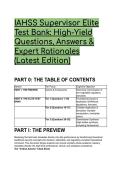
IAHSS Supervisor Elite
Test Bank: High-Yield
Questions, Answers &
Expert Rationales
(Latest Edition)
PART 0: THE TABLE OF CONTENTS
Section Tier Focus Cognitive Objective
PART I: THE PREVIEW Axioms & Frameworks Hard-deck memorization of
non-negotiable regulatory
standards.
PART II: THE ELITE TEST Tier 1 (Questions 1–18) Foundational Syntax &
BANK Application (Definitions,
regulations, formulas).
Tier 2 (Questions 19–37) Complex Application &
Simulation (Variable
manipulation, immediate
action).
Tier 3 (Questions 38–55) Grandmaster Synthesis
(High-stakes synthesis,
competing frameworks).
PART I: THE PREVIEW
Mastering this test bank translates directly into elite performance by transforming theoretical
healthcare security concepts into decisive, defensible, and regulatory-compliant operational
command. This document forges students into A-level scholars whose academic mastery
translates directly into high-level professional, clinical, and analytical competence.
The "Critical Axioms" Cheat Sheet
,Framework Core Axiom Application / Standard
The Joint Commission (TJC) LD.03.01.01 & EC.02.01.01 Requires a multidisciplinary
threat management team,
designated leadership, and
annual worksite analyses to
mitigate workplace violence
(WPV).
Weingarten Rights Investigatory Protections Triggered only when an
employee reasonably fears
discipline during an
investigatory interview.
Management must grant
representation, deny the
interview, or offer a choice.
Progressive Discipline Behavior-Driven Escalation Sequential correction (Verbal,
Written, Suspension,
Termination). Skipping steps is
forbidden unless the infraction
is severe (e.g., immediate
threat/violence).
The Kirkpatrick Model Training Evaluation Level 1: Reaction; Level 2:
Learning; Level 3: Behavior
(on-the-job application); Level
4: Results (organizational
impact).
Root Cause Analysis (RCA) Systemic Vulnerability Interdisciplinary, non-punitive
process executed post-sentinel
event to identify latent process
failures rather than assigning
individual blame.
PART II: THE ELITE TEST BANK
Tier 1 - Foundational Syntax & Application
Q1: Under The Joint Commission Standard LD.03.01.01 regarding workplace violence, which
requirement is MANDATORY for accredited healthcare facilities? A) The creation of a dedicated
armed response unit for the emergency department. B) The appointment of an external law
enforcement liaison to lead internal investigations. C) The establishment of a multidisciplinary
threat management team led by a designated individual. D) The installation of weapons
screening technology at all primary public entrances.
● Answer: C (The establishment of a multidisciplinary threat management team led by a
designated individual)
● Distractor Analysis:
○ A is incorrect: TJC does not mandate armed response units, though facilities may
choose to utilize them based on independent risk assessments.
○ B is incorrect: While external law enforcement collaboration is encouraged, TJC
, specifically requires an internal designated individual to lead the program.
○ D is incorrect: Weapons screening is a recommended mitigation strategy under
certain IAHSS design guidelines, but it is not a rigid TJC mandate for all facilities.
The Mentor's Analysis: TJC Standard LD.03.01.01 focuses on leadership oversight and the
creation of a culture of safety. When facing WPV mandates, the immediate priority is
multidisciplinary collaboration. By utilizing a multidisciplinary threat management team, you
bypass the common trap of isolating workplace violence prevention solely within the security
department. Professional Intuition: Workplace violence prevention is an enterprise-wide
responsibility requiring clinical, human resources, and security integration.
Q2: An employee sustains an injury resulting from a physical assault by a patient in the hospital
lobby. According to OSHA requirements, within what timeframe MUST the employer record this
recordable injury on the OSHA 300 Log? A) Within 24 hours of the incident. B) Within 72 hours
of the incident. C) Within 7 calendar days of learning about the incident. D) Within 30 days of
the conclusion of the internal investigation.
● Answer: C (Within 7 calendar days of learning about the incident)
● Distractor Analysis:
○ A is incorrect: 24 hours is a common internal incident reporting metric but not the
OSHA standard for the 300 Log.
○ B is incorrect: 72 hours is an arbitrary timeframe unrelated to federal recordkeeping
standards.
○ D is incorrect: Waiting for an internal investigation to conclude violates federal law;
recording must occur upon learning of the recordable event.
The Mentor's Analysis: Federal compliance leaves no room for administrative delays. When
facing an OSHA recordable incident, the immediate priority is logging the event to maintain
regulatory compliance. By utilizing the 7-calendar-day mandate, you bypass the common trap of
failing federal compliance audits. Professional Intuition: Regulatory timelines begin the
moment management gains knowledge of the incident, not when the investigation
concludes.
Q3: A security supervisor calls an officer into the office to ask questions regarding missing
equipment. The officer fears discipline and requests a union steward. Under Weingarten rights,
what is the MOST APPROPRIATE initial action for the supervisor? A) Proceed with the
interview, as missing equipment falls under routine operational inquiries. B) Deny the request
because Weingarten rights only apply to clinical staff. C) Grant the request, discontinue the
interview, or offer the officer a choice to continue without representation. D) Demand a written
statement from the officer before allowing the union steward to enter.
● Answer: C (Grant the request, discontinue the interview, or offer the officer a choice to
continue without representation)
● Distractor Analysis:
○ A is incorrect: The officer reasonably fears discipline, meaning this is an
investigatory interview, triggering Weingarten protections.
○ B is incorrect: Weingarten rights apply to all unionized employees, including security
personnel.
○ D is incorrect: Forcing a written statement prior to representation is a direct violation
of the worker's rights to representation during the investigatory phase.
The Mentor's Analysis: The NLRA protects an employee's right to representation during
investigatory interviews. When facing a request for representation, the immediate priority is
suspending interrogation. By utilizing the three legal options, you bypass the common trap of
coercing a confession and committing an unfair labor practice. Professional Intuition: Once
Test Bank: High-Yield
Questions, Answers &
Expert Rationales
(Latest Edition)
PART 0: THE TABLE OF CONTENTS
Section Tier Focus Cognitive Objective
PART I: THE PREVIEW Axioms & Frameworks Hard-deck memorization of
non-negotiable regulatory
standards.
PART II: THE ELITE TEST Tier 1 (Questions 1–18) Foundational Syntax &
BANK Application (Definitions,
regulations, formulas).
Tier 2 (Questions 19–37) Complex Application &
Simulation (Variable
manipulation, immediate
action).
Tier 3 (Questions 38–55) Grandmaster Synthesis
(High-stakes synthesis,
competing frameworks).
PART I: THE PREVIEW
Mastering this test bank translates directly into elite performance by transforming theoretical
healthcare security concepts into decisive, defensible, and regulatory-compliant operational
command. This document forges students into A-level scholars whose academic mastery
translates directly into high-level professional, clinical, and analytical competence.
The "Critical Axioms" Cheat Sheet
,Framework Core Axiom Application / Standard
The Joint Commission (TJC) LD.03.01.01 & EC.02.01.01 Requires a multidisciplinary
threat management team,
designated leadership, and
annual worksite analyses to
mitigate workplace violence
(WPV).
Weingarten Rights Investigatory Protections Triggered only when an
employee reasonably fears
discipline during an
investigatory interview.
Management must grant
representation, deny the
interview, or offer a choice.
Progressive Discipline Behavior-Driven Escalation Sequential correction (Verbal,
Written, Suspension,
Termination). Skipping steps is
forbidden unless the infraction
is severe (e.g., immediate
threat/violence).
The Kirkpatrick Model Training Evaluation Level 1: Reaction; Level 2:
Learning; Level 3: Behavior
(on-the-job application); Level
4: Results (organizational
impact).
Root Cause Analysis (RCA) Systemic Vulnerability Interdisciplinary, non-punitive
process executed post-sentinel
event to identify latent process
failures rather than assigning
individual blame.
PART II: THE ELITE TEST BANK
Tier 1 - Foundational Syntax & Application
Q1: Under The Joint Commission Standard LD.03.01.01 regarding workplace violence, which
requirement is MANDATORY for accredited healthcare facilities? A) The creation of a dedicated
armed response unit for the emergency department. B) The appointment of an external law
enforcement liaison to lead internal investigations. C) The establishment of a multidisciplinary
threat management team led by a designated individual. D) The installation of weapons
screening technology at all primary public entrances.
● Answer: C (The establishment of a multidisciplinary threat management team led by a
designated individual)
● Distractor Analysis:
○ A is incorrect: TJC does not mandate armed response units, though facilities may
choose to utilize them based on independent risk assessments.
○ B is incorrect: While external law enforcement collaboration is encouraged, TJC
, specifically requires an internal designated individual to lead the program.
○ D is incorrect: Weapons screening is a recommended mitigation strategy under
certain IAHSS design guidelines, but it is not a rigid TJC mandate for all facilities.
The Mentor's Analysis: TJC Standard LD.03.01.01 focuses on leadership oversight and the
creation of a culture of safety. When facing WPV mandates, the immediate priority is
multidisciplinary collaboration. By utilizing a multidisciplinary threat management team, you
bypass the common trap of isolating workplace violence prevention solely within the security
department. Professional Intuition: Workplace violence prevention is an enterprise-wide
responsibility requiring clinical, human resources, and security integration.
Q2: An employee sustains an injury resulting from a physical assault by a patient in the hospital
lobby. According to OSHA requirements, within what timeframe MUST the employer record this
recordable injury on the OSHA 300 Log? A) Within 24 hours of the incident. B) Within 72 hours
of the incident. C) Within 7 calendar days of learning about the incident. D) Within 30 days of
the conclusion of the internal investigation.
● Answer: C (Within 7 calendar days of learning about the incident)
● Distractor Analysis:
○ A is incorrect: 24 hours is a common internal incident reporting metric but not the
OSHA standard for the 300 Log.
○ B is incorrect: 72 hours is an arbitrary timeframe unrelated to federal recordkeeping
standards.
○ D is incorrect: Waiting for an internal investigation to conclude violates federal law;
recording must occur upon learning of the recordable event.
The Mentor's Analysis: Federal compliance leaves no room for administrative delays. When
facing an OSHA recordable incident, the immediate priority is logging the event to maintain
regulatory compliance. By utilizing the 7-calendar-day mandate, you bypass the common trap of
failing federal compliance audits. Professional Intuition: Regulatory timelines begin the
moment management gains knowledge of the incident, not when the investigation
concludes.
Q3: A security supervisor calls an officer into the office to ask questions regarding missing
equipment. The officer fears discipline and requests a union steward. Under Weingarten rights,
what is the MOST APPROPRIATE initial action for the supervisor? A) Proceed with the
interview, as missing equipment falls under routine operational inquiries. B) Deny the request
because Weingarten rights only apply to clinical staff. C) Grant the request, discontinue the
interview, or offer the officer a choice to continue without representation. D) Demand a written
statement from the officer before allowing the union steward to enter.
● Answer: C (Grant the request, discontinue the interview, or offer the officer a choice to
continue without representation)
● Distractor Analysis:
○ A is incorrect: The officer reasonably fears discipline, meaning this is an
investigatory interview, triggering Weingarten protections.
○ B is incorrect: Weingarten rights apply to all unionized employees, including security
personnel.
○ D is incorrect: Forcing a written statement prior to representation is a direct violation
of the worker's rights to representation during the investigatory phase.
The Mentor's Analysis: The NLRA protects an employee's right to representation during
investigatory interviews. When facing a request for representation, the immediate priority is
suspending interrogation. By utilizing the three legal options, you bypass the common trap of
coercing a confession and committing an unfair labor practice. Professional Intuition: Once


