

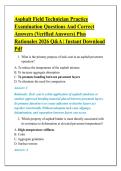
Asphalt Field Technician Practice
Examination Questions And Correct
Answers (Verified Answers) Plus
Rationales 2026 Q&A | Instant Download
Pdf
1. What is the primary purpose of tack coat in an asphalt pavement
operation?
A. To reduce the temperature of the asphalt mixture
B. To increase aggregate absorption
C. To promote bonding between pavement layers
D. To eliminate the need for compaction
Answer: C
Rationale: Tack coat is a thin application of asphalt emulsion or
another approved bonding material placed between pavement layers.
Its primary function is to create adhesion so that the layers act
together structurally. Without adequate tack coat, slippage,
delamination, and separation between layers can occur.
2. Which property of asphalt binder is most directly associated with
its resistance to deformation at elevated pavement temperatures?
A. High-temperature stiffness
B. Color
C. Aggregate gradation
D. Surface texture
Answer: A
,Rationale: High-temperature binder stiffness is important because
asphalt pavements can become susceptible to rutting when
temperatures rise. Binder performance at elevated temperatures
contributes to the mixture's ability to resist permanent deformation
under repeated traffic loading.
3. During asphalt placement, what instrument is commonly used to
verify the temperature of the hot-mix asphalt?
A. Nuclear density gauge
B. Straightedge
C. Sand cone
D. Infrared or probe-type thermometer
Answer: D
Rationale: Temperature measurements are routinely taken during
asphalt production, delivery, placement, and compaction. Probe
thermometers provide direct temperature measurements, while
infrared thermometers can provide rapid surface readings. The
specific instrument and measurement procedure should follow the
project specifications.
4. What is the primary purpose of aggregate gradation control in an
asphalt mixture?
A. To determine the pavement color
B. To establish the distribution of aggregate particle sizes
C. To measure binder viscosity only
D. To determine the roller operating speed
Answer: B
Rationale: Aggregate gradation describes the proportion of particles of
different sizes in the mixture. Proper gradation affects workability,
,void structure, stability, permeability, durability, and overall mixture
performance. Field technicians must verify that delivered materials
conform to the approved job mix formula and specifications.
5. What does a nuclear density gauge primarily measure during
asphalt pavement construction?
A. Asphalt binder grade
B. Aggregate mineralogy
C. In-place density or density-related properties
D. Asphalt emulsion residue
Answer: C
Rationale: Nuclear density gauges are commonly used to estimate in-
place density of compacted asphalt and other construction materials.
They allow rapid field measurements and can help technicians
determine whether compaction requirements are being achieved.
Proper calibration, standardization, and operating procedures are
essential.
6. What is a major consequence of insufficient asphalt compaction?
A. Increased air voids and reduced pavement durability
B. Elimination of permeability
C. Increased binder content automatically
D. Improved resistance to moisture damage in every case
Answer: A
Rationale: Insufficient compaction generally leaves excessive air voids
in the asphalt mixture. Excessive air voids can allow water and air to
penetrate the pavement, accelerating oxidation, moisture-related
deterioration, raveling, and other forms of distress.
, 7. Which piece of equipment is specifically designed to provide
vibratory compaction of asphalt?
A. Asphalt paver
B. Milling machine
C. Material transfer vehicle
D. Vibratory roller
Answer: D
Rationale: Vibratory rollers use rotating eccentric weights to generate
dynamic forces that improve aggregate rearrangement and density.
They are widely used for asphalt compaction. The technician should
monitor operating mode, speed, amplitude, frequency, and temperature
to help maintain consistent compaction.
8. What is the function of the screed on an asphalt paver?
A. To cool the mixture
B. To spread, level, and partially compact the asphalt mixture
C. To crush oversized aggregate
D. To determine binder penetration grade
Answer: B
Rationale: The screed is the principal component that shapes the
asphalt mat behind the paver. It controls the initial thickness and
smoothness of the placed mixture and provides some initial
compaction. Proper screed operation is important for achieving
uniform pavement thickness and surface profile.
9. Why should an asphalt technician monitor the time between
mixing and placement?
A. Because aggregate becomes radioactive over time
B. Because pavement thickness automatically increases
Examination Questions And Correct
Answers (Verified Answers) Plus
Rationales 2026 Q&A | Instant Download
1. What is the primary purpose of tack coat in an asphalt pavement
operation?
A. To reduce the temperature of the asphalt mixture
B. To increase aggregate absorption
C. To promote bonding between pavement layers
D. To eliminate the need for compaction
Answer: C
Rationale: Tack coat is a thin application of asphalt emulsion or
another approved bonding material placed between pavement layers.
Its primary function is to create adhesion so that the layers act
together structurally. Without adequate tack coat, slippage,
delamination, and separation between layers can occur.
2. Which property of asphalt binder is most directly associated with
its resistance to deformation at elevated pavement temperatures?
A. High-temperature stiffness
B. Color
C. Aggregate gradation
D. Surface texture
Answer: A
,Rationale: High-temperature binder stiffness is important because
asphalt pavements can become susceptible to rutting when
temperatures rise. Binder performance at elevated temperatures
contributes to the mixture's ability to resist permanent deformation
under repeated traffic loading.
3. During asphalt placement, what instrument is commonly used to
verify the temperature of the hot-mix asphalt?
A. Nuclear density gauge
B. Straightedge
C. Sand cone
D. Infrared or probe-type thermometer
Answer: D
Rationale: Temperature measurements are routinely taken during
asphalt production, delivery, placement, and compaction. Probe
thermometers provide direct temperature measurements, while
infrared thermometers can provide rapid surface readings. The
specific instrument and measurement procedure should follow the
project specifications.
4. What is the primary purpose of aggregate gradation control in an
asphalt mixture?
A. To determine the pavement color
B. To establish the distribution of aggregate particle sizes
C. To measure binder viscosity only
D. To determine the roller operating speed
Answer: B
Rationale: Aggregate gradation describes the proportion of particles of
different sizes in the mixture. Proper gradation affects workability,
,void structure, stability, permeability, durability, and overall mixture
performance. Field technicians must verify that delivered materials
conform to the approved job mix formula and specifications.
5. What does a nuclear density gauge primarily measure during
asphalt pavement construction?
A. Asphalt binder grade
B. Aggregate mineralogy
C. In-place density or density-related properties
D. Asphalt emulsion residue
Answer: C
Rationale: Nuclear density gauges are commonly used to estimate in-
place density of compacted asphalt and other construction materials.
They allow rapid field measurements and can help technicians
determine whether compaction requirements are being achieved.
Proper calibration, standardization, and operating procedures are
essential.
6. What is a major consequence of insufficient asphalt compaction?
A. Increased air voids and reduced pavement durability
B. Elimination of permeability
C. Increased binder content automatically
D. Improved resistance to moisture damage in every case
Answer: A
Rationale: Insufficient compaction generally leaves excessive air voids
in the asphalt mixture. Excessive air voids can allow water and air to
penetrate the pavement, accelerating oxidation, moisture-related
deterioration, raveling, and other forms of distress.
, 7. Which piece of equipment is specifically designed to provide
vibratory compaction of asphalt?
A. Asphalt paver
B. Milling machine
C. Material transfer vehicle
D. Vibratory roller
Answer: D
Rationale: Vibratory rollers use rotating eccentric weights to generate
dynamic forces that improve aggregate rearrangement and density.
They are widely used for asphalt compaction. The technician should
monitor operating mode, speed, amplitude, frequency, and temperature
to help maintain consistent compaction.
8. What is the function of the screed on an asphalt paver?
A. To cool the mixture
B. To spread, level, and partially compact the asphalt mixture
C. To crush oversized aggregate
D. To determine binder penetration grade
Answer: B
Rationale: The screed is the principal component that shapes the
asphalt mat behind the paver. It controls the initial thickness and
smoothness of the placed mixture and provides some initial
compaction. Proper screed operation is important for achieving
uniform pavement thickness and surface profile.
9. Why should an asphalt technician monitor the time between
mixing and placement?
A. Because aggregate becomes radioactive over time
B. Because pavement thickness automatically increases


