
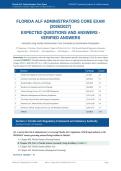
Florida ALF Administrators Core Exam 2026/2027 Expected Questions & Verified Answers
175 Questions | 9 Sections | Chapter 429 F.S. & Rule 59A-36 F.A.C.
FLORIDA ALF ADMINISTRATORS CORE EXAM
(2026/2027)
EXPECTED QUESTIONS AND ANSWERS -
VERIFIED ANSWERS
Assisted Living Facility Administrator Core Competency Examination Preparation
175 Questions | 9 Sections | Florida Statutes Chapter 429 Part I & F.A.C. 59A-36 with Detailed Regulatory Rationales
Cognitive Mix: ~35% Recall • ~45% Application • ~20% Analysis • ~70% Scenario-Based / ~30% Direct Recall
Instructions: For each question, select the single best answer. Each question provides four options (A–D); the correct option
is marked [CORRECT]. Detailed rationales explain why the correct answer is right and why the distractors are wrong, citing
Chapter 429 F.S., Rule 59A-36 F.A.C., AHCA expectations, administrator accountability, and resident safety considerations.
Use this packet for ALF administrator core competency exam preparation and self-assessment.
# Section Q Range Count
1 Florida ALF Regulatory Framework and Statutory Authority Q1-Q25 25
2 Licensure, Ownership, and Administrator Responsibilities Q26-Q46 21
3 Resident Rights, Admissions, and Discharge Q47-Q68 22
4 Resident Care Standards and Service Planning Q69-Q90 22
5 Limited Nursing Services, ECC, and LMH Designations Q91-Q110 20
6 Medication Management and Pharmacy Regulations Q111-Q130 20
7 Life Safety, Physical Plant, and Emergency Preparedness Q131-Q150 20
8 Dementia Care, Mental Health, and Special Populations Q151-Q160 10
9 Personnel, Staffing, Training, Records, QA, and Mandatory Reporting Q161-Q175 15
TOTAL Q1-Q175 175
Section 1: Florida ALF Regulatory Framework and Statutory Authority
Questions Q1-Q25 | 25 Questions
Q1. A newly hired ALF administrator is reviewing Florida ALF regulations. Which legal authority is the
PRIMARY statute governing assisted living facilities in Florida?
A. Chapter 400, Florida Statutes (Nursing Homes)
B. Chapter 429, Part I, Florida Statutes (Assisted Living Facilities) [CORRECT]
C. Chapter 394, Florida Statutes (Baker Act)
D. Chapter 435, Florida Statutes (Background Screening)
Correct Answer: B
Florida ALF Administrators Core Exam AHCA - Chapter 429 F.S. & Rule 59A-36 F.A.C. Page 1
,Florida ALF Administrators Core Exam 2026/2027 Expected Questions & Verified Answers
175 Questions | 9 Sections | Chapter 429 F.S. & Rule 59A-36 F.A.C.
Rationale: Chapter 429, Part I, Florida Statutes is the primary statutory authority governing assisted living
facilities in Florida. Chapter 400 governs nursing homes and cannot be applied to ALFs. Chapter 394 (Baker
Act) addresses involuntary mental health examination and Chapter 435 governs background screening
requirements for certain professions. The administrator must always reference 429 F.S. as the primary statute
and 59A-36 F.A.C. for detailed rules.
Q2. Which state agency is responsible for licensing, regulating, and surveying assisted living facilities in
Florida?
A. Department of Elder Affairs (DOEA)
B. Agency for Health Care Administration (AHCA) [CORRECT]
C. Department of Children and Families (DCF)
D. Department of Health (DOH)
Correct Answer: B
Rationale: The Agency for Health Care Administration (AHCA) is the regulatory authority for licensing,
surveying, and enforcing rules for ALFs in Florida. DOEA oversees aging programs but does not license ALFs.
DCF handles abuse/neglect reports and Baker Act, while DOH regulates other health professions.
Administrators interact primarily with AHCA for all licensure and compliance matters.
Q3. The administrative rules implementing Chapter 429, F.S., are found in which section of the Florida
Administrative Code (F.A.C.)?
A. Rule 59A-3, F.A.C.
B. Rule 59A-4, F.A.C.
C. Rule 59A-36, F.A.C. [CORRECT]
D. Rule 59A-35, F.A.C.
Correct Answer: C
Rationale: Rule 59A-36, F.A.C. is the administrative code that implements Chapter 429, Part I, F.S., providing
detailed requirements for ALF operation, licensure, resident care, and life safety. Rule 59A-3 governs hospitals,
59A-4 governs nursing homes. The administrator must consult 59A-36 F.A.C. for operational specifics such as
staffing ratios, training hours, and physical plant requirements.
Q4. An administrator asks how AHCA surveys ALFs. Which statement is most accurate regarding ALF
survey frequency?
A. ALFs are surveyed annually.
B. ALFs are surveyed biennially (every 2 years), with complaint investigations as needed. [CORRECT]
C. ALFs are surveyed only when a complaint is received.
D. ALFs are surveyed every 5 years.
Correct Answer: B
Florida ALF Administrators Core Exam AHCA - Chapter 429 F.S. & Rule 59A-36 F.A.C. Page 2
,Florida ALF Administrators Core Exam 2026/2027 Expected Questions & Verified Answers
175 Questions | 9 Sections | Chapter 429 F.S. & Rule 59A-36 F.A.C.
Rationale: AHCA conducts biennial (every 2 years) standard surveys of ALFs in addition to complaint
investigations. Surveyors review resident files, medication records, staffing records, life safety compliance, and
resident rights. Surveys may be unannounced. A facility with prior deficiencies or high complaint volume may
receive more frequent surveys. Administrators must maintain continuous compliance, not just prepare for
survey.
Q5. Which of the following is a 'Class III' deficiency under AHCA regulations?
A. A deficiency that results in a condition that presents an immediate threat to the physical or emotional
well-being of a resident.
B. A deficiency that does not threaten a resident's well-being but should be corrected to ensure
consistency. [CORRECT]
C. A deficiency that presents a threat to a resident's well-being but is not immediate.
D. A deficiency with no consequence.
Correct Answer: B
Rationale: Class III deficiencies do not threaten resident well-being but should be corrected for consistency.
Class I deficiencies present an immediate threat to residents (immediate action required, possible license
revocation), and Class II deficiencies present a threat but not immediate. AHCA uses the severity classification
to determine enforcement action, fines, and plans of correction deadlines.
Q6. An ALF receives a Class I deficiency during an AHCA survey. What is the administrator's required
immediate action?
A. Submit a plan of correction within 30 days.
B. Take immediate corrective action to remove the threat, notify AHCA, and accept any enforcement
action which may include moratorium, revocation, or fines. [CORRECT]
C. Ignore the deficiency until the next survey.
D. Appeal immediately without correction.
Correct Answer: B
Rationale: A Class I deficiency requires immediate corrective action to remove the threat to residents. AHCA
may impose a moratorium on admissions, license revocation, and substantial fines. The administrator cannot
wait; failure to act constitutes continued endangerment. Appeals can be filed but do not stay enforcement for
Class I issues. Documentation of corrective action must be submitted to AHCA promptly.
Q7. Florida ALFs may hold different license types. Which license type authorizes a facility to provide the
most extensive services including aging-in-place through end of life?
A. Standard ALF license
B. Limited Mental Health (LMH) license
C. Extended Congregate Care (ECC) license [CORRECT]
D. Limited Nursing Services (LNS) license
Correct Answer: C
Florida ALF Administrators Core Exam AHCA - Chapter 429 F.S. & Rule 59A-36 F.A.C. Page 3
, Florida ALF Administrators Core Exam 2026/2027 Expected Questions & Verified Answers
175 Questions | 9 Sections | Chapter 429 F.S. & Rule 59A-36 F.A.C.
Rationale: The Extended Congregate Care (ECC) license authorizes the facility to provide the highest level of
services, allowing residents to age in place through end-of-life care, including limited nursing services and total
care. A standard ALF license provides basic personal care, LNS adds specific nursing tasks, and LMH addresses
mental health residents. ECC is the most comprehensive, requiring additional staffing and resident capacity
criteria.
Q8. Which scenario BEST describes a 'change of ownership' requiring a new ALF license application
under Chapter 429?
A. Change of administrator only
B. Sale of the facility's assets by a corporation where the majority ownership (more than 50%)
changes; new license application required per Rule 59A-36.012 [CORRECT]
C. Change in director of nursing
D. Renovation of the facility
Correct Answer: B
Rationale: A change of ownership (CHOW) occurs when there is a sale of the facility or a change in the
majority ownership (>50%) of a corporate licensee. The new owner must apply for a new license before
operation, undergo background screening, and disclose financial information. Change of administrator or
director of nursing alone is not a CHOW but must be reported to AHCA within 10 days. Renovations require
permits, not a new license.
Q9. When must an ALF administrator report a change of administrator to AHCA?
A. Within 5 business days
B. Within 10 days after the change [CORRECT]
C. Within 30 days
D. Only at license renewal
Correct Answer: B
Rationale: The facility must notify AHCA within 10 days of any change of administrator. The new
administrator must meet all qualifications, including the required 26-hour core training and AHCA administrator
registration. Failure to report is a deficiency. Reporting ensures AHCA has current contact information for the
responsible party and can verify qualifications and background screening.
Q10. Which entity investigates allegations of resident abuse, neglect, or exploitation in a Florida ALF?
A. AHCA only
B. Department of Children and Families (DCF) Adult Protective Services, with AHCA for regulatory
violations and law enforcement for criminal acts [CORRECT]
C. Local police only
D. Long-Term Care Ombudsman only
Correct Answer: B
Florida ALF Administrators Core Exam AHCA - Chapter 429 F.S. & Rule 59A-36 F.A.C. Page 4
175 Questions | 9 Sections | Chapter 429 F.S. & Rule 59A-36 F.A.C.
FLORIDA ALF ADMINISTRATORS CORE EXAM
(2026/2027)
EXPECTED QUESTIONS AND ANSWERS -
VERIFIED ANSWERS
Assisted Living Facility Administrator Core Competency Examination Preparation
175 Questions | 9 Sections | Florida Statutes Chapter 429 Part I & F.A.C. 59A-36 with Detailed Regulatory Rationales
Cognitive Mix: ~35% Recall • ~45% Application • ~20% Analysis • ~70% Scenario-Based / ~30% Direct Recall
Instructions: For each question, select the single best answer. Each question provides four options (A–D); the correct option
is marked [CORRECT]. Detailed rationales explain why the correct answer is right and why the distractors are wrong, citing
Chapter 429 F.S., Rule 59A-36 F.A.C., AHCA expectations, administrator accountability, and resident safety considerations.
Use this packet for ALF administrator core competency exam preparation and self-assessment.
# Section Q Range Count
1 Florida ALF Regulatory Framework and Statutory Authority Q1-Q25 25
2 Licensure, Ownership, and Administrator Responsibilities Q26-Q46 21
3 Resident Rights, Admissions, and Discharge Q47-Q68 22
4 Resident Care Standards and Service Planning Q69-Q90 22
5 Limited Nursing Services, ECC, and LMH Designations Q91-Q110 20
6 Medication Management and Pharmacy Regulations Q111-Q130 20
7 Life Safety, Physical Plant, and Emergency Preparedness Q131-Q150 20
8 Dementia Care, Mental Health, and Special Populations Q151-Q160 10
9 Personnel, Staffing, Training, Records, QA, and Mandatory Reporting Q161-Q175 15
TOTAL Q1-Q175 175
Section 1: Florida ALF Regulatory Framework and Statutory Authority
Questions Q1-Q25 | 25 Questions
Q1. A newly hired ALF administrator is reviewing Florida ALF regulations. Which legal authority is the
PRIMARY statute governing assisted living facilities in Florida?
A. Chapter 400, Florida Statutes (Nursing Homes)
B. Chapter 429, Part I, Florida Statutes (Assisted Living Facilities) [CORRECT]
C. Chapter 394, Florida Statutes (Baker Act)
D. Chapter 435, Florida Statutes (Background Screening)
Correct Answer: B
Florida ALF Administrators Core Exam AHCA - Chapter 429 F.S. & Rule 59A-36 F.A.C. Page 1
,Florida ALF Administrators Core Exam 2026/2027 Expected Questions & Verified Answers
175 Questions | 9 Sections | Chapter 429 F.S. & Rule 59A-36 F.A.C.
Rationale: Chapter 429, Part I, Florida Statutes is the primary statutory authority governing assisted living
facilities in Florida. Chapter 400 governs nursing homes and cannot be applied to ALFs. Chapter 394 (Baker
Act) addresses involuntary mental health examination and Chapter 435 governs background screening
requirements for certain professions. The administrator must always reference 429 F.S. as the primary statute
and 59A-36 F.A.C. for detailed rules.
Q2. Which state agency is responsible for licensing, regulating, and surveying assisted living facilities in
Florida?
A. Department of Elder Affairs (DOEA)
B. Agency for Health Care Administration (AHCA) [CORRECT]
C. Department of Children and Families (DCF)
D. Department of Health (DOH)
Correct Answer: B
Rationale: The Agency for Health Care Administration (AHCA) is the regulatory authority for licensing,
surveying, and enforcing rules for ALFs in Florida. DOEA oversees aging programs but does not license ALFs.
DCF handles abuse/neglect reports and Baker Act, while DOH regulates other health professions.
Administrators interact primarily with AHCA for all licensure and compliance matters.
Q3. The administrative rules implementing Chapter 429, F.S., are found in which section of the Florida
Administrative Code (F.A.C.)?
A. Rule 59A-3, F.A.C.
B. Rule 59A-4, F.A.C.
C. Rule 59A-36, F.A.C. [CORRECT]
D. Rule 59A-35, F.A.C.
Correct Answer: C
Rationale: Rule 59A-36, F.A.C. is the administrative code that implements Chapter 429, Part I, F.S., providing
detailed requirements for ALF operation, licensure, resident care, and life safety. Rule 59A-3 governs hospitals,
59A-4 governs nursing homes. The administrator must consult 59A-36 F.A.C. for operational specifics such as
staffing ratios, training hours, and physical plant requirements.
Q4. An administrator asks how AHCA surveys ALFs. Which statement is most accurate regarding ALF
survey frequency?
A. ALFs are surveyed annually.
B. ALFs are surveyed biennially (every 2 years), with complaint investigations as needed. [CORRECT]
C. ALFs are surveyed only when a complaint is received.
D. ALFs are surveyed every 5 years.
Correct Answer: B
Florida ALF Administrators Core Exam AHCA - Chapter 429 F.S. & Rule 59A-36 F.A.C. Page 2
,Florida ALF Administrators Core Exam 2026/2027 Expected Questions & Verified Answers
175 Questions | 9 Sections | Chapter 429 F.S. & Rule 59A-36 F.A.C.
Rationale: AHCA conducts biennial (every 2 years) standard surveys of ALFs in addition to complaint
investigations. Surveyors review resident files, medication records, staffing records, life safety compliance, and
resident rights. Surveys may be unannounced. A facility with prior deficiencies or high complaint volume may
receive more frequent surveys. Administrators must maintain continuous compliance, not just prepare for
survey.
Q5. Which of the following is a 'Class III' deficiency under AHCA regulations?
A. A deficiency that results in a condition that presents an immediate threat to the physical or emotional
well-being of a resident.
B. A deficiency that does not threaten a resident's well-being but should be corrected to ensure
consistency. [CORRECT]
C. A deficiency that presents a threat to a resident's well-being but is not immediate.
D. A deficiency with no consequence.
Correct Answer: B
Rationale: Class III deficiencies do not threaten resident well-being but should be corrected for consistency.
Class I deficiencies present an immediate threat to residents (immediate action required, possible license
revocation), and Class II deficiencies present a threat but not immediate. AHCA uses the severity classification
to determine enforcement action, fines, and plans of correction deadlines.
Q6. An ALF receives a Class I deficiency during an AHCA survey. What is the administrator's required
immediate action?
A. Submit a plan of correction within 30 days.
B. Take immediate corrective action to remove the threat, notify AHCA, and accept any enforcement
action which may include moratorium, revocation, or fines. [CORRECT]
C. Ignore the deficiency until the next survey.
D. Appeal immediately without correction.
Correct Answer: B
Rationale: A Class I deficiency requires immediate corrective action to remove the threat to residents. AHCA
may impose a moratorium on admissions, license revocation, and substantial fines. The administrator cannot
wait; failure to act constitutes continued endangerment. Appeals can be filed but do not stay enforcement for
Class I issues. Documentation of corrective action must be submitted to AHCA promptly.
Q7. Florida ALFs may hold different license types. Which license type authorizes a facility to provide the
most extensive services including aging-in-place through end of life?
A. Standard ALF license
B. Limited Mental Health (LMH) license
C. Extended Congregate Care (ECC) license [CORRECT]
D. Limited Nursing Services (LNS) license
Correct Answer: C
Florida ALF Administrators Core Exam AHCA - Chapter 429 F.S. & Rule 59A-36 F.A.C. Page 3
, Florida ALF Administrators Core Exam 2026/2027 Expected Questions & Verified Answers
175 Questions | 9 Sections | Chapter 429 F.S. & Rule 59A-36 F.A.C.
Rationale: The Extended Congregate Care (ECC) license authorizes the facility to provide the highest level of
services, allowing residents to age in place through end-of-life care, including limited nursing services and total
care. A standard ALF license provides basic personal care, LNS adds specific nursing tasks, and LMH addresses
mental health residents. ECC is the most comprehensive, requiring additional staffing and resident capacity
criteria.
Q8. Which scenario BEST describes a 'change of ownership' requiring a new ALF license application
under Chapter 429?
A. Change of administrator only
B. Sale of the facility's assets by a corporation where the majority ownership (more than 50%)
changes; new license application required per Rule 59A-36.012 [CORRECT]
C. Change in director of nursing
D. Renovation of the facility
Correct Answer: B
Rationale: A change of ownership (CHOW) occurs when there is a sale of the facility or a change in the
majority ownership (>50%) of a corporate licensee. The new owner must apply for a new license before
operation, undergo background screening, and disclose financial information. Change of administrator or
director of nursing alone is not a CHOW but must be reported to AHCA within 10 days. Renovations require
permits, not a new license.
Q9. When must an ALF administrator report a change of administrator to AHCA?
A. Within 5 business days
B. Within 10 days after the change [CORRECT]
C. Within 30 days
D. Only at license renewal
Correct Answer: B
Rationale: The facility must notify AHCA within 10 days of any change of administrator. The new
administrator must meet all qualifications, including the required 26-hour core training and AHCA administrator
registration. Failure to report is a deficiency. Reporting ensures AHCA has current contact information for the
responsible party and can verify qualifications and background screening.
Q10. Which entity investigates allegations of resident abuse, neglect, or exploitation in a Florida ALF?
A. AHCA only
B. Department of Children and Families (DCF) Adult Protective Services, with AHCA for regulatory
violations and law enforcement for criminal acts [CORRECT]
C. Local police only
D. Long-Term Care Ombudsman only
Correct Answer: B
Florida ALF Administrators Core Exam AHCA - Chapter 429 F.S. & Rule 59A-36 F.A.C. Page 4


