
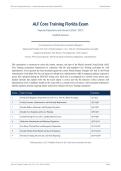
ALF Core Training Florida Exam — Expected Questions and Answers (2026/2027) Verified Answers
ALF Core Training Florida Exam
Expected Questions and Answers ()
Verified Answers
A Comprehensive 150-Question Examination Blueprint
Aligned with Chapter 429, Part I, Florida Statutes | F.A.C. 59A-36 | AHCA Regulatory Oversight
Cognitive Distribution: 35% Recall | 45% Application | 20% Analysis
Format: 70% Scenario-Based | 30% Direct Recall of Statutes, Regulations, and Definitions
This examination is constructed to mirror the content, structure, and rigor of the Florida Assisted Living Facility (ALF)
Core Training examination administered in connection with the state-mandated Core Training curriculum for ALF
administrators. Every question has been developed against the current Florida Statutes (Chapter 429, Part I), the Florida
Administrative Code (Rule 59A-36), and Agency for Health Care Administration (AHCA) regulatory guidance expected to
govern ALF operations during the 2026-2027 testing cycle. Each item is accompanied by a verified correct answer and a
detailed rationale that explains both why the keyed option is correct and why the distractors reflect common ALF
administration errors. Candidates should use this exam both as a content review tool and as a self-assessment instrument to
identify regulatory domains requiring further study before sitting for the Core Training examination.
Section Topic Coverage Questions
1 Florida ALF Regulatory Framework (Ch. 429, F.A.C. 59A-36, AHCA Oversight) Q1–Q22
2 Facility Licensure, Administration, and Ownership Requirements Q23–Q40
3 Resident Rights, Admissions, and Discharge Procedures Q41–Q58
4 Resident Care Standards and Service Planning Q59–Q78
5 Limited Nursing Services, ECC, and Specialized Licenses Q79–Q96
6 Medication Administration and Pharmacy Regulations Q97–Q114
7 Life Safety, Physical Plant, and Emergency Preparedness Q115–Q132
8 Resident Health, Mental Health, and Special Populations Q133–Q142
9 Personnel, Training, Records, QA, and Abuse Reporting Q143–Q150
Total Questions: 150 | Multiple Choice (A–D) | One Correct Answer Per Item
ALF Core Training | Chapter 429, F.S. | F.A.C. 59A-36 | AHCA Page 1
,ALF Core Training Florida Exam — Expected Questions and Answers (2026/2027) Verified Answers
Section 1: Florida ALF Regulatory Framework (Chapter 429, Part I, F.A.C. 59A-36, & AHCA
Oversight)
Q1: Which Florida Statute chapter serves as the primary statutory authority governing the licensure and
operation of Assisted Living Facilities in Florida?
A. Chapter 400, Part II, F.S., which exclusively governs assisted living facilities and adult family care homes.
B. Chapter 429, Part I, F.S., which establishes the regulatory framework for assisted living facilities in
Florida. [CORRECT]
C. Chapter 408, F.S., the Health Facility and Services Development Act, which is the sole authority for ALF licensure.
D. Chapter 394, F.S., the Baker Act, which is the primary authority for ALF operations and resident care.
Correct Answer: B
Rationale: Chapter 429, Part I, Florida Statutes is the primary statutory authority governing assisted living facilities (ALFs)
in Florida. Chapter 400 Part II addresses adult family care homes and certain other community care settings, not ALFs.
Chapter 408 addresses health facility licensure generally but is not the principal ALF statute. Chapter 394 (Baker Act)
addresses involuntary examination and mental health services, not ALF licensure, although it interacts with ALF practice
when residents experience mental health crises.
Q2: Which agency within Florida state government is statutorily designated as the regulatory authority
responsible for licensing, surveying, and enforcing rules governing Assisted Living Facilities?
A. The Department of Elderly Affairs (DOEA), which licenses and surveys all assisted living facilities in Florida.
B. The Department of Children and Families (DCF), which has exclusive jurisdiction over ALF licensing and
enforcement.
C. The Agency for Health Care Administration (AHCA), which licenses, surveys, and enforces regulations for
ALFs under Chapter 429, F.S. [CORRECT]
D. The Agency for Persons with Disabilities (APD), which licenses ALFs that serve residents with developmental
disabilities.
Correct Answer: C
Rationale: AHCA is the statutorily designated regulatory authority for ALF licensure, surveys, and enforcement under
Chapter 429, F.S., and is responsible for implementing Rule 59A-36, F.A.C. DOEA administers aging and community care
programs but does not license ALFs. DCF and APD coordinate with AHCA on specific populations (mental health residents
or residents with developmental disabilities) but do not hold ALF licensing authority.
Q3: An ALF administrator is researching the operational rules that interpret Chapter 429, F.S. Which
Florida Administrative Code rule constitutes the principal administrative rule governing ALF operations?
A. Rule 59A-4, F.A.C., which governs hospice and end-of-life services in residential settings.
B. Rule 59A-36, F.A.C., which contains the administrative rules implementing Chapter 429, F.S. for ALFs.
[CORRECT]
C. Rule 59A-8, F.A.C., which addresses home health agencies and ALF coordination only.
D. Rule 59A-18, F.A.C., which governs nursing home operations and supersedes ALF rules.
Correct Answer: B
Rationale: Rule 59A-36, F.A.C. is the principal administrative rule implementing Chapter 429, F.S. for assisted living
facilities, addressing licensure, administration, resident care, services, and physical plant standards. The other rules listed
govern other provider types (hospice, home health, nursing homes) and do not implement ALF statutory requirements.
ALF Core Training | Chapter 429, F.S. | F.A.C. 59A-36 | AHCA Page 2
,ALF Core Training Florida Exam — Expected Questions and Answers (2026/2027) Verified Answers
Q4: A new administrator asks whether federal CMS regulations primarily govern ALF operations in Florida.
Which response most accurately reflects Florida's regulatory structure for ALFs?
A. ALFs are primarily regulated by CMS under federal regulations at 42 CFR Part 483, and Florida rules are
secondary.
B. ALFs in Florida are regulated principally at the state level by AHCA under Chapter 429, F.S. and Rule
59A-36, F.A.C., because there is no comprehensive federal ALF regulatory framework. [CORRECT]
C. ALFs are jointly regulated by AHCA and CMS under equal authority, with federal regulations controlling in any
conflict.
D. ALFs are regulated exclusively at the county level, and state rules are advisory only.
Correct Answer: B
Rationale: Assisted living facilities are regulated primarily at the state level. There is no comprehensive federal CMS
regulatory framework for ALFs as there is for nursing homes (42 CFR Part 483) or hospitals. Florida's framework,
established under Chapter 429, F.S. and Rule 59A-36, F.A.C., and administered by AHCA, is the controlling regulatory
authority for ALFs in Florida.
Q5: A facility is being constructed that will provide housing, meals, and personal care services to seven elderly
residents who need assistance with activities of daily living. Based on Florida's statutory definition of
"assisted living facility," how should this facility be classified?
A. It is not an ALF because it has fewer than eight residents and is exempt from licensure under all circumstances.
B. It is not an ALF because providing meals disqualifies it from ALF status and requires an adult family care home
license instead.
C. It meets the Chapter 429, F.S. definition of an assisted living facility and must obtain AHCA licensure,
since the statute applies to facilities of any size providing housing, meals, and personal care services.
[CORRECT]
D. It is a home health agency because it provides personal care services to residents in a residential setting.
Correct Answer: C
Rationale: Section 429.01, F.S. defines an assisted living facility to include any facility providing housing, meals, and
personal care services to residents, regardless of size. The Chapter 429 framework applies broadly, and the facility must
obtain AHCA licensure before operation. Adult family care homes are governed by a different statute (Chapter 400, Part II),
and providing meals does not disqualify a facility from ALF status.
Q6: During a regulatory review, an administrator is uncertain which specific statutory provisions address
AHCA's enforcement authority over ALFs. Which statement most accurately reflects the source of AHCA's
enforcement power?
A. AHCA's enforcement authority over ALFs derives exclusively from Rule 59A-36, F.A.C., with no statutory basis.
B. AHCA's enforcement authority derives from Chapter 429, F.S. and Section 408.82, F.S., which authorize
imposition of administrative fines, license revocation, suspension, and other sanctions. [CORRECT]
C. AHCA has only advisory authority and must refer all enforcement actions to the Department of Elderly Affairs.
D. AHCA's enforcement authority is limited to issuing warnings and cannot include fines, moratoriums, or revocation.
Correct Answer: B
Rationale: AHCA's enforcement authority over ALFs is grounded in both Chapter 429, F.S. and Section 408.82, F.S. (the
Health Care Licensing Procedures Act). These statutes authorize AHCA to impose administrative fines, deny/suspend/revoke
licenses, place facilities on a moratorium on admissions, and take other enforcement actions. Rule 59A-36 implements but
does not independently create the underlying statutory authority.
ALF Core Training | Chapter 429, F.S. | F.A.C. 59A-36 | AHCA Page 3
, ALF Core Training Florida Exam — Expected Questions and Answers (2026/2027) Verified Answers
Q7: Which of the following best describes the legal relationship between Chapter 429, F.S. and Rule 59A-36,
F.A.C.?
A. They are independent and a facility may comply with whichever it chooses; conflicts are resolved in favor of the
rule.
B. Rule 59A-36, F.A.C. is the administrative implementation of Chapter 429, F.S.; the rule must be consistent
with the statute, and where the two conflict, the statute controls. [CORRECT]
C. Rule 59A-36 supersedes Chapter 429 when the rule provides more detailed operational guidance.
D. Both are advisory and AHCA may apply either at its discretion without legal constraint.
Correct Answer: B
Rationale: Under Florida administrative law, an administrative rule may not contradict its enabling statute. Rule 59A-36,
F.A.C. implements the statutory authority granted in Chapter 429, F.S. Where the rule and statute conflict, the statute
controls because agencies may exceed only the authority delegated to them by the legislature. Administrators must comply
with both, but the statute is the superior legal authority.
Q8: An ALF administrator is uncertain whether the facility's resident records may be inspected by AHCA
surveyors during an unannounced visit. Which statement most accurately reflects AHCA's access authority?
A. AHCA may access resident records only if the administrator provides written consent at the time of the survey.
B. AHCA surveyors have the authority to enter ALF premises, inspect records, and interview staff and
residents during regular or unannounced surveys, consistent with the facility's license and applicable law.
[CORRECT]
C. AHCA may only inspect records that have been redacted of all resident-identifying information in advance.
D. AHCA's access is limited to common areas and does not extend to resident records under any circumstances.
Correct Answer: B
Rationale: Under Chapter 408.82, F.S. and Chapter 429, F.S., AHCA has the authority to enter ALF premises, inspect
records, interview residents and staff, and otherwise assess compliance during announced or unannounced surveys. This
access is a condition of licensure. Resident-identifying records may be reviewed by AHCA in connection with its regulatory
function, subject to applicable confidentiality protections.
Q9: A complaint is filed with AHCA alleging that an ALF provided inadequate personal care to a resident.
Which statement best describes the administrator's obligations and AHCA's response framework?
A. The administrator has no obligation to respond, and AHCA may investigate only if the resident files a separate
lawsuit first.
B. AHCA must investigate complaints within statutory timeframes, and the facility must cooperate fully with
the investigation, produce requested records, and permit resident and staff interviews. [CORRECT]
C. AHCA may investigate only complaints submitted by attorneys and may not act on complaints from family
members or residents.
D. AHCA investigates only anonymous complaints, and named complainants are automatically disqualified from
participation.
Correct Answer: B
Rationale: AHCA is required to investigate complaints against licensed facilities within timeframes established by law. The
ALF must cooperate, produce requested records, and permit interviews with staff and residents. Complaints may be filed by
residents, family members, staff, ombudsmen, or other concerned parties; anonymity is permitted but not required, and
AHCA's investigative authority is broad.
ALF Core Training | Chapter 429, F.S. | F.A.C. 59A-36 | AHCA Page 4
ALF Core Training Florida Exam
Expected Questions and Answers ()
Verified Answers
A Comprehensive 150-Question Examination Blueprint
Aligned with Chapter 429, Part I, Florida Statutes | F.A.C. 59A-36 | AHCA Regulatory Oversight
Cognitive Distribution: 35% Recall | 45% Application | 20% Analysis
Format: 70% Scenario-Based | 30% Direct Recall of Statutes, Regulations, and Definitions
This examination is constructed to mirror the content, structure, and rigor of the Florida Assisted Living Facility (ALF)
Core Training examination administered in connection with the state-mandated Core Training curriculum for ALF
administrators. Every question has been developed against the current Florida Statutes (Chapter 429, Part I), the Florida
Administrative Code (Rule 59A-36), and Agency for Health Care Administration (AHCA) regulatory guidance expected to
govern ALF operations during the 2026-2027 testing cycle. Each item is accompanied by a verified correct answer and a
detailed rationale that explains both why the keyed option is correct and why the distractors reflect common ALF
administration errors. Candidates should use this exam both as a content review tool and as a self-assessment instrument to
identify regulatory domains requiring further study before sitting for the Core Training examination.
Section Topic Coverage Questions
1 Florida ALF Regulatory Framework (Ch. 429, F.A.C. 59A-36, AHCA Oversight) Q1–Q22
2 Facility Licensure, Administration, and Ownership Requirements Q23–Q40
3 Resident Rights, Admissions, and Discharge Procedures Q41–Q58
4 Resident Care Standards and Service Planning Q59–Q78
5 Limited Nursing Services, ECC, and Specialized Licenses Q79–Q96
6 Medication Administration and Pharmacy Regulations Q97–Q114
7 Life Safety, Physical Plant, and Emergency Preparedness Q115–Q132
8 Resident Health, Mental Health, and Special Populations Q133–Q142
9 Personnel, Training, Records, QA, and Abuse Reporting Q143–Q150
Total Questions: 150 | Multiple Choice (A–D) | One Correct Answer Per Item
ALF Core Training | Chapter 429, F.S. | F.A.C. 59A-36 | AHCA Page 1
,ALF Core Training Florida Exam — Expected Questions and Answers (2026/2027) Verified Answers
Section 1: Florida ALF Regulatory Framework (Chapter 429, Part I, F.A.C. 59A-36, & AHCA
Oversight)
Q1: Which Florida Statute chapter serves as the primary statutory authority governing the licensure and
operation of Assisted Living Facilities in Florida?
A. Chapter 400, Part II, F.S., which exclusively governs assisted living facilities and adult family care homes.
B. Chapter 429, Part I, F.S., which establishes the regulatory framework for assisted living facilities in
Florida. [CORRECT]
C. Chapter 408, F.S., the Health Facility and Services Development Act, which is the sole authority for ALF licensure.
D. Chapter 394, F.S., the Baker Act, which is the primary authority for ALF operations and resident care.
Correct Answer: B
Rationale: Chapter 429, Part I, Florida Statutes is the primary statutory authority governing assisted living facilities (ALFs)
in Florida. Chapter 400 Part II addresses adult family care homes and certain other community care settings, not ALFs.
Chapter 408 addresses health facility licensure generally but is not the principal ALF statute. Chapter 394 (Baker Act)
addresses involuntary examination and mental health services, not ALF licensure, although it interacts with ALF practice
when residents experience mental health crises.
Q2: Which agency within Florida state government is statutorily designated as the regulatory authority
responsible for licensing, surveying, and enforcing rules governing Assisted Living Facilities?
A. The Department of Elderly Affairs (DOEA), which licenses and surveys all assisted living facilities in Florida.
B. The Department of Children and Families (DCF), which has exclusive jurisdiction over ALF licensing and
enforcement.
C. The Agency for Health Care Administration (AHCA), which licenses, surveys, and enforces regulations for
ALFs under Chapter 429, F.S. [CORRECT]
D. The Agency for Persons with Disabilities (APD), which licenses ALFs that serve residents with developmental
disabilities.
Correct Answer: C
Rationale: AHCA is the statutorily designated regulatory authority for ALF licensure, surveys, and enforcement under
Chapter 429, F.S., and is responsible for implementing Rule 59A-36, F.A.C. DOEA administers aging and community care
programs but does not license ALFs. DCF and APD coordinate with AHCA on specific populations (mental health residents
or residents with developmental disabilities) but do not hold ALF licensing authority.
Q3: An ALF administrator is researching the operational rules that interpret Chapter 429, F.S. Which
Florida Administrative Code rule constitutes the principal administrative rule governing ALF operations?
A. Rule 59A-4, F.A.C., which governs hospice and end-of-life services in residential settings.
B. Rule 59A-36, F.A.C., which contains the administrative rules implementing Chapter 429, F.S. for ALFs.
[CORRECT]
C. Rule 59A-8, F.A.C., which addresses home health agencies and ALF coordination only.
D. Rule 59A-18, F.A.C., which governs nursing home operations and supersedes ALF rules.
Correct Answer: B
Rationale: Rule 59A-36, F.A.C. is the principal administrative rule implementing Chapter 429, F.S. for assisted living
facilities, addressing licensure, administration, resident care, services, and physical plant standards. The other rules listed
govern other provider types (hospice, home health, nursing homes) and do not implement ALF statutory requirements.
ALF Core Training | Chapter 429, F.S. | F.A.C. 59A-36 | AHCA Page 2
,ALF Core Training Florida Exam — Expected Questions and Answers (2026/2027) Verified Answers
Q4: A new administrator asks whether federal CMS regulations primarily govern ALF operations in Florida.
Which response most accurately reflects Florida's regulatory structure for ALFs?
A. ALFs are primarily regulated by CMS under federal regulations at 42 CFR Part 483, and Florida rules are
secondary.
B. ALFs in Florida are regulated principally at the state level by AHCA under Chapter 429, F.S. and Rule
59A-36, F.A.C., because there is no comprehensive federal ALF regulatory framework. [CORRECT]
C. ALFs are jointly regulated by AHCA and CMS under equal authority, with federal regulations controlling in any
conflict.
D. ALFs are regulated exclusively at the county level, and state rules are advisory only.
Correct Answer: B
Rationale: Assisted living facilities are regulated primarily at the state level. There is no comprehensive federal CMS
regulatory framework for ALFs as there is for nursing homes (42 CFR Part 483) or hospitals. Florida's framework,
established under Chapter 429, F.S. and Rule 59A-36, F.A.C., and administered by AHCA, is the controlling regulatory
authority for ALFs in Florida.
Q5: A facility is being constructed that will provide housing, meals, and personal care services to seven elderly
residents who need assistance with activities of daily living. Based on Florida's statutory definition of
"assisted living facility," how should this facility be classified?
A. It is not an ALF because it has fewer than eight residents and is exempt from licensure under all circumstances.
B. It is not an ALF because providing meals disqualifies it from ALF status and requires an adult family care home
license instead.
C. It meets the Chapter 429, F.S. definition of an assisted living facility and must obtain AHCA licensure,
since the statute applies to facilities of any size providing housing, meals, and personal care services.
[CORRECT]
D. It is a home health agency because it provides personal care services to residents in a residential setting.
Correct Answer: C
Rationale: Section 429.01, F.S. defines an assisted living facility to include any facility providing housing, meals, and
personal care services to residents, regardless of size. The Chapter 429 framework applies broadly, and the facility must
obtain AHCA licensure before operation. Adult family care homes are governed by a different statute (Chapter 400, Part II),
and providing meals does not disqualify a facility from ALF status.
Q6: During a regulatory review, an administrator is uncertain which specific statutory provisions address
AHCA's enforcement authority over ALFs. Which statement most accurately reflects the source of AHCA's
enforcement power?
A. AHCA's enforcement authority over ALFs derives exclusively from Rule 59A-36, F.A.C., with no statutory basis.
B. AHCA's enforcement authority derives from Chapter 429, F.S. and Section 408.82, F.S., which authorize
imposition of administrative fines, license revocation, suspension, and other sanctions. [CORRECT]
C. AHCA has only advisory authority and must refer all enforcement actions to the Department of Elderly Affairs.
D. AHCA's enforcement authority is limited to issuing warnings and cannot include fines, moratoriums, or revocation.
Correct Answer: B
Rationale: AHCA's enforcement authority over ALFs is grounded in both Chapter 429, F.S. and Section 408.82, F.S. (the
Health Care Licensing Procedures Act). These statutes authorize AHCA to impose administrative fines, deny/suspend/revoke
licenses, place facilities on a moratorium on admissions, and take other enforcement actions. Rule 59A-36 implements but
does not independently create the underlying statutory authority.
ALF Core Training | Chapter 429, F.S. | F.A.C. 59A-36 | AHCA Page 3
, ALF Core Training Florida Exam — Expected Questions and Answers (2026/2027) Verified Answers
Q7: Which of the following best describes the legal relationship between Chapter 429, F.S. and Rule 59A-36,
F.A.C.?
A. They are independent and a facility may comply with whichever it chooses; conflicts are resolved in favor of the
rule.
B. Rule 59A-36, F.A.C. is the administrative implementation of Chapter 429, F.S.; the rule must be consistent
with the statute, and where the two conflict, the statute controls. [CORRECT]
C. Rule 59A-36 supersedes Chapter 429 when the rule provides more detailed operational guidance.
D. Both are advisory and AHCA may apply either at its discretion without legal constraint.
Correct Answer: B
Rationale: Under Florida administrative law, an administrative rule may not contradict its enabling statute. Rule 59A-36,
F.A.C. implements the statutory authority granted in Chapter 429, F.S. Where the rule and statute conflict, the statute
controls because agencies may exceed only the authority delegated to them by the legislature. Administrators must comply
with both, but the statute is the superior legal authority.
Q8: An ALF administrator is uncertain whether the facility's resident records may be inspected by AHCA
surveyors during an unannounced visit. Which statement most accurately reflects AHCA's access authority?
A. AHCA may access resident records only if the administrator provides written consent at the time of the survey.
B. AHCA surveyors have the authority to enter ALF premises, inspect records, and interview staff and
residents during regular or unannounced surveys, consistent with the facility's license and applicable law.
[CORRECT]
C. AHCA may only inspect records that have been redacted of all resident-identifying information in advance.
D. AHCA's access is limited to common areas and does not extend to resident records under any circumstances.
Correct Answer: B
Rationale: Under Chapter 408.82, F.S. and Chapter 429, F.S., AHCA has the authority to enter ALF premises, inspect
records, interview residents and staff, and otherwise assess compliance during announced or unannounced surveys. This
access is a condition of licensure. Resident-identifying records may be reviewed by AHCA in connection with its regulatory
function, subject to applicable confidentiality protections.
Q9: A complaint is filed with AHCA alleging that an ALF provided inadequate personal care to a resident.
Which statement best describes the administrator's obligations and AHCA's response framework?
A. The administrator has no obligation to respond, and AHCA may investigate only if the resident files a separate
lawsuit first.
B. AHCA must investigate complaints within statutory timeframes, and the facility must cooperate fully with
the investigation, produce requested records, and permit resident and staff interviews. [CORRECT]
C. AHCA may investigate only complaints submitted by attorneys and may not act on complaints from family
members or residents.
D. AHCA investigates only anonymous complaints, and named complainants are automatically disqualified from
participation.
Correct Answer: B
Rationale: AHCA is required to investigate complaints against licensed facilities within timeframes established by law. The
ALF must cooperate, produce requested records, and permit interviews with staff and residents. Complaints may be filed by
residents, family members, staff, ombudsmen, or other concerned parties; anonymity is permitted but not required, and
AHCA's investigative authority is broad.
ALF Core Training | Chapter 429, F.S. | F.A.C. 59A-36 | AHCA Page 4


