
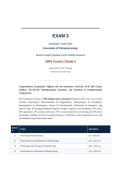
EXAM 3
NUR2063 / NUR 2063
Essentials of Pathophysiology
Review Guide Questions and Verified Answers
100% Correct | Grade A
Latest Update
Rasmussen University
Comprehensive Examination Aligned with the Rasmussen University NUR 2063 Course
Syllabus, NCLEX-RN Pathophysiology Standards, and Essentials of Pathophysiology
Competencies.
This examination consists of 100 multiple-choice questions distributed across seven core sections
covering Neurological, Musculoskeletal & Integumentary, Hematological & Oncological,
Immunological & Inflammatory, Genetic & Developmental, Multisystem & Integrative, and
Special Topics & Emerging Pathophysiological Concepts. Cognitive level distribution: 20% recall,
50% application, 30% analysis. Item style: 75% scenario-based clinical reasoning and 25% direct
knowledge, including 15 clinical reasoning scenarios, 10 laboratory value interpretation items, and
10 pathophysiological mechanism items.
Sectio
Topic Questions
n
1 Neurological Pathophysiology Q1 - Q20 (20)
2 Musculoskeletal & Integumentary Pathophysiology Q21 - Q35 (15)
3 Hematological & Oncological Pathophysiology Q36 - Q50 (15)
4 Immunological & Inflammatory Pathophysiology Q51 - Q65 (15)
,NUR 2063 Essentials of Pathophysiology - Exam 3 2026/2027 Edition | Grade A Review
5 Genetic & Developmental Pathophysiology Q66 - Q75 (10)
6 Multisystem & Integrative Pathophysiology Q76 - Q90 (15)
7 Special Topics & Emerging Pathophysiological Concepts Q91 - Q100 (10)
Rasmussen University | NCLEX-RN Pathophysiology Standards Page 2
,NUR 2063 Essentials of Pathophysiology - Exam 3 2026/2027 Edition | Grade A Review
Examination Instructions
1. Format: This examination contains 100 multiple-choice questions. Each question has four answer choices (A,
B, C, D) with exactly one correct response.
2. Answer Key: The correct answer is marked with *[CORRECT]* in the option list, followed by an explicit
'Correct Answer' line, and a detailed rationale.
3. Rationale: Each rationale explains why the correct answer is right and why the distractors are wrong, with
reference to NUR 2063 curriculum, NCLEX-RN standards, and pathophysiology principles.
4. Cognitive Levels: Questions are distributed across recall (20%), application (50%), and analysis (30%)
cognitive levels to mirror NCLEX-RN examination standards.
5. Item Style: Approximately 75% of items are scenario-based (patient presentations, clinical situations, case
studies); 25% are direct knowledge items.
6. Special Inclusions: 15 scenario-based clinical reasoning questions, 10 laboratory value interpretation and
diagnostic findings questions, and 10 pathophysiological mechanism questions are integrated throughout the exam.
7. Section Structure: The exam is divided into seven sections as listed on the cover. Questions are sequential
from Q1 to Q100 with no breaks or interruptions.
8. Studying with this Guide: Read each question carefully, identify the key pathophysiological concept being
tested, eliminate clearly incorrect distractors, and verify your selection against the rationale provided.
Disclaimer: This review guide is an educational study aid aligned with the Rasmussen University NUR 2063 Essentials of
Pathophysiology course syllabus. It is not affiliated with, endorsed by, or sponsored by Rasmussen University or the NCLEX-RN
examination. Always consult current course materials and clinical guidelines for authoritative information.
Rasmussen University | NCLEX-RN Pathophysiology Standards Page 3
, NUR 2063 Essentials of Pathophysiology - Exam 3 2026/2027 Edition | Grade A Review
Section 1: Neurological Pathophysiology
Questions 1 - 20 (20 questions)
Q1: A 68-year-old male presents with sudden right-sided hemiparesis, expressive aphasia, and
facial droop that began 90 minutes ago. CT scan shows no hemorrhage. Which pathophysiological
process is most likely occurring?
A. Occlusion of the right middle cerebral artery causing ischemic infarction
B. Occlusion of the left middle cerebral artery causing ischemic infarction *[CORRECT]*
C. Rupture of the right anterior communicating artery causing hemorrhagic stroke
D. Vasospasm of the basilar artery causing brainstem ischemia
Correct Answer: B
Rationale: Expressive aphasia (Broca's area) and right-sided hemiparesis localize to the LEFT hemisphere, and the middle
cerebral artery is the most common site of ischemic stroke. The CT without hemorrhage confirms ischemic
pathophysiology. Option A is wrong because right MCA occlusion would cause LEFT-sided deficits. Option C is incorrect
because hemorrhage would be visible on CT. Option D would produce brainstem signs such as vertigo and cranial nerve
palsies rather than hemiparesis with aphasia.
Q2: A 72-year-old female with atrial fibrillation develops acute left-sided weakness lasting 25
minutes that completely resolves. CT is negative. Which statement best describes the
pathophysiology and clinical significance of this event?
A. Cerebral vasospasm with no increased risk for future stroke
B. Cardioembolic transient ischemic attack with high short-term stroke risk requiring urgent evaluation
*[CORRECT]*
C. Hemorrhagic stroke in evolution requiring immediate thrombolytics
D. Postictal Todd's paralysis confirmed by EEG findings
Correct Answer: B
Rationale: Atrial fibrillation causes stasis of blood in the left atrium leading to thrombus formation; emboli then lodge in
cerebral vessels producing transient ischemia. A TIA is defined by symptom resolution within 24 hours (typically <1 hour)
and represents a warning sign with up to 10-15% risk of stroke within 90 days. Option A is wrong because AF is
thromboembolic, not vasospastic. Option C is incorrect because thrombolytics would be contraindicated in hemorrhage.
Option D requires seizure history and EEG confirmation.
Q3: A 55-year-old male with a 20-year history of hypertension suddenly develops the 'worst
headache of his life,' vomiting, and decreased level of consciousness. Which pathophysiological
mechanism is most likely responsible?
A. Atherosclerotic plaque rupture in the internal carotid artery
B. Rupture of a saccular (berry) aneurysm at the circle of Willis causing subarachnoid hemorrhage
*[CORRECT]*
C. Lacunar infarct from lipohyalinosis of small penetrating arteries
D. Cerebral venous sinus thrombosis secondary to dehydration
Rasmussen University | NCLEX-RN Pathophysiology Standards Page 4
NUR2063 / NUR 2063
Essentials of Pathophysiology
Review Guide Questions and Verified Answers
100% Correct | Grade A
Latest Update
Rasmussen University
Comprehensive Examination Aligned with the Rasmussen University NUR 2063 Course
Syllabus, NCLEX-RN Pathophysiology Standards, and Essentials of Pathophysiology
Competencies.
This examination consists of 100 multiple-choice questions distributed across seven core sections
covering Neurological, Musculoskeletal & Integumentary, Hematological & Oncological,
Immunological & Inflammatory, Genetic & Developmental, Multisystem & Integrative, and
Special Topics & Emerging Pathophysiological Concepts. Cognitive level distribution: 20% recall,
50% application, 30% analysis. Item style: 75% scenario-based clinical reasoning and 25% direct
knowledge, including 15 clinical reasoning scenarios, 10 laboratory value interpretation items, and
10 pathophysiological mechanism items.
Sectio
Topic Questions
n
1 Neurological Pathophysiology Q1 - Q20 (20)
2 Musculoskeletal & Integumentary Pathophysiology Q21 - Q35 (15)
3 Hematological & Oncological Pathophysiology Q36 - Q50 (15)
4 Immunological & Inflammatory Pathophysiology Q51 - Q65 (15)
,NUR 2063 Essentials of Pathophysiology - Exam 3 2026/2027 Edition | Grade A Review
5 Genetic & Developmental Pathophysiology Q66 - Q75 (10)
6 Multisystem & Integrative Pathophysiology Q76 - Q90 (15)
7 Special Topics & Emerging Pathophysiological Concepts Q91 - Q100 (10)
Rasmussen University | NCLEX-RN Pathophysiology Standards Page 2
,NUR 2063 Essentials of Pathophysiology - Exam 3 2026/2027 Edition | Grade A Review
Examination Instructions
1. Format: This examination contains 100 multiple-choice questions. Each question has four answer choices (A,
B, C, D) with exactly one correct response.
2. Answer Key: The correct answer is marked with *[CORRECT]* in the option list, followed by an explicit
'Correct Answer' line, and a detailed rationale.
3. Rationale: Each rationale explains why the correct answer is right and why the distractors are wrong, with
reference to NUR 2063 curriculum, NCLEX-RN standards, and pathophysiology principles.
4. Cognitive Levels: Questions are distributed across recall (20%), application (50%), and analysis (30%)
cognitive levels to mirror NCLEX-RN examination standards.
5. Item Style: Approximately 75% of items are scenario-based (patient presentations, clinical situations, case
studies); 25% are direct knowledge items.
6. Special Inclusions: 15 scenario-based clinical reasoning questions, 10 laboratory value interpretation and
diagnostic findings questions, and 10 pathophysiological mechanism questions are integrated throughout the exam.
7. Section Structure: The exam is divided into seven sections as listed on the cover. Questions are sequential
from Q1 to Q100 with no breaks or interruptions.
8. Studying with this Guide: Read each question carefully, identify the key pathophysiological concept being
tested, eliminate clearly incorrect distractors, and verify your selection against the rationale provided.
Disclaimer: This review guide is an educational study aid aligned with the Rasmussen University NUR 2063 Essentials of
Pathophysiology course syllabus. It is not affiliated with, endorsed by, or sponsored by Rasmussen University or the NCLEX-RN
examination. Always consult current course materials and clinical guidelines for authoritative information.
Rasmussen University | NCLEX-RN Pathophysiology Standards Page 3
, NUR 2063 Essentials of Pathophysiology - Exam 3 2026/2027 Edition | Grade A Review
Section 1: Neurological Pathophysiology
Questions 1 - 20 (20 questions)
Q1: A 68-year-old male presents with sudden right-sided hemiparesis, expressive aphasia, and
facial droop that began 90 minutes ago. CT scan shows no hemorrhage. Which pathophysiological
process is most likely occurring?
A. Occlusion of the right middle cerebral artery causing ischemic infarction
B. Occlusion of the left middle cerebral artery causing ischemic infarction *[CORRECT]*
C. Rupture of the right anterior communicating artery causing hemorrhagic stroke
D. Vasospasm of the basilar artery causing brainstem ischemia
Correct Answer: B
Rationale: Expressive aphasia (Broca's area) and right-sided hemiparesis localize to the LEFT hemisphere, and the middle
cerebral artery is the most common site of ischemic stroke. The CT without hemorrhage confirms ischemic
pathophysiology. Option A is wrong because right MCA occlusion would cause LEFT-sided deficits. Option C is incorrect
because hemorrhage would be visible on CT. Option D would produce brainstem signs such as vertigo and cranial nerve
palsies rather than hemiparesis with aphasia.
Q2: A 72-year-old female with atrial fibrillation develops acute left-sided weakness lasting 25
minutes that completely resolves. CT is negative. Which statement best describes the
pathophysiology and clinical significance of this event?
A. Cerebral vasospasm with no increased risk for future stroke
B. Cardioembolic transient ischemic attack with high short-term stroke risk requiring urgent evaluation
*[CORRECT]*
C. Hemorrhagic stroke in evolution requiring immediate thrombolytics
D. Postictal Todd's paralysis confirmed by EEG findings
Correct Answer: B
Rationale: Atrial fibrillation causes stasis of blood in the left atrium leading to thrombus formation; emboli then lodge in
cerebral vessels producing transient ischemia. A TIA is defined by symptom resolution within 24 hours (typically <1 hour)
and represents a warning sign with up to 10-15% risk of stroke within 90 days. Option A is wrong because AF is
thromboembolic, not vasospastic. Option C is incorrect because thrombolytics would be contraindicated in hemorrhage.
Option D requires seizure history and EEG confirmation.
Q3: A 55-year-old male with a 20-year history of hypertension suddenly develops the 'worst
headache of his life,' vomiting, and decreased level of consciousness. Which pathophysiological
mechanism is most likely responsible?
A. Atherosclerotic plaque rupture in the internal carotid artery
B. Rupture of a saccular (berry) aneurysm at the circle of Willis causing subarachnoid hemorrhage
*[CORRECT]*
C. Lacunar infarct from lipohyalinosis of small penetrating arteries
D. Cerebral venous sinus thrombosis secondary to dehydration
Rasmussen University | NCLEX-RN Pathophysiology Standards Page 4


