
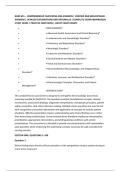
NURS 651 – COMPREHENSIVE QUESTIONS AND ANSWERS | VERIFIED AND WELLDETAILED
ANSWERS | DETAILED EXPLANATIONS AND RATIONALES | COMPLETE EXAM PREPARATION
STUDY GUIDE | PRACTICE QUESTIONS | LATEST EXAM UPDATE
• CORE DOMAINS*
• • Advanced Health Assessment and Clinical Reasoning*
• • Cardiovascular and Hematologic Disorders*
• • Pulmonary and Respiratory Disorders*
• • Neurologic Disorders*
• • Endocrine and Metabolic Disorders*
• • Gastrointestinal and Hepatic Disorders*
• • Renal and Genitourinary Disorders*
• • Musculoskeletal, Rheumatologic, and Integumentary
Disorders*
• • Infectious, Immune, and Multisystem Disorders*
• • Pharmacologic Principles, Prevention, and Patient
Management*
• INTRODUCTION*
This comprehensive assessment is designed to strengthen the knowledge and clinical
reasoning needed for NURS 651. The questions evaluate foundational concepts, disease
mechanisms, assessment findings, diagnostic interpretation, therapeutic principles, patient
safety, prevention, and clinical decision-making. Multiple-choice questions are used to test
both recognition of essential information and application of concepts to realistic patient
situations. Effective preparation requires understanding why clinical findings occur rather
than memorizing isolated facts. Scenario-based items therefore emphasize interpretation,
prioritization, appropriate interventions, and distinguishing conditions with similar
presentations. The assessment is intended to provide structured practice with examination-
style questions while reinforcing the underlying concepts necessary for safe and informed
nursing practice.
SECTION ONE: QUESTIONS 1–100
Question 1.
Which finding most directly reflects activation of the sympathetic nervous system during an
acute stress response?
,A. Decreased heart rate
B. Increased heart rate
C. Increased gastrointestinal motility
D. Increased insulin secretion
Correct Answer: B. Increased heart rate
Explanation: Sympathetic activation produces the classic “fight-or-flight” response, including
increased heart rate, contractility, bronchodilation, and redistribution of blood flow toward
skeletal muscle. Parasympathetic functions such as gastrointestinal activity are generally
reduced.
Question 2.
Which assessment finding is most characteristic of left-sided heart failure?
A. Jugular venous distention
B. Dependent peripheral edema
C. Pulmonary crackles
D. Hepatomegaly
Correct Answer: C. Pulmonary crackles
Explanation: Left ventricular failure causes blood to back up into the pulmonary circulation,
increasing pulmonary capillary pressure and promoting pulmonary edema. Crackles,
dyspnea, orthopnea, and reduced oxygenation are common consequences. Right-sided
failure more directly produces systemic venous congestion.
Question 3.
A patient with chronic obstructive pulmonary disease has prolonged expiration and
diminished breath sounds. Which mechanism best explains these findings?
A. Increased airway resistance
B. Increased pulmonary compliance caused by fibrosis
C. Reduced residual volume
D. Increased alveolar surface area
Correct Answer: A. Increased airway resistance
Explanation: COPD involves persistent airflow limitation. Bronchoconstriction, mucus
production, airway inflammation, and loss of elastic recoil can increase airway resistance,
particularly during expiration, making exhalation prolonged and difficult.
Question 4.
Which laboratory finding is most consistent with iron-deficiency anemia?
,A. Increased ferritin
B. Increased mean corpuscular volume
C. Decreased serum iron
D. Increased vitamin B12
Correct Answer: C. Decreased serum iron
Explanation: Iron deficiency typically produces low serum iron, low ferritin, increased total
iron-binding capacity, and microcytic, hypochromic red blood cells. Ferritin reflects iron
stores and is generally reduced in uncomplicated iron deficiency.
Question 5.
Which physiologic change is expected when arterial carbon dioxide levels increase?
A. Increased blood pH
B. Respiratory alkalosis
C. Decreased hydrogen ion concentration
D. Respiratory acidosis
Correct Answer: D. Respiratory acidosis
Explanation: Carbon dioxide combines with water to form carbonic acid, which dissociates
into hydrogen ions and bicarbonate. Increased PaCO₂ therefore increases acidity and lowers
blood pH, producing respiratory acidosis.
Question 6.
A patient develops facial swelling, hypotension, wheezing, and difficulty breathing
immediately after receiving a medication. Which process is most likely responsible?
A. Type I hypersensitivity reaction
B. Type II hypersensitivity reaction
C. Type III hypersensitivity reaction
D. Type IV hypersensitivity reaction
Correct Answer: A. Type I hypersensitivity reaction
Explanation: Type I hypersensitivity is an immediate, IgE-mediated reaction involving mast-
cell degranulation. Histamine and other mediators can cause vasodilation, increased vascular
permeability, bronchoconstriction, urticaria, and potentially anaphylactic shock.
Question 7.
Which finding is most characteristic of nephrotic syndrome?
A. Severe hematuria as the defining feature
B. Massive proteinuria and hypoalbuminemia
, C. Increased serum albumin
D. Reduced urinary protein excretion
Correct Answer: B. Massive proteinuria and hypoalbuminemia
Explanation: Nephrotic syndrome results from increased glomerular permeability to
proteins, producing significant proteinuria. Loss of albumin lowers plasma oncotic pressure
and contributes to generalized edema.
Question 8.
Which hormone is primarily responsible for increasing blood glucose during fasting?
A. Insulin
B. Calcitonin
C. Glucagon
D. Aldosterone
Correct Answer: C. Glucagon
Explanation: Glucagon is secreted by pancreatic alpha cells when blood glucose falls. It
promotes hepatic glycogenolysis and gluconeogenesis, thereby increasing circulating
glucose. Insulin has the opposing effect.
Question 9.
A patient has sudden unilateral weakness, facial drooping, and difficulty speaking. What is
the priority clinical consideration?
A. Migraine without aura
B. Acute ischemic stroke
C. Peripheral neuropathy
D. Tension headache
Correct Answer: B. Acute ischemic stroke
Explanation: Sudden focal neurologic deficits are classic warning signs of stroke. Rapid
recognition and evaluation are essential because time-sensitive therapies may be
appropriate for eligible patients.
Question 10.
Which mechanism primarily causes edema in a patient with severe hypoalbuminemia?
A. Increased plasma oncotic pressure
B. Decreased capillary hydrostatic pressure
C. Decreased plasma oncotic pressure
D. Increased intracellular osmotic pressure
ANSWERS | DETAILED EXPLANATIONS AND RATIONALES | COMPLETE EXAM PREPARATION
STUDY GUIDE | PRACTICE QUESTIONS | LATEST EXAM UPDATE
• CORE DOMAINS*
• • Advanced Health Assessment and Clinical Reasoning*
• • Cardiovascular and Hematologic Disorders*
• • Pulmonary and Respiratory Disorders*
• • Neurologic Disorders*
• • Endocrine and Metabolic Disorders*
• • Gastrointestinal and Hepatic Disorders*
• • Renal and Genitourinary Disorders*
• • Musculoskeletal, Rheumatologic, and Integumentary
Disorders*
• • Infectious, Immune, and Multisystem Disorders*
• • Pharmacologic Principles, Prevention, and Patient
Management*
• INTRODUCTION*
This comprehensive assessment is designed to strengthen the knowledge and clinical
reasoning needed for NURS 651. The questions evaluate foundational concepts, disease
mechanisms, assessment findings, diagnostic interpretation, therapeutic principles, patient
safety, prevention, and clinical decision-making. Multiple-choice questions are used to test
both recognition of essential information and application of concepts to realistic patient
situations. Effective preparation requires understanding why clinical findings occur rather
than memorizing isolated facts. Scenario-based items therefore emphasize interpretation,
prioritization, appropriate interventions, and distinguishing conditions with similar
presentations. The assessment is intended to provide structured practice with examination-
style questions while reinforcing the underlying concepts necessary for safe and informed
nursing practice.
SECTION ONE: QUESTIONS 1–100
Question 1.
Which finding most directly reflects activation of the sympathetic nervous system during an
acute stress response?
,A. Decreased heart rate
B. Increased heart rate
C. Increased gastrointestinal motility
D. Increased insulin secretion
Correct Answer: B. Increased heart rate
Explanation: Sympathetic activation produces the classic “fight-or-flight” response, including
increased heart rate, contractility, bronchodilation, and redistribution of blood flow toward
skeletal muscle. Parasympathetic functions such as gastrointestinal activity are generally
reduced.
Question 2.
Which assessment finding is most characteristic of left-sided heart failure?
A. Jugular venous distention
B. Dependent peripheral edema
C. Pulmonary crackles
D. Hepatomegaly
Correct Answer: C. Pulmonary crackles
Explanation: Left ventricular failure causes blood to back up into the pulmonary circulation,
increasing pulmonary capillary pressure and promoting pulmonary edema. Crackles,
dyspnea, orthopnea, and reduced oxygenation are common consequences. Right-sided
failure more directly produces systemic venous congestion.
Question 3.
A patient with chronic obstructive pulmonary disease has prolonged expiration and
diminished breath sounds. Which mechanism best explains these findings?
A. Increased airway resistance
B. Increased pulmonary compliance caused by fibrosis
C. Reduced residual volume
D. Increased alveolar surface area
Correct Answer: A. Increased airway resistance
Explanation: COPD involves persistent airflow limitation. Bronchoconstriction, mucus
production, airway inflammation, and loss of elastic recoil can increase airway resistance,
particularly during expiration, making exhalation prolonged and difficult.
Question 4.
Which laboratory finding is most consistent with iron-deficiency anemia?
,A. Increased ferritin
B. Increased mean corpuscular volume
C. Decreased serum iron
D. Increased vitamin B12
Correct Answer: C. Decreased serum iron
Explanation: Iron deficiency typically produces low serum iron, low ferritin, increased total
iron-binding capacity, and microcytic, hypochromic red blood cells. Ferritin reflects iron
stores and is generally reduced in uncomplicated iron deficiency.
Question 5.
Which physiologic change is expected when arterial carbon dioxide levels increase?
A. Increased blood pH
B. Respiratory alkalosis
C. Decreased hydrogen ion concentration
D. Respiratory acidosis
Correct Answer: D. Respiratory acidosis
Explanation: Carbon dioxide combines with water to form carbonic acid, which dissociates
into hydrogen ions and bicarbonate. Increased PaCO₂ therefore increases acidity and lowers
blood pH, producing respiratory acidosis.
Question 6.
A patient develops facial swelling, hypotension, wheezing, and difficulty breathing
immediately after receiving a medication. Which process is most likely responsible?
A. Type I hypersensitivity reaction
B. Type II hypersensitivity reaction
C. Type III hypersensitivity reaction
D. Type IV hypersensitivity reaction
Correct Answer: A. Type I hypersensitivity reaction
Explanation: Type I hypersensitivity is an immediate, IgE-mediated reaction involving mast-
cell degranulation. Histamine and other mediators can cause vasodilation, increased vascular
permeability, bronchoconstriction, urticaria, and potentially anaphylactic shock.
Question 7.
Which finding is most characteristic of nephrotic syndrome?
A. Severe hematuria as the defining feature
B. Massive proteinuria and hypoalbuminemia
, C. Increased serum albumin
D. Reduced urinary protein excretion
Correct Answer: B. Massive proteinuria and hypoalbuminemia
Explanation: Nephrotic syndrome results from increased glomerular permeability to
proteins, producing significant proteinuria. Loss of albumin lowers plasma oncotic pressure
and contributes to generalized edema.
Question 8.
Which hormone is primarily responsible for increasing blood glucose during fasting?
A. Insulin
B. Calcitonin
C. Glucagon
D. Aldosterone
Correct Answer: C. Glucagon
Explanation: Glucagon is secreted by pancreatic alpha cells when blood glucose falls. It
promotes hepatic glycogenolysis and gluconeogenesis, thereby increasing circulating
glucose. Insulin has the opposing effect.
Question 9.
A patient has sudden unilateral weakness, facial drooping, and difficulty speaking. What is
the priority clinical consideration?
A. Migraine without aura
B. Acute ischemic stroke
C. Peripheral neuropathy
D. Tension headache
Correct Answer: B. Acute ischemic stroke
Explanation: Sudden focal neurologic deficits are classic warning signs of stroke. Rapid
recognition and evaluation are essential because time-sensitive therapies may be
appropriate for eligible patients.
Question 10.
Which mechanism primarily causes edema in a patient with severe hypoalbuminemia?
A. Increased plasma oncotic pressure
B. Decreased capillary hydrostatic pressure
C. Decreased plasma oncotic pressure
D. Increased intracellular osmotic pressure


