
Exam 1 medsurg Galen 2026/2027 (Answered)
Exam 1 medsurg Galen
Study online at https://quizlet.com/_8uqjco
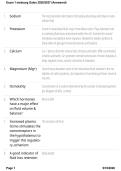
1. Sodium The most abundant electrolyte in the body and primary electrolyte in extra-
cellular fluid
2. Potassium Found in intracellular fluid, major intracellular cation. Plays important role
in maintaing fluid osmo and volume within the cell. Essential for normal
membrane excitability & nerve impulses. Needed for protein synthesis &
break down of glycogen & maintain plasma acid balance.
3. Calcium Ca+ / phos to form the mineral salts of bones and teeth. 99% concentrated
in bones and teeth. Ca+ promotes normal transmission of nerve impulses &
helps regulate norms, muscle contraction & relaxation.
4. Magnesium (Mg+) Second most abundant cation in the intracellular fluid; involved in the me-
tabolism of carbs & proteins, also important in functioning of heart, nerves &
muscles.
5. Osmolality Concentration of a solution determined by the number of dissolved particles
per kilogram of wTer; controls
6. Which hormones Renin & ADH
have a major effect
on fluid volume &
balance?
7. Increased plasma The sensation of thirst.
Osmo stimulates the
osmoreceptors in
the hypothalamus to
trigger this regulato-
ry ,echanism
8. A good indicator of Body weight.
fluid loss retention
1/5
Page 1 9/18/2026
, Exam 1 medsurg Galen 2026/2027 (Answered)
Exam 1 medsurg Galen
Study online at https://quizlet.com/_8uqjco
9. Condition in the pa- Vomiting, diarrhea, kidney disease, diabetes, salicylate poisoning, congestive
tient's health history heart failure, cerebral injuries, ulcerative colitis and hormonal imbalance.
that might put pa-
tient at risk for flu-
id and electrolyte im-
balance
10. Characteristics of pH, specific gravity, osmolality, creatinine clearance, urinalysis sodium and
urine that we ob- urine potassium.
serve include...
11. Skin characteristics Color, moisture, turgor, puffy or sunken eyes and edema.
that we look for in
our pt
12. H2O & sodium reten-
tion in the tissues; re-
sults from excessive
reabsorbtion or inad-
equate secretion of
Na.
13. Typical care for a pt Weight & I.O. monitoring.
with edema includes
what?
14. Used to detect
glomerular damage
in the kidneys
15. Used to measure re-
nal tubular function
2/5
Page 2 9/18/2026
Exam 1 medsurg Galen
Study online at https://quizlet.com/_8uqjco
1. Sodium The most abundant electrolyte in the body and primary electrolyte in extra-
cellular fluid
2. Potassium Found in intracellular fluid, major intracellular cation. Plays important role
in maintaing fluid osmo and volume within the cell. Essential for normal
membrane excitability & nerve impulses. Needed for protein synthesis &
break down of glycogen & maintain plasma acid balance.
3. Calcium Ca+ / phos to form the mineral salts of bones and teeth. 99% concentrated
in bones and teeth. Ca+ promotes normal transmission of nerve impulses &
helps regulate norms, muscle contraction & relaxation.
4. Magnesium (Mg+) Second most abundant cation in the intracellular fluid; involved in the me-
tabolism of carbs & proteins, also important in functioning of heart, nerves &
muscles.
5. Osmolality Concentration of a solution determined by the number of dissolved particles
per kilogram of wTer; controls
6. Which hormones Renin & ADH
have a major effect
on fluid volume &
balance?
7. Increased plasma The sensation of thirst.
Osmo stimulates the
osmoreceptors in
the hypothalamus to
trigger this regulato-
ry ,echanism
8. A good indicator of Body weight.
fluid loss retention
1/5
Page 1 9/18/2026
, Exam 1 medsurg Galen 2026/2027 (Answered)
Exam 1 medsurg Galen
Study online at https://quizlet.com/_8uqjco
9. Condition in the pa- Vomiting, diarrhea, kidney disease, diabetes, salicylate poisoning, congestive
tient's health history heart failure, cerebral injuries, ulcerative colitis and hormonal imbalance.
that might put pa-
tient at risk for flu-
id and electrolyte im-
balance
10. Characteristics of pH, specific gravity, osmolality, creatinine clearance, urinalysis sodium and
urine that we ob- urine potassium.
serve include...
11. Skin characteristics Color, moisture, turgor, puffy or sunken eyes and edema.
that we look for in
our pt
12. H2O & sodium reten-
tion in the tissues; re-
sults from excessive
reabsorbtion or inad-
equate secretion of
Na.
13. Typical care for a pt Weight & I.O. monitoring.
with edema includes
what?
14. Used to detect
glomerular damage
in the kidneys
15. Used to measure re-
nal tubular function
2/5
Page 2 9/18/2026


