
NSG 550 Exam 3 - Diagnostic Reasoning for Nurse Practitioners Wilkes University | 2026/2027 Edition
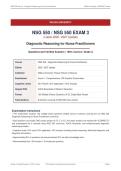
WILKES UNIVERSITY
NSG 550 / NSG 550 EXAM 3
(Latest Update)
Diagnostic Reasoning for Nurse Practitioners
Questions and Verified Answers | 100% Correct | Grade A
Course NSG 550 - Diagnostic Reasoning for Nurse Practitioners
Edition Update
Institution Wilkes University, Passan School of Nursing
Examination Exam 3 - Comprehensive 100-Question Examination
Cognitive Levels 20% Recall | 50% Application | 30% Analysis
Aligned With AACN Essentials of Master's Education
Format 100 Multiple Choice Questions (A-D), Single Best Answer
Total Sections 8 Sections covering all NSG 550 core content
Examination Instructions
• This examination contains 100 multiple-choice questions divided across 8 sections covering the full NSG 550
Diagnostic Reasoning for Nurse Practitioners curriculum.
• Each question has exactly ONE correct answer (A, B, C, or D). All correct answers are marked with *[CORRECT]*
and accompanied by a rationale citing NSG 550 curriculum, AACN Essentials, and evidence-based diagnostic
reasoning principles.
• Cognitive levels: 20% recall, 50% application, 30% analysis (including clinical reasoning, differential diagnosis, and
diagnostic formulation).
• Approximately 80% of questions are scenario-based; 20% are direct knowledge items.
• Recommended time: 150 minutes (1.5 minutes per question).
Grade A Verified Answers | 100% Correct 100-Question Comprehensive Examination Page 1
,NSG 550 Exam 3 - Diagnostic Reasoning for Nurse Practitioners Wilkes University | 2026/2027 Edition
Section 1: Foundations of Diagnostic Reasoning
Q1: A 52-year-old male presents with substernal chest pressure radiating to the left arm. The NP
immediately considers acute coronary syndrome (ACS) before fully completing the history. Which
reasoning process BEST describes this initial diagnostic step?
A. Pure analytic reasoning using Bayesian probability
B. Hypothetico-deductive reasoning generating early hypotheses *[CORRECT]*
C. Algorithmic reasoning following a rigid clinical pathway
D. Retrospective reasoning based on outcome feedback
Correct Answer: B
Rationale: Hypothetico-deductive reasoning, a core NSG 550 concept, generates early hypotheses from
presenting cues and then tests them through targeted data collection. The NP's early consideration of ACS reflects
hypothesis generation that will be confirmed or refuted by subsequent ECG, troponins, and history (OLDCARTS).
Pure Bayesian reasoning (A) requires formal probability calculation, algorithmic reasoning (C) lacks flexibility for
complex presentations, and retrospective reasoning (D) occurs after the encounter ends.
Q2: An experienced NP assesses a patient with classic unilateral throbbing headache,
photophobia, and nausea, immediately recognizing migraine without systematically listing
alternatives. Which cognitive process is primarily operating?
A. System 2 analytical reasoning
B. Hypothetico-deductive reasoning
C. System 1 pattern recognition (intuitive reasoning) *[CORRECT]*
D. Bayesian probabilistic reasoning
Correct Answer: C
Rationale: System 1 thinking (pattern recognition) operates rapidly and intuitively, matching the presentation
against stored illness scripts built through clinical experience. Dual process theory, central to NSG 550, recognizes
that experts toggle between System 1 (fast, automatic) and System 2 (slow, analytical). System 2 (A) and
hypothetico-deductive (B) are slower, deliberate processes. Bayesian reasoning (D) requires explicit probability
estimation, not immediate recognition.
Q3: Which of the following BEST defines diagnostic reasoning as taught in the NSG 550
curriculum?
A. The mechanical application of clinical guidelines to reach a single diagnosis
B. The dynamic process of collecting, integrating, and interpreting clinical data to generate, test,
and refine explanatory hypotheses about a patient's problem *[CORRECT]*
C. The memorization and recall of disease presentations for matching to patients
D. The selection of laboratory and imaging tests to confirm a suspected diagnosis
Correct Answer: B
Rationale: Diagnostic reasoning is a dynamic, iterative cognitive process integrating data collection, hypothesis
generation, testing, and refinement - a definition aligned with AACN Essentials for master's-level practice. Option A
reduces reasoning to algorithmic application; option C reduces it to memorization; option D limits it to test selection.
True diagnostic reasoning encompasses all phases from data gathering through formulation and is the foundation
of advanced practice nursing judgment.
Grade A Verified Answers | 100% Correct 100-Question Comprehensive Examination Page 2
, NSG 550 Exam 3 - Diagnostic Reasoning for Nurse Practitioners Wilkes University | 2026/2027 Edition
Q4: A novice NP working up a patient with fatigue generates a list of 12 possible diagnoses and
struggles to prioritize them. An expert NP evaluating the same patient quickly identifies three
probable diagnoses. The expert's advantage is BEST explained by:
A. Greater access to online clinical databases
B. More fully developed illness scripts enabling efficient pattern matching *[CORRECT]*
C. Avoidance of analytical reasoning in favor of intuition
D. Reduced reliance on patient history
Correct Answer: B
Rationale: Expert clinicians possess rich, elaborated illness scripts - cognitive structures containing disease
epidemiology, timing, clinical features, and course - that allow rapid, accurate pattern matching. NSG 550
emphasizes that expert-novice differences stem from knowledge organization, not merely knowledge volume.
Novices lack compiled scripts and exhaustively list possibilities. Experts do not abandon analysis (C) - they apply it
selectively - and they typically value history more, not less (D).
Q5: An NP caring for a 68-year-old with acute dyspnea realizes her initial impression of "anxiety"
may be premature and consciously reconsiders pulmonary embolism. This deliberate reflection is
BEST described as:
A. Premature closure
B. Anchoring bias
C. Metacognition *[CORRECT]*
D. Availability bias
Correct Answer: C
Rationale: Metacognition - thinking about one's own thinking - allows the clinician to recognize cognitive shortcuts,
question initial impressions, and re-engage analytical reasoning. NSG 550 highlights metacognition as a primary
safeguard against diagnostic error. Premature closure (A) is the error of accepting a diagnosis before full
verification; anchoring (B) is fixating on initial data; availability (D) is overestimating easily recalled conditions. The
NP's reflective pause exemplifies correct metacognitive practice.
Q6: Dual process theory identifies two cognitive systems operating during diagnosis. Which
pairing is MOST accurate?
A. System 1: analytical; System 2: intuitive
B. System 1: intuitive, fast, automatic; System 2: analytical, slow, deliberate *[CORRECT]*
C. System 1: probabilistic; System 2: deterministic
D. System 1: Bayesian; System 2: heuristic
Correct Answer: B
Rationale: Dual process theory, a foundational NSG 550 framework, distinguishes System 1 (fast, automatic,
intuitive, pattern-based) from System 2 (slow, deliberate, analytical, rule-based). The two systems work together:
System 1 generates rapid hypotheses that System 2 verifies. Confusing the two systems (A) or substituting
probabilistic/deterministic and Bayesian/heuristic labels (C, D) misrepresents the cognitive architecture essential to
diagnostic reasoning.
Q7: A patient with abdominal pain is told by the NP, "I think we should consider both a CT scan
and watchful waiting - let's discuss what matters most to you." Which concept is the NP
demonstrating?
A. Paternalistic decision-making
B. Shared decision-making and patient-centered diagnosis *[CORRECT]*
C. Diagnostic momentum
Grade A Verified Answers | 100% Correct 100-Question Comprehensive Examination Page 3
WILKES UNIVERSITY
NSG 550 / NSG 550 EXAM 3
(Latest Update)
Diagnostic Reasoning for Nurse Practitioners
Questions and Verified Answers | 100% Correct | Grade A
Course NSG 550 - Diagnostic Reasoning for Nurse Practitioners
Edition Update
Institution Wilkes University, Passan School of Nursing
Examination Exam 3 - Comprehensive 100-Question Examination
Cognitive Levels 20% Recall | 50% Application | 30% Analysis
Aligned With AACN Essentials of Master's Education
Format 100 Multiple Choice Questions (A-D), Single Best Answer
Total Sections 8 Sections covering all NSG 550 core content
Examination Instructions
• This examination contains 100 multiple-choice questions divided across 8 sections covering the full NSG 550
Diagnostic Reasoning for Nurse Practitioners curriculum.
• Each question has exactly ONE correct answer (A, B, C, or D). All correct answers are marked with *[CORRECT]*
and accompanied by a rationale citing NSG 550 curriculum, AACN Essentials, and evidence-based diagnostic
reasoning principles.
• Cognitive levels: 20% recall, 50% application, 30% analysis (including clinical reasoning, differential diagnosis, and
diagnostic formulation).
• Approximately 80% of questions are scenario-based; 20% are direct knowledge items.
• Recommended time: 150 minutes (1.5 minutes per question).
Grade A Verified Answers | 100% Correct 100-Question Comprehensive Examination Page 1
,NSG 550 Exam 3 - Diagnostic Reasoning for Nurse Practitioners Wilkes University | 2026/2027 Edition
Section 1: Foundations of Diagnostic Reasoning
Q1: A 52-year-old male presents with substernal chest pressure radiating to the left arm. The NP
immediately considers acute coronary syndrome (ACS) before fully completing the history. Which
reasoning process BEST describes this initial diagnostic step?
A. Pure analytic reasoning using Bayesian probability
B. Hypothetico-deductive reasoning generating early hypotheses *[CORRECT]*
C. Algorithmic reasoning following a rigid clinical pathway
D. Retrospective reasoning based on outcome feedback
Correct Answer: B
Rationale: Hypothetico-deductive reasoning, a core NSG 550 concept, generates early hypotheses from
presenting cues and then tests them through targeted data collection. The NP's early consideration of ACS reflects
hypothesis generation that will be confirmed or refuted by subsequent ECG, troponins, and history (OLDCARTS).
Pure Bayesian reasoning (A) requires formal probability calculation, algorithmic reasoning (C) lacks flexibility for
complex presentations, and retrospective reasoning (D) occurs after the encounter ends.
Q2: An experienced NP assesses a patient with classic unilateral throbbing headache,
photophobia, and nausea, immediately recognizing migraine without systematically listing
alternatives. Which cognitive process is primarily operating?
A. System 2 analytical reasoning
B. Hypothetico-deductive reasoning
C. System 1 pattern recognition (intuitive reasoning) *[CORRECT]*
D. Bayesian probabilistic reasoning
Correct Answer: C
Rationale: System 1 thinking (pattern recognition) operates rapidly and intuitively, matching the presentation
against stored illness scripts built through clinical experience. Dual process theory, central to NSG 550, recognizes
that experts toggle between System 1 (fast, automatic) and System 2 (slow, analytical). System 2 (A) and
hypothetico-deductive (B) are slower, deliberate processes. Bayesian reasoning (D) requires explicit probability
estimation, not immediate recognition.
Q3: Which of the following BEST defines diagnostic reasoning as taught in the NSG 550
curriculum?
A. The mechanical application of clinical guidelines to reach a single diagnosis
B. The dynamic process of collecting, integrating, and interpreting clinical data to generate, test,
and refine explanatory hypotheses about a patient's problem *[CORRECT]*
C. The memorization and recall of disease presentations for matching to patients
D. The selection of laboratory and imaging tests to confirm a suspected diagnosis
Correct Answer: B
Rationale: Diagnostic reasoning is a dynamic, iterative cognitive process integrating data collection, hypothesis
generation, testing, and refinement - a definition aligned with AACN Essentials for master's-level practice. Option A
reduces reasoning to algorithmic application; option C reduces it to memorization; option D limits it to test selection.
True diagnostic reasoning encompasses all phases from data gathering through formulation and is the foundation
of advanced practice nursing judgment.
Grade A Verified Answers | 100% Correct 100-Question Comprehensive Examination Page 2
, NSG 550 Exam 3 - Diagnostic Reasoning for Nurse Practitioners Wilkes University | 2026/2027 Edition
Q4: A novice NP working up a patient with fatigue generates a list of 12 possible diagnoses and
struggles to prioritize them. An expert NP evaluating the same patient quickly identifies three
probable diagnoses. The expert's advantage is BEST explained by:
A. Greater access to online clinical databases
B. More fully developed illness scripts enabling efficient pattern matching *[CORRECT]*
C. Avoidance of analytical reasoning in favor of intuition
D. Reduced reliance on patient history
Correct Answer: B
Rationale: Expert clinicians possess rich, elaborated illness scripts - cognitive structures containing disease
epidemiology, timing, clinical features, and course - that allow rapid, accurate pattern matching. NSG 550
emphasizes that expert-novice differences stem from knowledge organization, not merely knowledge volume.
Novices lack compiled scripts and exhaustively list possibilities. Experts do not abandon analysis (C) - they apply it
selectively - and they typically value history more, not less (D).
Q5: An NP caring for a 68-year-old with acute dyspnea realizes her initial impression of "anxiety"
may be premature and consciously reconsiders pulmonary embolism. This deliberate reflection is
BEST described as:
A. Premature closure
B. Anchoring bias
C. Metacognition *[CORRECT]*
D. Availability bias
Correct Answer: C
Rationale: Metacognition - thinking about one's own thinking - allows the clinician to recognize cognitive shortcuts,
question initial impressions, and re-engage analytical reasoning. NSG 550 highlights metacognition as a primary
safeguard against diagnostic error. Premature closure (A) is the error of accepting a diagnosis before full
verification; anchoring (B) is fixating on initial data; availability (D) is overestimating easily recalled conditions. The
NP's reflective pause exemplifies correct metacognitive practice.
Q6: Dual process theory identifies two cognitive systems operating during diagnosis. Which
pairing is MOST accurate?
A. System 1: analytical; System 2: intuitive
B. System 1: intuitive, fast, automatic; System 2: analytical, slow, deliberate *[CORRECT]*
C. System 1: probabilistic; System 2: deterministic
D. System 1: Bayesian; System 2: heuristic
Correct Answer: B
Rationale: Dual process theory, a foundational NSG 550 framework, distinguishes System 1 (fast, automatic,
intuitive, pattern-based) from System 2 (slow, deliberate, analytical, rule-based). The two systems work together:
System 1 generates rapid hypotheses that System 2 verifies. Confusing the two systems (A) or substituting
probabilistic/deterministic and Bayesian/heuristic labels (C, D) misrepresents the cognitive architecture essential to
diagnostic reasoning.
Q7: A patient with abdominal pain is told by the NP, "I think we should consider both a CT scan
and watchful waiting - let's discuss what matters most to you." Which concept is the NP
demonstrating?
A. Paternalistic decision-making
B. Shared decision-making and patient-centered diagnosis *[CORRECT]*
C. Diagnostic momentum
Grade A Verified Answers | 100% Correct 100-Question Comprehensive Examination Page 3


