
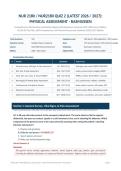
NUR 2180 / NUR2180 QUIZ 2 (LATEST ):
PHYSICAL ASSESSMENT - RASMUSSEN
Comprehensive 100-Question Examination aligned with Rasmussen University NUR 2180 Course Syllabus,
NCLEX-RN Test Plan, QSEN Competencies, and Physical Assessment Standards (2026/2027 Edition)
Total Questions: 100 Cognitive Levels: 20% Recall / 50% Application / 30% Analysis
Question Format: Multiple Choice (4 options) Style: 75% Scenario-based / 25% Direct Knowledge
Course: NUR 2180 Physical Assessment Institution: Rasmussen University
Edition: Latest Aligned With: NCLEX-RN Test Plan & QSEN
Examination Structure
# Section Questions Topic Focus
1 General Survey, Vital Signs, & Pain Assessment Q1 - Q15 (15 Q) Vital signs, pain scales, PQRST, OLDCARTS
2 Skin, Hair, & Nails Assessment Q16 - Q27 (12 Q) Lesions, pressure injury staging, ABCDE
3 Head, Eyes, Ears, Nose, & Throat (HEENT) Q28 - Q47 (20 Q) PERRLA, Snellen, Rinne/Weber, otoscopy
4 Neurological & Mental Status Assessment Q48 - Q62 (15 Q) GCS, cranial nerves, reflexes, cerebellar
5 Cardiovascular & Peripheral Vascular Q63 - Q77 (15 Q) Heart sounds, murmurs, JVD, pulses, DVT
6 Respiratory Assessment Q78 - Q90 (13 Q) Breath sounds, ABGs, adventitious sounds
7 Abdominal & Gastrointestinal Assessment Q91 - Q100 (10 Q) Inspection, auscultation, percussion, palpation
Section 1: General Survey, Vital Signs, & Pain Assessment
Topics: general survey, vital signs across lifespan, pain assessment tools, types of pain, cultural influences
Q1: A 68-year-old male presents to the emergency department. The nurse observes that he appears
disheveled, has poor eye contact, speaks in a soft monotone voice, and is clutching his abdomen. Which
component of the general survey is the nurse primarily assessing when noting the patient's clutching
behavior and posture?
A. Hygiene and grooming
B. Behavior and posture *[CORRECT]*
C. Speech pattern and mood
D. Body type and developmental stage
Correct Answer: B
Rationale:
The general survey includes appearance, behavior, mood, hygiene, body type, posture, gait, and speech.
Clutching the abdomen and posture are aspects of behavior and posture. Hygiene relates to cleanliness, speech
NUR 2180 / NUR2180 Quiz 2 (Latest ): Physical Assessment - Rasmussen Page 1
, relates to verbal characteristics, and body type refers to physical build (ectomorph, mesomorph, endomorph).
NUR 2180 curriculum emphasizes observing the whole patient before focused assessment.
Q2: A nurse is measuring vital signs on a healthy 35-year-old adult. Which of the following findings
should the nurse identify as within the expected reference range for a resting adult pulse?
A. 42 beats per minute
B. 58 beats per minute
C. 78 beats per minute *[CORRECT]*
D. 118 beats per minute
Correct Answer: C
Rationale:
The normal adult resting heart rate is 60 to 100 beats per minute. A rate of 42 bpm indicates bradycardia and
may be concerning unless the patient is an athlete. 58 bpm is also bradycardic. 118 bpm indicates tachycardia. A
rate of 78 bpm falls within the expected reference range per NCLEX-RN standards and NUR 2180 physical
assessment guidelines.
Q3: A nursing student is preparing to assess a patient's radial pulse. Which technique demonstrates
correct nursing practice according to NUR 2180 standards?
A. Counting the pulse for 15 seconds and multiplying by 4 in a patient with a regular rhythm
*[CORRECT]*
B. Counting the pulse for 30 seconds and multiplying by 2 in a patient with an irregular rhythm
C. Using the thumb to palpate the radial artery because it has the strongest pulse
D. Counting the pulse for a full minute only if the rate is below 60
Correct Answer: A
Rationale:
For a regular radial pulse, counting for 30 seconds and multiplying by 2 is acceptable, but for an irregular
rhythm, the nurse must count for a full 60 seconds. Using the thumb is incorrect because the thumb has its own
pulse, which can be confused with the patient's pulse. The index and middle fingers should be used. A 15-second
count multiplied by 4 is acceptable for a regular, stable pulse in non-critical settings.
Q4: A nurse is preparing to measure a patient's blood pressure. Which action by the nurse indicates a
need for further education on proper blood pressure technique?
A. Having the patient sit quietly for 5 minutes before measurement
B. Placing the cuff on the upper arm with the bladder centered over the brachial artery
C. Using a cuff that covers 80% of the upper arm circumference
D. Measuring the blood pressure in the arm with a known arteriovenous fistula *[CORRECT]*
Correct Answer: D
Rationale:
Blood pressure should never be measured in an arm with an arteriovenous fistula, on the side of a mastectomy,
with IV fluids infusing, or with a cast. The cuff bladder should cover 80% of the arm circumference and be
centered over the brachial artery. The patient should rest for 5 minutes and sit with feet flat on the floor. These
standards align with American Heart Association guidelines taught in NUR 2180.
NUR 2180 / NUR2180 Quiz 2 (Latest ): Physical Assessment - Rasmussen Page 2
, Q5: A nurse is assessing pain in a 4-year-old postoperative pediatric patient. Which pain assessment tool
is most appropriate for this developmental stage?
A. Numeric rating scale 0 to 10
B. Visual analog scale
C. FLACC Behavioral Pain Assessment Scale *[CORRECT]*
D. PAINAD scale
Correct Answer: C
Rationale:
The FLACC scale (Face, Legs, Activity, Cry, Consolability) is designed for children aged 2 months to 7 years
who cannot verbally report pain. A 4-year-old lacks the cognitive ability to reliably use numeric or visual analog
scales. PAINAD is used for patients with advanced dementia. The numeric 0 to 10 scale requires abstract
reasoning typically developed by age 7 or older.
Q6: A patient reports abdominal pain. Using the PQRST mnemonic, the 'Q' component is best assessed
by which nurse statement?
A. 'Can you describe what the pain feels like?' *[CORRECT]*
B. 'When did the pain first start?'
C. 'Does the pain feel sharp, dull, throbbing, or burning?'
D. 'What makes the pain better or worse?'
Correct Answer: A
Rationale:
In the PQRST pain mnemonic, P is provocation/palliation, Q is quality, R is region/radiation, S is severity, and T
is timing. Asking the patient to describe what the pain feels like assesses quality. 'When did the pain start?'
assesses timing. 'Sharp, dull, throbbing, burning' would be the patient's answer, not the question asked. 'What
makes it better or worse' assesses provocation/palliation.
Q7: A patient with a history of diabetes describes burning, tingling pain in both feet that worsens at
night. The nurse documents this as which type of pain?
A. Nociceptive somatic pain
B. Nociceptive visceral pain
C. Neuropathic pain *[CORRECT]*
D. Referred pain
Correct Answer: C
Rationale:
Neuropathic pain results from damage to or dysfunction of the nervous system and is described as burning,
tingling, shooting, or electric shock-like. Diabetic peripheral neuropathy is a classic cause. Nociceptive somatic
pain arises from skin, bones, muscles (sharp, aching, throbbing). Visceral pain originates from organs
(cramping, pressure). Referred pain is perceived at a location different from the source.
Q8: A nurse is assessing oxygen saturation on a patient with COPD. The patient's SpO2 reads 88% on
room air. Based on NUR 2180 physical assessment principles, how should the nurse interpret this
NUR 2180 / NUR2180 Quiz 2 (Latest ): Physical Assessment - Rasmussen Page 3
, finding?
A. The reading is normal for a patient with COPD and requires no intervention
B. The reading is critically low and requires immediate supplemental oxygen to achieve 100%
C. The reading is consistent with COPD baseline and requires careful oxygen administration to avoid
suppressing the hypoxic drive *[CORRECT]*
D. The reading indicates equipment malfunction and should be rechecked on a different finger
Correct Answer: C
Rationale:
Patients with COPD often have baseline SpO2 values of 88% to 92% because their respiratory drive is triggered
by hypoxemia rather than hypercapnia. Aggressive oxygen therapy to achieve 100% can suppress the hypoxic
drive and cause respiratory depression. Normal SpO2 is 95% to 100%. A reading of 88% in a COPD patient
warrants careful oxygen titration, not aggressive correction.
Q9: A nurse is preparing to measure a patient's temperature. Which route provides the most accurate
reflection of core body temperature?
A. Oral
B. Tympanic *[CORRECT]*
C. Axillary
D. Temporal artery
Correct Answer: B
Rationale:
The tympanic membrane shares its blood supply with the hypothalamus, the body's thermoregulation center,
making tympanic temperature a close approximation of core temperature. Oral temperatures can be affected by
recent food or fluid intake. Axillary is the least accurate method. Temporal artery is reasonably accurate but less
reflective of true core temperature than tympanic.
Q10: A nurse is caring for an 82-year-old patient with advanced dementia who is unable to verbally
report pain. Which pain assessment tool is most appropriate?
A. Wong-Baker FACES Pain Rating Scale
B. Numeric Rating Scale 0 to 10
C. PAINAD (Pain Assessment in Advanced Dementia) *[CORRECT]*
D. Brief Pain Inventory
Correct Answer: C
Rationale:
The PAINAD scale is specifically validated for assessing pain in patients with advanced dementia who cannot
self-report. It evaluates five behavioral indicators: breathing, negative vocalization, facial expression, body
language, and consolability. Wong-Baker FACES and numeric scales require patient comprehension. The Brief
Pain Inventory requires verbal or written responses, which is not feasible with advanced dementia.
Q11: A nurse is assessing a patient for orthostatic hypotension. The patient's supine blood pressure is
132/82 mmHg with a heart rate of 76 bpm. After standing for 1 minute, the blood pressure is 112/74
mmHg with a heart rate of 94 bpm. Which interpretation is correct?
NUR 2180 / NUR2180 Quiz 2 (Latest ): Physical Assessment - Rasmussen Page 4
PHYSICAL ASSESSMENT - RASMUSSEN
Comprehensive 100-Question Examination aligned with Rasmussen University NUR 2180 Course Syllabus,
NCLEX-RN Test Plan, QSEN Competencies, and Physical Assessment Standards (2026/2027 Edition)
Total Questions: 100 Cognitive Levels: 20% Recall / 50% Application / 30% Analysis
Question Format: Multiple Choice (4 options) Style: 75% Scenario-based / 25% Direct Knowledge
Course: NUR 2180 Physical Assessment Institution: Rasmussen University
Edition: Latest Aligned With: NCLEX-RN Test Plan & QSEN
Examination Structure
# Section Questions Topic Focus
1 General Survey, Vital Signs, & Pain Assessment Q1 - Q15 (15 Q) Vital signs, pain scales, PQRST, OLDCARTS
2 Skin, Hair, & Nails Assessment Q16 - Q27 (12 Q) Lesions, pressure injury staging, ABCDE
3 Head, Eyes, Ears, Nose, & Throat (HEENT) Q28 - Q47 (20 Q) PERRLA, Snellen, Rinne/Weber, otoscopy
4 Neurological & Mental Status Assessment Q48 - Q62 (15 Q) GCS, cranial nerves, reflexes, cerebellar
5 Cardiovascular & Peripheral Vascular Q63 - Q77 (15 Q) Heart sounds, murmurs, JVD, pulses, DVT
6 Respiratory Assessment Q78 - Q90 (13 Q) Breath sounds, ABGs, adventitious sounds
7 Abdominal & Gastrointestinal Assessment Q91 - Q100 (10 Q) Inspection, auscultation, percussion, palpation
Section 1: General Survey, Vital Signs, & Pain Assessment
Topics: general survey, vital signs across lifespan, pain assessment tools, types of pain, cultural influences
Q1: A 68-year-old male presents to the emergency department. The nurse observes that he appears
disheveled, has poor eye contact, speaks in a soft monotone voice, and is clutching his abdomen. Which
component of the general survey is the nurse primarily assessing when noting the patient's clutching
behavior and posture?
A. Hygiene and grooming
B. Behavior and posture *[CORRECT]*
C. Speech pattern and mood
D. Body type and developmental stage
Correct Answer: B
Rationale:
The general survey includes appearance, behavior, mood, hygiene, body type, posture, gait, and speech.
Clutching the abdomen and posture are aspects of behavior and posture. Hygiene relates to cleanliness, speech
NUR 2180 / NUR2180 Quiz 2 (Latest ): Physical Assessment - Rasmussen Page 1
, relates to verbal characteristics, and body type refers to physical build (ectomorph, mesomorph, endomorph).
NUR 2180 curriculum emphasizes observing the whole patient before focused assessment.
Q2: A nurse is measuring vital signs on a healthy 35-year-old adult. Which of the following findings
should the nurse identify as within the expected reference range for a resting adult pulse?
A. 42 beats per minute
B. 58 beats per minute
C. 78 beats per minute *[CORRECT]*
D. 118 beats per minute
Correct Answer: C
Rationale:
The normal adult resting heart rate is 60 to 100 beats per minute. A rate of 42 bpm indicates bradycardia and
may be concerning unless the patient is an athlete. 58 bpm is also bradycardic. 118 bpm indicates tachycardia. A
rate of 78 bpm falls within the expected reference range per NCLEX-RN standards and NUR 2180 physical
assessment guidelines.
Q3: A nursing student is preparing to assess a patient's radial pulse. Which technique demonstrates
correct nursing practice according to NUR 2180 standards?
A. Counting the pulse for 15 seconds and multiplying by 4 in a patient with a regular rhythm
*[CORRECT]*
B. Counting the pulse for 30 seconds and multiplying by 2 in a patient with an irregular rhythm
C. Using the thumb to palpate the radial artery because it has the strongest pulse
D. Counting the pulse for a full minute only if the rate is below 60
Correct Answer: A
Rationale:
For a regular radial pulse, counting for 30 seconds and multiplying by 2 is acceptable, but for an irregular
rhythm, the nurse must count for a full 60 seconds. Using the thumb is incorrect because the thumb has its own
pulse, which can be confused with the patient's pulse. The index and middle fingers should be used. A 15-second
count multiplied by 4 is acceptable for a regular, stable pulse in non-critical settings.
Q4: A nurse is preparing to measure a patient's blood pressure. Which action by the nurse indicates a
need for further education on proper blood pressure technique?
A. Having the patient sit quietly for 5 minutes before measurement
B. Placing the cuff on the upper arm with the bladder centered over the brachial artery
C. Using a cuff that covers 80% of the upper arm circumference
D. Measuring the blood pressure in the arm with a known arteriovenous fistula *[CORRECT]*
Correct Answer: D
Rationale:
Blood pressure should never be measured in an arm with an arteriovenous fistula, on the side of a mastectomy,
with IV fluids infusing, or with a cast. The cuff bladder should cover 80% of the arm circumference and be
centered over the brachial artery. The patient should rest for 5 minutes and sit with feet flat on the floor. These
standards align with American Heart Association guidelines taught in NUR 2180.
NUR 2180 / NUR2180 Quiz 2 (Latest ): Physical Assessment - Rasmussen Page 2
, Q5: A nurse is assessing pain in a 4-year-old postoperative pediatric patient. Which pain assessment tool
is most appropriate for this developmental stage?
A. Numeric rating scale 0 to 10
B. Visual analog scale
C. FLACC Behavioral Pain Assessment Scale *[CORRECT]*
D. PAINAD scale
Correct Answer: C
Rationale:
The FLACC scale (Face, Legs, Activity, Cry, Consolability) is designed for children aged 2 months to 7 years
who cannot verbally report pain. A 4-year-old lacks the cognitive ability to reliably use numeric or visual analog
scales. PAINAD is used for patients with advanced dementia. The numeric 0 to 10 scale requires abstract
reasoning typically developed by age 7 or older.
Q6: A patient reports abdominal pain. Using the PQRST mnemonic, the 'Q' component is best assessed
by which nurse statement?
A. 'Can you describe what the pain feels like?' *[CORRECT]*
B. 'When did the pain first start?'
C. 'Does the pain feel sharp, dull, throbbing, or burning?'
D. 'What makes the pain better or worse?'
Correct Answer: A
Rationale:
In the PQRST pain mnemonic, P is provocation/palliation, Q is quality, R is region/radiation, S is severity, and T
is timing. Asking the patient to describe what the pain feels like assesses quality. 'When did the pain start?'
assesses timing. 'Sharp, dull, throbbing, burning' would be the patient's answer, not the question asked. 'What
makes it better or worse' assesses provocation/palliation.
Q7: A patient with a history of diabetes describes burning, tingling pain in both feet that worsens at
night. The nurse documents this as which type of pain?
A. Nociceptive somatic pain
B. Nociceptive visceral pain
C. Neuropathic pain *[CORRECT]*
D. Referred pain
Correct Answer: C
Rationale:
Neuropathic pain results from damage to or dysfunction of the nervous system and is described as burning,
tingling, shooting, or electric shock-like. Diabetic peripheral neuropathy is a classic cause. Nociceptive somatic
pain arises from skin, bones, muscles (sharp, aching, throbbing). Visceral pain originates from organs
(cramping, pressure). Referred pain is perceived at a location different from the source.
Q8: A nurse is assessing oxygen saturation on a patient with COPD. The patient's SpO2 reads 88% on
room air. Based on NUR 2180 physical assessment principles, how should the nurse interpret this
NUR 2180 / NUR2180 Quiz 2 (Latest ): Physical Assessment - Rasmussen Page 3
, finding?
A. The reading is normal for a patient with COPD and requires no intervention
B. The reading is critically low and requires immediate supplemental oxygen to achieve 100%
C. The reading is consistent with COPD baseline and requires careful oxygen administration to avoid
suppressing the hypoxic drive *[CORRECT]*
D. The reading indicates equipment malfunction and should be rechecked on a different finger
Correct Answer: C
Rationale:
Patients with COPD often have baseline SpO2 values of 88% to 92% because their respiratory drive is triggered
by hypoxemia rather than hypercapnia. Aggressive oxygen therapy to achieve 100% can suppress the hypoxic
drive and cause respiratory depression. Normal SpO2 is 95% to 100%. A reading of 88% in a COPD patient
warrants careful oxygen titration, not aggressive correction.
Q9: A nurse is preparing to measure a patient's temperature. Which route provides the most accurate
reflection of core body temperature?
A. Oral
B. Tympanic *[CORRECT]*
C. Axillary
D. Temporal artery
Correct Answer: B
Rationale:
The tympanic membrane shares its blood supply with the hypothalamus, the body's thermoregulation center,
making tympanic temperature a close approximation of core temperature. Oral temperatures can be affected by
recent food or fluid intake. Axillary is the least accurate method. Temporal artery is reasonably accurate but less
reflective of true core temperature than tympanic.
Q10: A nurse is caring for an 82-year-old patient with advanced dementia who is unable to verbally
report pain. Which pain assessment tool is most appropriate?
A. Wong-Baker FACES Pain Rating Scale
B. Numeric Rating Scale 0 to 10
C. PAINAD (Pain Assessment in Advanced Dementia) *[CORRECT]*
D. Brief Pain Inventory
Correct Answer: C
Rationale:
The PAINAD scale is specifically validated for assessing pain in patients with advanced dementia who cannot
self-report. It evaluates five behavioral indicators: breathing, negative vocalization, facial expression, body
language, and consolability. Wong-Baker FACES and numeric scales require patient comprehension. The Brief
Pain Inventory requires verbal or written responses, which is not feasible with advanced dementia.
Q11: A nurse is assessing a patient for orthostatic hypotension. The patient's supine blood pressure is
132/82 mmHg with a heart rate of 76 bpm. After standing for 1 minute, the blood pressure is 112/74
mmHg with a heart rate of 94 bpm. Which interpretation is correct?
NUR 2180 / NUR2180 Quiz 2 (Latest ): Physical Assessment - Rasmussen Page 4


