

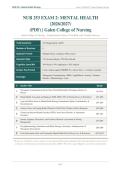
NUR 253 – Mental Health Nursing Exam 2 (2026/2027) | Galen College of Nursing
NUR 253 EXAM 2: MENTAL HEALTH
(2026/2027)
(PDF) | Galen College of Nursing
Galen College of Nursing – Comprehensive Exam 2 Test Bank with Verified Answers
Total Questions 105 (Sequential Q1–Q105)
Number of Sections 8
Question Format Multiple Choice (4 options, ONE correct)
Question Style 75% Scenario-Based • 25% Direct Recall
Cognitive Level Mix 30% Recall • 50% Application • 20% Analysis
Answer Key Format Correct option tagged [CORRECT] • Answer line • 2–4 sentence rationale
Therapeutic Communication • MSE • Legal/Ethical • Anxiety • Trauma •
Coverage
Somatic • Pharmacology • Crisis
# Section Title Range
Therapeutic Communication and the Nurse-Client Relationship (Techniques, Barriers, &
1 Q1-Q16
Phases)
2 Mental Health Assessment and Diagnosis (MSE, DSM-5-TR, & Nursing Process in Psychiatry) Q17-Q30
Legal and Ethical Issues in Mental Health Nursing (Commitment, Rights, Confidentiality, &
3 Q31-Q44
Documentation)
4 Anxiety, Stress, and Coping-Related Disorders (GAD, Panic, Phobias, & Stress Response) Q45-Q60
Trauma and Stressor-Related Disorders (PTSD, Acute Stress Disorder, & Adjustment
5 Q61-Q72
Disorders)
Somatic Symptom, Dissociative, and Factitious Disorders (Assessment & Nursing
6 Q73-Q84
Management)
Psychopharmacology Foundations and Milieu Therapy (Anxiolytics, Antidepressants, &
7 Q85-Q96
Therapeutic Environment)
8 Crisis Intervention, Grief, and Community Mental Health (Crisis Theory, Loss, & Resources) Q97-Q105
All answers verified for accuracy against current mental health nursing standards. Each rationale includes correct-answer
verification with therapeutic communication principles, DSM-5-TR criteria, legal obligations, and safety considerations.
Page 1
,NUR 253 – Mental Health Nursing Exam 2 (2026/2027) | Galen College of Nursing
SECTION 1
Section 1: Therapeutic Communication and the Nurse-Client Relationship
(Techniques, Barriers, & Phases)
Questions Q1-Q16
Q1: A psychiatric-mental health nurse is working with a client who states, "I just feel so lost since my
husband died. Nothing matters anymore." Which response by the nurse BEST demonstrates the
therapeutic communication technique of reflection?
A. "You're saying that since your husband's death, you feel lost and that nothing matters anymore."
[CORRECT]
B. "Don't worry, things will get better with time. You just need to be patient."
C. "Why do you think you feel this way? Have you talked to anyone about this before?"
D. "You should try joining a bereavement group; I think it would really help you."
Correct Answer: A
Rationale: Reflection is the therapeutic technique of paraphrasing and mirroring back the client's feelings or
message to encourage further exploration. Option B is false reassurance (non-therapeutic), Option C is asking
"why" which puts clients on the defensive, and Option D is giving advice (non-therapeutic). Verified correct:
reflection restates the client's message to promote deeper sharing.
Q2: A client tells the nurse, "I'm a complete failure. I can't do anything right." Which response BEST
demonstrates the technique of restating?
A. "You feel like a complete failure and that you can't do anything right." [CORRECT]
B. "I'm sure that's not true. You've accomplished a lot in your life."
C. "Tell me more about why you believe you're a failure."
D. "Everyone feels that way sometimes. It will pass."
Correct Answer: A
Rationale: Restating repeats the main idea of the client's message almost verbatim to validate and encourage
elaboration. Option B is disagreement/false reassurance, Option C is exploring (also therapeutic but not restating),
Option D is minimizing and stereotypical. Verified correct: restating mirrors the client's words back to confirm
understanding.
Page 2
,NUR 253 – Mental Health Nursing Exam 2 (2026/2027) | Galen College of Nursing
Q3: During a therapy session, a client states, "I'm not sure what you mean by coping strategies."
Which response BEST demonstrates clarification?
A. "I'm asking about the specific ways you handle stress, such as exercise, talking to friends, or writing in a
journal. Does that make sense?" [CORRECT]
B. "You should already know what coping strategies are."
C. "Let's move on to something else then."
D. "Coping strategies are things everyone does. Don't you read?"
Correct Answer: A
Rationale: Clarification seeks to make sure the message is understood and helps the client articulate their
experience. Option B is belittling, Option C is changing the subject (non-therapeutic), Option D is sarcastic and
judgmental. Verified correct: clarification provides concrete examples to confirm mutual understanding.
Q4: A nurse responds to a client's concerns by saying, "Don't worry, everything will be fine. The
doctors here are the best." This response is an example of which non-therapeutic communication
barrier?
A. False reassurance, which dismisses the client's concerns and shuts down further communication.
[CORRECT]
B. Reflection, which validates the client's feelings.
C. Active listening, which builds rapport.
D. Clarification, which ensures understanding.
Correct Answer: A
Rationale: False reassurance offers unsupported comfort and minimizes the client's concerns, blocking further
exploration. Verified correct: false reassurance dismisses feelings and inhibits therapeutic dialogue.
Q5: A client newly diagnosed with depression asks the nurse, "What should I do about my job? I can't
go back." Which response is an example of giving advice, a non-therapeutic barrier?
A. "I think you should quit your job and focus on yourself for now." [CORRECT]
B. "Let's explore some options you might consider regarding your work situation."
C. "How do you feel about returning to work?"
D. "What have you considered doing about your job?"
Correct Answer: A
Rationale: Giving advice tells the client what to do, depriving them of autonomy and self-determination. Options
B, C, and D are therapeutic (exploring, reflecting feelings, and seeking client input). Verified correct: giving
advice denies the client's right to make their own decisions.
Page 3
, NUR 253 – Mental Health Nursing Exam 2 (2026/2027) | Galen College of Nursing
Q6: A client expresses fear about an upcoming procedure. The nurse responds, "We can talk about
that later. Right now, let's discuss your medications." This response demonstrates which
non-therapeutic barrier?
A. Changing the subject, which signals that the client's concerns are not important and avoids dealing with
feelings. [CORRECT]
B. Reflection, which mirrors the client's feelings.
C. Focusing, which keeps the conversation on track.
D. Summarizing, which condenses key points.
Correct Answer: A
Rationale: Changing the subject abruptly dismisses the client's expressed concern, signaling it is not valued.
Verified correct: changing the subject is a recognized non-therapeutic barrier that blocks exploration of feelings.
Q7: The nurse-client relationship consists of sequential phases. Which sequence represents the
correct order of phases as described by Hildegard Peplau?
A. Pre-orientation, orientation (introductory), working, and termination. [CORRECT]
B. Orientation, working, pre-orientation, and termination.
C. Working, pre-orientation, termination, and orientation.
D. Pre-orientation, working, orientation, and termination.
Correct Answer: A
Rationale: Peplau's phases of the therapeutic relationship are pre-orientation (before meeting the client),
orientation (introductory/contracting), working (problem-solving), and termination (closing the relationship).
Verified correct: this is the established Peplau sequence taught in NUR 253.
Q8: A nursing student is preparing to meet a new client. The student reviews the medical record,
gathers relevant information, and plans the initial interaction. This activity BEST represents which
phase of the nurse-client relationship?
A. Pre-orientation phase, during which the nurse prepares before meeting the client. [CORRECT]
B. Orientation phase, when the contract is established.
C. Working phase, when problems are addressed.
D. Termination phase, when the relationship ends.
Correct Answer: A
Rationale: The pre-orientation phase occurs before the nurse meets the client and involves gathering data and
planning. Verified correct: pre-orientation is the preparatory phase that precedes the first interaction.
Page 4
NUR 253 EXAM 2: MENTAL HEALTH
(2026/2027)
(PDF) | Galen College of Nursing
Galen College of Nursing – Comprehensive Exam 2 Test Bank with Verified Answers
Total Questions 105 (Sequential Q1–Q105)
Number of Sections 8
Question Format Multiple Choice (4 options, ONE correct)
Question Style 75% Scenario-Based • 25% Direct Recall
Cognitive Level Mix 30% Recall • 50% Application • 20% Analysis
Answer Key Format Correct option tagged [CORRECT] • Answer line • 2–4 sentence rationale
Therapeutic Communication • MSE • Legal/Ethical • Anxiety • Trauma •
Coverage
Somatic • Pharmacology • Crisis
# Section Title Range
Therapeutic Communication and the Nurse-Client Relationship (Techniques, Barriers, &
1 Q1-Q16
Phases)
2 Mental Health Assessment and Diagnosis (MSE, DSM-5-TR, & Nursing Process in Psychiatry) Q17-Q30
Legal and Ethical Issues in Mental Health Nursing (Commitment, Rights, Confidentiality, &
3 Q31-Q44
Documentation)
4 Anxiety, Stress, and Coping-Related Disorders (GAD, Panic, Phobias, & Stress Response) Q45-Q60
Trauma and Stressor-Related Disorders (PTSD, Acute Stress Disorder, & Adjustment
5 Q61-Q72
Disorders)
Somatic Symptom, Dissociative, and Factitious Disorders (Assessment & Nursing
6 Q73-Q84
Management)
Psychopharmacology Foundations and Milieu Therapy (Anxiolytics, Antidepressants, &
7 Q85-Q96
Therapeutic Environment)
8 Crisis Intervention, Grief, and Community Mental Health (Crisis Theory, Loss, & Resources) Q97-Q105
All answers verified for accuracy against current mental health nursing standards. Each rationale includes correct-answer
verification with therapeutic communication principles, DSM-5-TR criteria, legal obligations, and safety considerations.
Page 1
,NUR 253 – Mental Health Nursing Exam 2 (2026/2027) | Galen College of Nursing
SECTION 1
Section 1: Therapeutic Communication and the Nurse-Client Relationship
(Techniques, Barriers, & Phases)
Questions Q1-Q16
Q1: A psychiatric-mental health nurse is working with a client who states, "I just feel so lost since my
husband died. Nothing matters anymore." Which response by the nurse BEST demonstrates the
therapeutic communication technique of reflection?
A. "You're saying that since your husband's death, you feel lost and that nothing matters anymore."
[CORRECT]
B. "Don't worry, things will get better with time. You just need to be patient."
C. "Why do you think you feel this way? Have you talked to anyone about this before?"
D. "You should try joining a bereavement group; I think it would really help you."
Correct Answer: A
Rationale: Reflection is the therapeutic technique of paraphrasing and mirroring back the client's feelings or
message to encourage further exploration. Option B is false reassurance (non-therapeutic), Option C is asking
"why" which puts clients on the defensive, and Option D is giving advice (non-therapeutic). Verified correct:
reflection restates the client's message to promote deeper sharing.
Q2: A client tells the nurse, "I'm a complete failure. I can't do anything right." Which response BEST
demonstrates the technique of restating?
A. "You feel like a complete failure and that you can't do anything right." [CORRECT]
B. "I'm sure that's not true. You've accomplished a lot in your life."
C. "Tell me more about why you believe you're a failure."
D. "Everyone feels that way sometimes. It will pass."
Correct Answer: A
Rationale: Restating repeats the main idea of the client's message almost verbatim to validate and encourage
elaboration. Option B is disagreement/false reassurance, Option C is exploring (also therapeutic but not restating),
Option D is minimizing and stereotypical. Verified correct: restating mirrors the client's words back to confirm
understanding.
Page 2
,NUR 253 – Mental Health Nursing Exam 2 (2026/2027) | Galen College of Nursing
Q3: During a therapy session, a client states, "I'm not sure what you mean by coping strategies."
Which response BEST demonstrates clarification?
A. "I'm asking about the specific ways you handle stress, such as exercise, talking to friends, or writing in a
journal. Does that make sense?" [CORRECT]
B. "You should already know what coping strategies are."
C. "Let's move on to something else then."
D. "Coping strategies are things everyone does. Don't you read?"
Correct Answer: A
Rationale: Clarification seeks to make sure the message is understood and helps the client articulate their
experience. Option B is belittling, Option C is changing the subject (non-therapeutic), Option D is sarcastic and
judgmental. Verified correct: clarification provides concrete examples to confirm mutual understanding.
Q4: A nurse responds to a client's concerns by saying, "Don't worry, everything will be fine. The
doctors here are the best." This response is an example of which non-therapeutic communication
barrier?
A. False reassurance, which dismisses the client's concerns and shuts down further communication.
[CORRECT]
B. Reflection, which validates the client's feelings.
C. Active listening, which builds rapport.
D. Clarification, which ensures understanding.
Correct Answer: A
Rationale: False reassurance offers unsupported comfort and minimizes the client's concerns, blocking further
exploration. Verified correct: false reassurance dismisses feelings and inhibits therapeutic dialogue.
Q5: A client newly diagnosed with depression asks the nurse, "What should I do about my job? I can't
go back." Which response is an example of giving advice, a non-therapeutic barrier?
A. "I think you should quit your job and focus on yourself for now." [CORRECT]
B. "Let's explore some options you might consider regarding your work situation."
C. "How do you feel about returning to work?"
D. "What have you considered doing about your job?"
Correct Answer: A
Rationale: Giving advice tells the client what to do, depriving them of autonomy and self-determination. Options
B, C, and D are therapeutic (exploring, reflecting feelings, and seeking client input). Verified correct: giving
advice denies the client's right to make their own decisions.
Page 3
, NUR 253 – Mental Health Nursing Exam 2 (2026/2027) | Galen College of Nursing
Q6: A client expresses fear about an upcoming procedure. The nurse responds, "We can talk about
that later. Right now, let's discuss your medications." This response demonstrates which
non-therapeutic barrier?
A. Changing the subject, which signals that the client's concerns are not important and avoids dealing with
feelings. [CORRECT]
B. Reflection, which mirrors the client's feelings.
C. Focusing, which keeps the conversation on track.
D. Summarizing, which condenses key points.
Correct Answer: A
Rationale: Changing the subject abruptly dismisses the client's expressed concern, signaling it is not valued.
Verified correct: changing the subject is a recognized non-therapeutic barrier that blocks exploration of feelings.
Q7: The nurse-client relationship consists of sequential phases. Which sequence represents the
correct order of phases as described by Hildegard Peplau?
A. Pre-orientation, orientation (introductory), working, and termination. [CORRECT]
B. Orientation, working, pre-orientation, and termination.
C. Working, pre-orientation, termination, and orientation.
D. Pre-orientation, working, orientation, and termination.
Correct Answer: A
Rationale: Peplau's phases of the therapeutic relationship are pre-orientation (before meeting the client),
orientation (introductory/contracting), working (problem-solving), and termination (closing the relationship).
Verified correct: this is the established Peplau sequence taught in NUR 253.
Q8: A nursing student is preparing to meet a new client. The student reviews the medical record,
gathers relevant information, and plans the initial interaction. This activity BEST represents which
phase of the nurse-client relationship?
A. Pre-orientation phase, during which the nurse prepares before meeting the client. [CORRECT]
B. Orientation phase, when the contract is established.
C. Working phase, when problems are addressed.
D. Termination phase, when the relationship ends.
Correct Answer: A
Rationale: The pre-orientation phase occurs before the nurse meets the client and involves gathering data and
planning. Verified correct: pre-orientation is the preparatory phase that precedes the first interaction.
Page 4


