
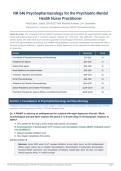
NR 546 Psychopharmacology for the Psychiatric-Mental
Health Nurse Practitioner
Final Exam | Latest 2026/2027 with Revised Answers | A+ Guarantee
140 Questions | 9 Sections | Chamberlain University PMHNP Psychopharmacology
About this exam: This 140-question NR 546 PMHNP Psychopharmacology final exam reflects the Latest 2026/2027 update with
revised and verified answers at the A+ guarantee standard. Cognitive mix: ~30% recall, ~50% application, ~20% analysis. 75%
scenario-based, 25% direct-recall. Each rationale is grounded in neurobiological mechanisms, pharmacokinetic principles,
current FDA approvals/black-box warnings, and PMHNP clinical guidelines. Commonly confused pairs are emphasized: NMS vs.
Serotonin Syndrome, akathisia vs. agitation, depression vs. bipolar depression. Use the rationales as verified study content for
A+ preparation.
Section Questions Count
Foundations of Psychopharmacology and Neurobiology Q1–Q14 14
Antidepressant Agents Q15–Q31 17
Antipsychotic Agents Q32–Q49 18
Mood Stabilizers and Anticonvulsants Q50–Q64 15
Anxiolytics, Hypnotics, and Sedatives Q65–Q79 15
ADHD Pharmacotherapy Q80–Q92 13
Substance Use Disorder Pharmacotherapy Q93–Q107 15
Special Populations and Complex Presentations Q108–Q125 18
Psychiatric Emergencies, Adverse Effects, and Professional Practice Q126–Q140 15
Section 1: Foundations of Psychopharmacology and Neurobiology
Competencies covered: Neurotransmitters, receptor subtypes, synaptic transmission, pharmacokinetics, pharmacodynamics, CYP450
interactions, pharmacogenomics (CYP2D6, CYP2C19), therapeutic index
Q1: A PMHNP is selecting an antidepressant for a patient with major depressive disorder. Which
neurobiological principle BEST explains the typical 2- to 6-week delay in full therapeutic response to
SSRIs?
A. Time needed for the drug to reach steady-state plasma concentration
B. Downregulation of postsynaptic 5-HT receptors and neuroplastic changes (BDNF-mediated) require
time [CORRECT]
C. Delayed reuptake inhibition onset
D. Slow hepatic metabolism of fluoxetine
Correct Answer: B
Rationale: Acute SSRI action (5-HT reuptake inhibition) occurs within hours, but full antidepressant
effects require weeks due to receptor downregulation, desensitization of presynaptic autoreceptors,
increased BDNF expression, and neuroplastic remodeling. Steady-state alone (A) does not explain
clinical response timing. A+ verified concept.
NR 546 Psychopharmacology for PMHNP | Final Exam 2026/2027 | Chamberlain University Page 1
, Q2: Which neurotransmitter system is PRIMARILY implicated in the positive symptoms of
schizophrenia and targeted by first-generation antipsychotics?
A. Norepinephrine
B. Dopamine (D2 receptor hyperactivity in the mesolimbic pathway) [CORRECT]
C. Serotonin
D. GABA
Correct Answer: B
Rationale: Positive symptoms (hallucinations, delusions) are linked to mesolimbic dopamine
hyperactivity; D2 blockade underlies first-generation antipsychotic efficacy (and EPS risk).
Negative/cognitive symptoms involve mesocortical and mesocortical pathways and
serotonin/norepinephrine/GABA systems. A+ verified.
Q3: A patient on paroxetine 20 mg/day requests to stop therapy. The PMHNP should know that
paroxetine has which pharmacokinetic property that increases discontinuation syndrome risk?
A. Long half-life (~24 hours)
B. Short half-life (~21 hours) with no active metabolite [CORRECT]
C. Linear kinetics only
D. Strong CYP2D6 inhibition only
Correct Answer: B
Rationale: Paroxetine has the shortest half-life of SSRIs (~21 hours) and no active metabolite, leading
to the most pronounced discontinuation syndrome. Fluoxetine's long half-life (1-4 days, plus active
metabolite norfluoxetine ~7-15 days) makes discontinuation rare. A+ verified.
Q4: Fluoxetine is a strong inhibitor of which CYP450 enzyme, requiring dose adjustments for
co-administered substrates like TCAs?
A. CYP3A4
B. CYP2D6 [CORRECT]
C. CYP1A2
D. CYP2C9
Correct Answer: B
Rationale: Fluoxetine and paroxetine are potent CYP2D6 inhibitors, increasing levels of CYP2D6
substrates (TCAs, beta-blockers, antiarrhythmics). Bupropion and paroxetine are also strong CYP2D6
inhibitors. A+ verified.
NR 546 Psychopharmacology for PMHNP | Final Exam 2026/2027 | Chamberlain University Page 2
, Q5: A patient is a CYP2D6 poor metabolizer. Which antidepressant should be used with caution or at
reduced dose due to risk of accumulation and adverse effects?
A. Atomoxetine
B. Paroxetine, atomoxetine, venlafaxine, and TCAs (CYP2D6 substrates) [CORRECT]
C. Lithium
D. Valproate
Correct Answer: B
Rationale: CYP2D6 poor metabolizers have reduced clearance of paroxetine, atomoxetine,
venlafaxine, and TCAs (notably nortriptyline), increasing risk of toxicity. CPIC guidelines inform dose
adjustment. A+ verified pharmacogenomics.
Q6: Which receptor pharmacology explains the increased risk of weight gain, sedation, and metabolic
syndrome with second-generation antipsychotics (e.g., olanzapine, clozapine)?
A. Selective D2 blockade
B. High-affinity antagonism at 5-HT2C and H1 receptors (and M3 muscarinic activity) [CORRECT]
C. Alpha-2 agonism
D. NMDA antagonism
Correct Answer: B
Rationale: 5-HT2C antagonism (olanzapine, clozapine) and H1 antagonism (most SGAs) drive
appetite, weight gain, and sedation; M3 antagonism contributes to metabolic dysfunction. Aripiprazole
and ziprasidone have lower receptor-binding risk. A+ verified.
Q7: A patient requires rapid onset of antipsychotic effect for acute agitation. Which route and
mechanism consideration is MOST appropriate?
A. Oral haloperidol only, given its slow absorption
B. IM olanzapine or IM haloperidol (with attention to QTc and EPS monitoring); both achieve D2
blockade quickly [CORRECT]
C. Sublingual atomoxetine
D. Topical risperidone
Correct Answer: B
Rationale: IM formulations (olanzapine, haloperidol) achieve rapid D2 occupancy for acute agitation.
IM olanzapine carries a black-box warning for sedation/airway when combined with parenteral
benzodiazepines; IM haloperidol requires ECG/QTc monitoring. A+ verified.
NR 546 Psychopharmacology for PMHNP | Final Exam 2026/2027 | Chamberlain University Page 3
, Q8: Which statement BEST describes first-pass (presystemic) metabolism and its relevance to oral
psychiatric medications?
A. Drug is metabolized in the kidney before reaching systemic circulation
B. Drug is metabolized in the gut wall and liver before reaching systemic circulation, reducing
bioavailability [CORRECT]
C. Drug is metabolized in the brain only
D. First-pass metabolism increases bioavailability
Correct Answer: B
Rationale: First-pass metabolism (gut wall + hepatic portal) reduces bioavailability of oral drugs,
explaining why some agents (e.g., propranolol, morphine) require higher oral vs. parenteral doses.
Sublingual and parenteral routes bypass first-pass. A+ verified PK concept.
Q9: Which pharmacokinetic property BEST explains lithium's narrow therapeutic index?
A. Wide distribution into adipose tissue
B. Renal handling similar to sodium; excreted unchanged; small margin between therapeutic (0.6-1.2
mEq/L) and toxic (>1.5 mEq/L) levels [CORRECT]
C. Hepatic metabolism to toxic metabolites
D. Strong plasma protein binding
Correct Answer: B
Rationale: Lithium is excreted unchanged by the kidneys (handling similar to sodium); dehydration,
hyponatremia, ACE inhibitors, NSAIDs, and thiazide diuretics reduce clearance and precipitate toxicity.
A+ verified.
Q10: Which patient factor MOST influences the volume of distribution (Vd) of lipophilic psychotropic
medications like diazepam?
A. CYP genotype
B. Age, body composition, and albumin level (lipophilic drugs distribute widely; Vd increases in elderly
and those with low albumin) [CORRECT]
C. Time of administration
D. Patient's favorite color
Correct Answer: B
Rationale: Lipophilic drugs (diazepam, trazodone) have large Vd; distribution increases with age and
decreases with low albumin (less protein binding), altering free fraction and clinical effects. A+ verified
PK principle.
NR 546 Psychopharmacology for PMHNP | Final Exam 2026/2027 | Chamberlain University Page 4
Health Nurse Practitioner
Final Exam | Latest 2026/2027 with Revised Answers | A+ Guarantee
140 Questions | 9 Sections | Chamberlain University PMHNP Psychopharmacology
About this exam: This 140-question NR 546 PMHNP Psychopharmacology final exam reflects the Latest 2026/2027 update with
revised and verified answers at the A+ guarantee standard. Cognitive mix: ~30% recall, ~50% application, ~20% analysis. 75%
scenario-based, 25% direct-recall. Each rationale is grounded in neurobiological mechanisms, pharmacokinetic principles,
current FDA approvals/black-box warnings, and PMHNP clinical guidelines. Commonly confused pairs are emphasized: NMS vs.
Serotonin Syndrome, akathisia vs. agitation, depression vs. bipolar depression. Use the rationales as verified study content for
A+ preparation.
Section Questions Count
Foundations of Psychopharmacology and Neurobiology Q1–Q14 14
Antidepressant Agents Q15–Q31 17
Antipsychotic Agents Q32–Q49 18
Mood Stabilizers and Anticonvulsants Q50–Q64 15
Anxiolytics, Hypnotics, and Sedatives Q65–Q79 15
ADHD Pharmacotherapy Q80–Q92 13
Substance Use Disorder Pharmacotherapy Q93–Q107 15
Special Populations and Complex Presentations Q108–Q125 18
Psychiatric Emergencies, Adverse Effects, and Professional Practice Q126–Q140 15
Section 1: Foundations of Psychopharmacology and Neurobiology
Competencies covered: Neurotransmitters, receptor subtypes, synaptic transmission, pharmacokinetics, pharmacodynamics, CYP450
interactions, pharmacogenomics (CYP2D6, CYP2C19), therapeutic index
Q1: A PMHNP is selecting an antidepressant for a patient with major depressive disorder. Which
neurobiological principle BEST explains the typical 2- to 6-week delay in full therapeutic response to
SSRIs?
A. Time needed for the drug to reach steady-state plasma concentration
B. Downregulation of postsynaptic 5-HT receptors and neuroplastic changes (BDNF-mediated) require
time [CORRECT]
C. Delayed reuptake inhibition onset
D. Slow hepatic metabolism of fluoxetine
Correct Answer: B
Rationale: Acute SSRI action (5-HT reuptake inhibition) occurs within hours, but full antidepressant
effects require weeks due to receptor downregulation, desensitization of presynaptic autoreceptors,
increased BDNF expression, and neuroplastic remodeling. Steady-state alone (A) does not explain
clinical response timing. A+ verified concept.
NR 546 Psychopharmacology for PMHNP | Final Exam 2026/2027 | Chamberlain University Page 1
, Q2: Which neurotransmitter system is PRIMARILY implicated in the positive symptoms of
schizophrenia and targeted by first-generation antipsychotics?
A. Norepinephrine
B. Dopamine (D2 receptor hyperactivity in the mesolimbic pathway) [CORRECT]
C. Serotonin
D. GABA
Correct Answer: B
Rationale: Positive symptoms (hallucinations, delusions) are linked to mesolimbic dopamine
hyperactivity; D2 blockade underlies first-generation antipsychotic efficacy (and EPS risk).
Negative/cognitive symptoms involve mesocortical and mesocortical pathways and
serotonin/norepinephrine/GABA systems. A+ verified.
Q3: A patient on paroxetine 20 mg/day requests to stop therapy. The PMHNP should know that
paroxetine has which pharmacokinetic property that increases discontinuation syndrome risk?
A. Long half-life (~24 hours)
B. Short half-life (~21 hours) with no active metabolite [CORRECT]
C. Linear kinetics only
D. Strong CYP2D6 inhibition only
Correct Answer: B
Rationale: Paroxetine has the shortest half-life of SSRIs (~21 hours) and no active metabolite, leading
to the most pronounced discontinuation syndrome. Fluoxetine's long half-life (1-4 days, plus active
metabolite norfluoxetine ~7-15 days) makes discontinuation rare. A+ verified.
Q4: Fluoxetine is a strong inhibitor of which CYP450 enzyme, requiring dose adjustments for
co-administered substrates like TCAs?
A. CYP3A4
B. CYP2D6 [CORRECT]
C. CYP1A2
D. CYP2C9
Correct Answer: B
Rationale: Fluoxetine and paroxetine are potent CYP2D6 inhibitors, increasing levels of CYP2D6
substrates (TCAs, beta-blockers, antiarrhythmics). Bupropion and paroxetine are also strong CYP2D6
inhibitors. A+ verified.
NR 546 Psychopharmacology for PMHNP | Final Exam 2026/2027 | Chamberlain University Page 2
, Q5: A patient is a CYP2D6 poor metabolizer. Which antidepressant should be used with caution or at
reduced dose due to risk of accumulation and adverse effects?
A. Atomoxetine
B. Paroxetine, atomoxetine, venlafaxine, and TCAs (CYP2D6 substrates) [CORRECT]
C. Lithium
D. Valproate
Correct Answer: B
Rationale: CYP2D6 poor metabolizers have reduced clearance of paroxetine, atomoxetine,
venlafaxine, and TCAs (notably nortriptyline), increasing risk of toxicity. CPIC guidelines inform dose
adjustment. A+ verified pharmacogenomics.
Q6: Which receptor pharmacology explains the increased risk of weight gain, sedation, and metabolic
syndrome with second-generation antipsychotics (e.g., olanzapine, clozapine)?
A. Selective D2 blockade
B. High-affinity antagonism at 5-HT2C and H1 receptors (and M3 muscarinic activity) [CORRECT]
C. Alpha-2 agonism
D. NMDA antagonism
Correct Answer: B
Rationale: 5-HT2C antagonism (olanzapine, clozapine) and H1 antagonism (most SGAs) drive
appetite, weight gain, and sedation; M3 antagonism contributes to metabolic dysfunction. Aripiprazole
and ziprasidone have lower receptor-binding risk. A+ verified.
Q7: A patient requires rapid onset of antipsychotic effect for acute agitation. Which route and
mechanism consideration is MOST appropriate?
A. Oral haloperidol only, given its slow absorption
B. IM olanzapine or IM haloperidol (with attention to QTc and EPS monitoring); both achieve D2
blockade quickly [CORRECT]
C. Sublingual atomoxetine
D. Topical risperidone
Correct Answer: B
Rationale: IM formulations (olanzapine, haloperidol) achieve rapid D2 occupancy for acute agitation.
IM olanzapine carries a black-box warning for sedation/airway when combined with parenteral
benzodiazepines; IM haloperidol requires ECG/QTc monitoring. A+ verified.
NR 546 Psychopharmacology for PMHNP | Final Exam 2026/2027 | Chamberlain University Page 3
, Q8: Which statement BEST describes first-pass (presystemic) metabolism and its relevance to oral
psychiatric medications?
A. Drug is metabolized in the kidney before reaching systemic circulation
B. Drug is metabolized in the gut wall and liver before reaching systemic circulation, reducing
bioavailability [CORRECT]
C. Drug is metabolized in the brain only
D. First-pass metabolism increases bioavailability
Correct Answer: B
Rationale: First-pass metabolism (gut wall + hepatic portal) reduces bioavailability of oral drugs,
explaining why some agents (e.g., propranolol, morphine) require higher oral vs. parenteral doses.
Sublingual and parenteral routes bypass first-pass. A+ verified PK concept.
Q9: Which pharmacokinetic property BEST explains lithium's narrow therapeutic index?
A. Wide distribution into adipose tissue
B. Renal handling similar to sodium; excreted unchanged; small margin between therapeutic (0.6-1.2
mEq/L) and toxic (>1.5 mEq/L) levels [CORRECT]
C. Hepatic metabolism to toxic metabolites
D. Strong plasma protein binding
Correct Answer: B
Rationale: Lithium is excreted unchanged by the kidneys (handling similar to sodium); dehydration,
hyponatremia, ACE inhibitors, NSAIDs, and thiazide diuretics reduce clearance and precipitate toxicity.
A+ verified.
Q10: Which patient factor MOST influences the volume of distribution (Vd) of lipophilic psychotropic
medications like diazepam?
A. CYP genotype
B. Age, body composition, and albumin level (lipophilic drugs distribute widely; Vd increases in elderly
and those with low albumin) [CORRECT]
C. Time of administration
D. Patient's favorite color
Correct Answer: B
Rationale: Lipophilic drugs (diazepam, trazodone) have large Vd; distribution increases with age and
decreases with low albumin (less protein binding), altering free fraction and clinical effects. A+ verified
PK principle.
NR 546 Psychopharmacology for PMHNP | Final Exam 2026/2027 | Chamberlain University Page 4


