
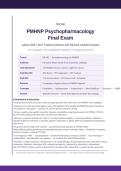
NR 546
PMHNP Psychopharmacology
Final Exam
Latest Tested Questions with Revised Verified Answers
(A+ Guarantee) • 145 Comprehensive Questions • 9 Competency Sections
Course NR 546 — Psychopharmacology for PMHNP
Audience Psychiatric-Mental Health Nurse Practitioner candidates
Total Questions 145 Multiple-Choice (4 options, single best answer)
Cognitive Mix 30% Recall | 50% Application | 20% Analysis
Style Mix 75% Scenario-based | 25% Direct recall / mechanism
Sections 9 competency-aligned sections per PMHNP blueprint
Coverage Foundations → Antidepressants → Antipsychotics → Mood Stabilizers → Anxiolytics → ADHD →
Version 2026/2027 Revised — current FDA approvals and black-box warnings
Examination Instructions
• Each question has ONE best answer. Select the single option that best reflects entry-level PMHNP clinical judgment.
• Rationales are revised and verified against current APA guidelines, FDA labeling, and PMHNP test plan competencies.
They double as a study guide — read them all, even for questions answered correctly.
• Always consider patient-specific factors first: diagnosis, comorbidities, organ function, genetics (CYP2D6, CYP2C19,
HLA-B*1502), pregnancy/lactation status, and concurrent medications.
• Master the commonly confused pairs: NMS vs. Serotonin Syndrome (rigidity vs. clonus/hyperreflexia), Akathisia vs.
Agitation (subjective restlessness vs. psychotic agitation), Depression vs. Bipolar depression (antidepressant monotherapy
risks switch).
• Drug interactions are high-yield: tamoxifen + paroxetine/fluoxetine/bupropion (CYP2D6); MAOI +
SSRIs/SNRIs/tramadol/meperidine/dextromethorphan/linezolid (serotonin syndrome); lithium + NSAIDs/ACE-I/thiazides
(toxicity); clozapine + smoking (CYP1A2).
• For emergencies: NMS → stop antipsychotic + dantrolene/bromocriptine; Serotonin syndrome → stop serotonergics +
cyproheptadine + benzodiazepine; acute agitation → de-escalation first, then PO/IM medication.
• Black box warnings to memorize: antidepressants (<24 suicidal thinking), clozapine (agranulocytosis, myocarditis, seizures,
constipation, orthostasis), lamotrigine (SJS), valproate (teratogenicity, hepatotoxicity, pancreatitis), carbamazepine
(HLA-B*1502/SJS, aplastic anemia), citalopram (QT), ziprasidone (QT), antipsychotics in elderly dementia (mortality).
Revised and verified for A+ preparation. Master psychopharmacology — your patients deserve evidence-based prescribing.
,NR 546 — PMHNP Psychopharmacology Final Exam Latest 2026/2027 | 145 Questions | A+ Guarantee
Section 1: Foundations of Psychopharmacology and Neurobiology
Neurotransmitters, receptor subtypes, synaptic transmission, pharmacokinetics, CYP450 system, and pharmacogenomics —
the neurobiological foundation for all PMHNP prescribing decisions.
Q1: A 32-year-old patient with major depressive disorder has a CYP2D6 poor metabolizer phenotype.
Which antidepressant is most likely to require dose reduction or alternative selection due to impaired
metabolism?
A. Citalopram (CYP2C19 substrate)
B. Fluoxetine (CYP2D6 substrate) [CORRECT]
C. Mirtazapine (CYP1A2, CYP3A4 substrate)
D. Bupropion (CYP2B6 substrate)
Correct Answer: B
Rationale: Fluoxetine is significantly metabolized by CYP2D6, and poor metabolizers accumulate the parent drug,
increasing side-effect risk (activation, anxiety, SI). Citalopram is primarily CYP2C19; mirtazapine uses CYP1A2/3A4;
bupropion is CYP2B6. Pharmacogenomic testing (CYP2D6, CYP2C19) guides antidepressant selection and dosing per
CPIC guidelines.
Q2: Which neurotransmitter is primarily implicated in the pathophysiology of psychosis and is the
primary target of first-generation antipsychotics?
A. Norepinephrine
B. Serotonin
C. Dopamine (especially D2 receptor hyperactivity in mesolimbic pathway) [CORRECT]
D. Glutamate
Correct Answer: C
Rationale: The dopamine hypothesis of schizophrenia posits excessive mesolimbic dopamine activity causing positive
symptoms. First-generation antipsychotics (haloperidol, chlorpromazine) block D2 receptors, with therapeutic benefit
correlating to D2 occupancy of ~60-80%. Second-generation agents add 5-HT2A blockade, improving negative/cognitive
symptoms and EPS profile.
Q3: A patient is started on paroxetine 20 mg daily. The patient is also taking tamoxifen for breast cancer.
What is the most appropriate action?
A. Continue paroxetine; no interaction concern
B. Switch paroxetine to fluoxetine or sertraline because paroxetine is a potent CYP2D6 inhibitor that
reduces tamoxifen conversion to active endoxifen, increasing breast cancer recurrence risk [CORRECT]
C. Increase tamoxifen dose
D. Discontinue tamoxifen
Correct Answer: B
Rationale: Tamoxifen is a prodrug requiring CYP2D6 conversion to active endoxifen. Paroxetine and fluoxetine are potent
CYP2D6 inhibitors that significantly reduce endoxifen levels, negating tamoxifen benefit. Switch to a weak CYP2D6
inhibitor (sertraline, citalopram, escitalopram, venlafaxine). This is a high-yield drug interaction tested on PMHNP exams.
Chamberlain PMHNP — Tested Questions with Revised Verified Answers Page 2
,NR 546 — PMHNP Psychopharmacology Final Exam Latest 2026/2027 | 145 Questions | A+ Guarantee
Q4: A patient exhibits the following genotype: CYP2C19 *2/*2 (poor metabolizer). Which SSRI would be
most affected and require dose reduction?
A. Fluoxetine
B. Citalopram or escitalopram [CORRECT]
C. Sertraline
D. Paroxetine
Correct Answer: B
Rationale: Citalopram and escitalopram are primarily metabolized by CYP2C19. Poor metabolizers (*2/*2) have
decreased clearance, leading to elevated plasma levels and increased QT prolongation risk. CPIC recommends 50% dose
reduction or alternative drug. Fluoxetine/paroxetine are CYP2D6 substrates; sertraline is metabolized by multiple CYPs.
Q5: A patient on fluoxetine 20 mg daily for 6 weeks reports new onset of jitteriness, insomnia, and
worsened anxiety. What is the pharmacologic explanation?
A. Allergy to fluoxetine
B. Serotonergic overactivation at synaptic 5-HT receptors early in therapy (activation syndrome)
[CORRECT]
C. Discontinuation syndrome
D. CYP2D6 ultrarapid metabolism
Correct Answer: B
Rationale: Early SSRI therapy can cause "activation syndrome" — jitteriness, anxiety, insomnia, and akathisia-like
restlessness — from acute serotonergic stimulation before receptor downregulation occurs. Manage by dose reduction,
slower titration, or short-term benzodiazepine. Distinguish from bipolar switch (which would include euphoria, decreased
need for sleep, goal-directed activity).
Q6: The half-life of fluoxetine plus its active metabolite norfluoxetine is approximately:
A. 12-24 hours
B. 2-4 days
C. 7-14 days
D. 1-2 weeks (fluoxetine ~1-4 days, norfluoxetine ~7-15 days; combined effective half-life up to ~7 days)
[CORRECT]
Correct Answer: D
Rationale: Fluoxetine has a long half-life (~1-4 days) and its active metabolite norfluoxetine ~7-15 days, giving an effective
half-life of up to 7 days. This is clinically significant: (1) fluoxetine autoinhibits CYP2D6 for weeks after discontinuation,
requiring 5-week washout before MAOI; (2) missed doses are forgiving; (3) discontinuation syndrome is rare with
fluoxetine.
Chamberlain PMHNP — Tested Questions with Revised Verified Answers Page 3
, NR 546 — PMHNP Psychopharmacology Final Exam Latest 2026/2027 | 145 Questions | A+ Guarantee
Q7: A 75-year-old patient with hepatic cirrhosis requires an SSRI. Which SSRI is generally considered
safest in significant hepatic impairment?
A. Paroxetine
B. Sertraline [CORRECT]
C. Fluoxetine
D. Citalopram (caution: QT prolongation)
Correct Answer: B
Rationale: Sertraline has minimal CYP inhibition, low protein binding, and inactive metabolites, making it the SSRI of
choice in hepatic impairment (start low, 25 mg, titrate slowly). Paroxetine has anticholinergic activity and high protein
binding. Fluoxetine’s long half-life is undesirable. Citalopram carries QT prolongation risk, problematic in liver disease
with electrolyte shifts.
Q8: Which receptor binding profile best explains olanzapine’s high risk for weight gain and metabolic
syndrome?
A. High D2 affinity only
B. Strong 5-HT2A blockade plus H1 (histamine) and 5-HT2C antagonism [CORRECT]
C. Alpha-1 adrenergic blockade
D. Muscarinic M1 antagonism
Correct Answer: B
Rationale: Olanzapine’s strong H1 (histamine) and 5-HT2C antagonism drives appetite stimulation and weight gain; the
resulting insulin resistance leads to metabolic syndrome. Weight gain rank: clozapine ≈ olanzapine > quetiapine >
risperidone > aripiprazole/ziprasidone/lurasidone. Baseline and ongoing metabolic monitoring (weight, BMI, waist, fasting
glucose, lipids) is mandatory with SGAs.
Q9: Which statement about the blood-brain barrier (BBB) and psychotropic medications is correct?
A. All psychotropics easily cross the BBB
B. Lipophilic (highly fat-soluble) drugs cross the BBB readily; highly protein-bound and hydrophilic drugs
cross poorly [CORRECT]
C. Highly ionized drugs cross more easily
D. The BBB is permeable to all drugs in psychiatric use
Correct Answer: B
Rationale: Lipophilic (lipid-soluble) drugs cross the BBB readily by passive diffusion. Highly protein-bound drugs have less
free drug to cross. Hydrophilic and ionized drugs cross poorly. Most psychotropics (benzodiazepines, antidepressants,
antipsychotics) are lipophilic. This principle also governs placental transfer and breast milk excretion.
Chamberlain PMHNP — Tested Questions with Revised Verified Answers Page 4
PMHNP Psychopharmacology
Final Exam
Latest Tested Questions with Revised Verified Answers
(A+ Guarantee) • 145 Comprehensive Questions • 9 Competency Sections
Course NR 546 — Psychopharmacology for PMHNP
Audience Psychiatric-Mental Health Nurse Practitioner candidates
Total Questions 145 Multiple-Choice (4 options, single best answer)
Cognitive Mix 30% Recall | 50% Application | 20% Analysis
Style Mix 75% Scenario-based | 25% Direct recall / mechanism
Sections 9 competency-aligned sections per PMHNP blueprint
Coverage Foundations → Antidepressants → Antipsychotics → Mood Stabilizers → Anxiolytics → ADHD →
Version 2026/2027 Revised — current FDA approvals and black-box warnings
Examination Instructions
• Each question has ONE best answer. Select the single option that best reflects entry-level PMHNP clinical judgment.
• Rationales are revised and verified against current APA guidelines, FDA labeling, and PMHNP test plan competencies.
They double as a study guide — read them all, even for questions answered correctly.
• Always consider patient-specific factors first: diagnosis, comorbidities, organ function, genetics (CYP2D6, CYP2C19,
HLA-B*1502), pregnancy/lactation status, and concurrent medications.
• Master the commonly confused pairs: NMS vs. Serotonin Syndrome (rigidity vs. clonus/hyperreflexia), Akathisia vs.
Agitation (subjective restlessness vs. psychotic agitation), Depression vs. Bipolar depression (antidepressant monotherapy
risks switch).
• Drug interactions are high-yield: tamoxifen + paroxetine/fluoxetine/bupropion (CYP2D6); MAOI +
SSRIs/SNRIs/tramadol/meperidine/dextromethorphan/linezolid (serotonin syndrome); lithium + NSAIDs/ACE-I/thiazides
(toxicity); clozapine + smoking (CYP1A2).
• For emergencies: NMS → stop antipsychotic + dantrolene/bromocriptine; Serotonin syndrome → stop serotonergics +
cyproheptadine + benzodiazepine; acute agitation → de-escalation first, then PO/IM medication.
• Black box warnings to memorize: antidepressants (<24 suicidal thinking), clozapine (agranulocytosis, myocarditis, seizures,
constipation, orthostasis), lamotrigine (SJS), valproate (teratogenicity, hepatotoxicity, pancreatitis), carbamazepine
(HLA-B*1502/SJS, aplastic anemia), citalopram (QT), ziprasidone (QT), antipsychotics in elderly dementia (mortality).
Revised and verified for A+ preparation. Master psychopharmacology — your patients deserve evidence-based prescribing.
,NR 546 — PMHNP Psychopharmacology Final Exam Latest 2026/2027 | 145 Questions | A+ Guarantee
Section 1: Foundations of Psychopharmacology and Neurobiology
Neurotransmitters, receptor subtypes, synaptic transmission, pharmacokinetics, CYP450 system, and pharmacogenomics —
the neurobiological foundation for all PMHNP prescribing decisions.
Q1: A 32-year-old patient with major depressive disorder has a CYP2D6 poor metabolizer phenotype.
Which antidepressant is most likely to require dose reduction or alternative selection due to impaired
metabolism?
A. Citalopram (CYP2C19 substrate)
B. Fluoxetine (CYP2D6 substrate) [CORRECT]
C. Mirtazapine (CYP1A2, CYP3A4 substrate)
D. Bupropion (CYP2B6 substrate)
Correct Answer: B
Rationale: Fluoxetine is significantly metabolized by CYP2D6, and poor metabolizers accumulate the parent drug,
increasing side-effect risk (activation, anxiety, SI). Citalopram is primarily CYP2C19; mirtazapine uses CYP1A2/3A4;
bupropion is CYP2B6. Pharmacogenomic testing (CYP2D6, CYP2C19) guides antidepressant selection and dosing per
CPIC guidelines.
Q2: Which neurotransmitter is primarily implicated in the pathophysiology of psychosis and is the
primary target of first-generation antipsychotics?
A. Norepinephrine
B. Serotonin
C. Dopamine (especially D2 receptor hyperactivity in mesolimbic pathway) [CORRECT]
D. Glutamate
Correct Answer: C
Rationale: The dopamine hypothesis of schizophrenia posits excessive mesolimbic dopamine activity causing positive
symptoms. First-generation antipsychotics (haloperidol, chlorpromazine) block D2 receptors, with therapeutic benefit
correlating to D2 occupancy of ~60-80%. Second-generation agents add 5-HT2A blockade, improving negative/cognitive
symptoms and EPS profile.
Q3: A patient is started on paroxetine 20 mg daily. The patient is also taking tamoxifen for breast cancer.
What is the most appropriate action?
A. Continue paroxetine; no interaction concern
B. Switch paroxetine to fluoxetine or sertraline because paroxetine is a potent CYP2D6 inhibitor that
reduces tamoxifen conversion to active endoxifen, increasing breast cancer recurrence risk [CORRECT]
C. Increase tamoxifen dose
D. Discontinue tamoxifen
Correct Answer: B
Rationale: Tamoxifen is a prodrug requiring CYP2D6 conversion to active endoxifen. Paroxetine and fluoxetine are potent
CYP2D6 inhibitors that significantly reduce endoxifen levels, negating tamoxifen benefit. Switch to a weak CYP2D6
inhibitor (sertraline, citalopram, escitalopram, venlafaxine). This is a high-yield drug interaction tested on PMHNP exams.
Chamberlain PMHNP — Tested Questions with Revised Verified Answers Page 2
,NR 546 — PMHNP Psychopharmacology Final Exam Latest 2026/2027 | 145 Questions | A+ Guarantee
Q4: A patient exhibits the following genotype: CYP2C19 *2/*2 (poor metabolizer). Which SSRI would be
most affected and require dose reduction?
A. Fluoxetine
B. Citalopram or escitalopram [CORRECT]
C. Sertraline
D. Paroxetine
Correct Answer: B
Rationale: Citalopram and escitalopram are primarily metabolized by CYP2C19. Poor metabolizers (*2/*2) have
decreased clearance, leading to elevated plasma levels and increased QT prolongation risk. CPIC recommends 50% dose
reduction or alternative drug. Fluoxetine/paroxetine are CYP2D6 substrates; sertraline is metabolized by multiple CYPs.
Q5: A patient on fluoxetine 20 mg daily for 6 weeks reports new onset of jitteriness, insomnia, and
worsened anxiety. What is the pharmacologic explanation?
A. Allergy to fluoxetine
B. Serotonergic overactivation at synaptic 5-HT receptors early in therapy (activation syndrome)
[CORRECT]
C. Discontinuation syndrome
D. CYP2D6 ultrarapid metabolism
Correct Answer: B
Rationale: Early SSRI therapy can cause "activation syndrome" — jitteriness, anxiety, insomnia, and akathisia-like
restlessness — from acute serotonergic stimulation before receptor downregulation occurs. Manage by dose reduction,
slower titration, or short-term benzodiazepine. Distinguish from bipolar switch (which would include euphoria, decreased
need for sleep, goal-directed activity).
Q6: The half-life of fluoxetine plus its active metabolite norfluoxetine is approximately:
A. 12-24 hours
B. 2-4 days
C. 7-14 days
D. 1-2 weeks (fluoxetine ~1-4 days, norfluoxetine ~7-15 days; combined effective half-life up to ~7 days)
[CORRECT]
Correct Answer: D
Rationale: Fluoxetine has a long half-life (~1-4 days) and its active metabolite norfluoxetine ~7-15 days, giving an effective
half-life of up to 7 days. This is clinically significant: (1) fluoxetine autoinhibits CYP2D6 for weeks after discontinuation,
requiring 5-week washout before MAOI; (2) missed doses are forgiving; (3) discontinuation syndrome is rare with
fluoxetine.
Chamberlain PMHNP — Tested Questions with Revised Verified Answers Page 3
, NR 546 — PMHNP Psychopharmacology Final Exam Latest 2026/2027 | 145 Questions | A+ Guarantee
Q7: A 75-year-old patient with hepatic cirrhosis requires an SSRI. Which SSRI is generally considered
safest in significant hepatic impairment?
A. Paroxetine
B. Sertraline [CORRECT]
C. Fluoxetine
D. Citalopram (caution: QT prolongation)
Correct Answer: B
Rationale: Sertraline has minimal CYP inhibition, low protein binding, and inactive metabolites, making it the SSRI of
choice in hepatic impairment (start low, 25 mg, titrate slowly). Paroxetine has anticholinergic activity and high protein
binding. Fluoxetine’s long half-life is undesirable. Citalopram carries QT prolongation risk, problematic in liver disease
with electrolyte shifts.
Q8: Which receptor binding profile best explains olanzapine’s high risk for weight gain and metabolic
syndrome?
A. High D2 affinity only
B. Strong 5-HT2A blockade plus H1 (histamine) and 5-HT2C antagonism [CORRECT]
C. Alpha-1 adrenergic blockade
D. Muscarinic M1 antagonism
Correct Answer: B
Rationale: Olanzapine’s strong H1 (histamine) and 5-HT2C antagonism drives appetite stimulation and weight gain; the
resulting insulin resistance leads to metabolic syndrome. Weight gain rank: clozapine ≈ olanzapine > quetiapine >
risperidone > aripiprazole/ziprasidone/lurasidone. Baseline and ongoing metabolic monitoring (weight, BMI, waist, fasting
glucose, lipids) is mandatory with SGAs.
Q9: Which statement about the blood-brain barrier (BBB) and psychotropic medications is correct?
A. All psychotropics easily cross the BBB
B. Lipophilic (highly fat-soluble) drugs cross the BBB readily; highly protein-bound and hydrophilic drugs
cross poorly [CORRECT]
C. Highly ionized drugs cross more easily
D. The BBB is permeable to all drugs in psychiatric use
Correct Answer: B
Rationale: Lipophilic (lipid-soluble) drugs cross the BBB readily by passive diffusion. Highly protein-bound drugs have less
free drug to cross. Hydrophilic and ionized drugs cross poorly. Most psychotropics (benzodiazepines, antidepressants,
antipsychotics) are lipophilic. This principle also governs placental transfer and breast milk excretion.
Chamberlain PMHNP — Tested Questions with Revised Verified Answers Page 4


