

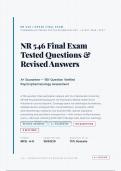
NR 54 6 / NR 54 6 FINAL EXAM
C HA M BE R L A IN P M HN P P S Y C HO P HA R M A C O L O GY · L AT E S T 2 0 2 0 2 7
NR 546 Final Exam
Tested Questions &
Revised Answers
A+ Guarantee — 150-Question Verified
Psychopharmacology Assessment
A 150-question final examination aligned with the Chamberlain University
NR 546 Psychopharmacology for the Psychiatric-Mental Health Nurse
Practitioner course blueprint. Coverage spans neurobiological foundations,
antidepressants, antipsychotics, mood stabilizers, anxiolytics, ADHD
pharmacotherapy, substance use disorder MAT, special-population
prescribing, and psychiatric emergencies — with revised verified answers
and A+ rationales reflecting 2026–2027 FDA approvals, black box warnings,
and current PMHNP evidence-based guidelines.
RE VI SE D AN SWE RS A+ GUARAN TE E 15 0 Q UE STI O N S
9 SE CTI O N S
F O R M AT CO GN ITIV E MIX Q UE STIO N STY LE
MCQ · A–D 30/50/20 75% Scenario
Z .A I · A D VA N C E D P R A C T I C E N U R S I N G E D U C AT I O N A + V ER IFIED
,NR 546 Final Exam · Latest · A+ Guarantee Chamberlain PMHNP Psychopharmacology
NR 546 / NR546 Final Exam
Tested Questions with Revised Answers · Latest · A+ Guarantee
Total Questions 150
Total Sections 9
Format Multiple Choice (A–D), one correct answer per question
Cognitive Mix ~30% recall, ~50% application, ~20% analysis
Question Style ~75% scenario-based, ~25% direct recall
Coverage Neurobiology; antidepressants; antipsychotics; mood stabilizers; anxiolytics; ADHD; MAT; special
populations; psychiatric emergencies
Answer Format Correct answer marked with [CORRECT]; rationale with pharmacologic reasoning and clinical
application
A+ Guarantee Revised verified answers reflecting 2026–2027 FDA approvals, black box warnings, and PMHNP
evidence-based guidelines
Section 1: Foundations of Psychopharmacology and Neurobiology
Neurotransmitters, Receptors, & Pharmacokinetics in Psychiatry (Q1–Q15)
Q1: A PMHNP is selecting an antidepressant for a patient with prominent anhedonia, psychomotor
slowing, and decreased motivation. The NP understands that these symptoms are most closely associated
with dysregulation in which dopaminergic pathway?
A. Mesolimbic pathway — associated with reward, motivation, and pleasure [CORRECT]
B. Nigrostriatal pathway — associated with voluntary movement
C. Tuberoinfundibular pathway — associated with prolactin regulation
D. Mesocortical pathway — associated with executive function and negative symptoms of schizophrenia
Correct Answer: A
Rationale: The mesolimbic pathway projects from the ventral tegmental area (VTA) to the nucleus accumbens and is the
primary reward circuit. Hypoactivity here produces anhedonia, apathy, and reduced motivation — key depressive symptoms.
The nigrostriatal pathway governs movement (EPS with D2 blockade). The tuberoinfundibular pathway regulates prolactin
(galactorrhea with D2 blockade). The mesocortical pathway governs prefrontal executive function and the negative symptoms
of schizophrenia. A+ verified: target the mesolimbic pathway when anhedonia is prominent.
Q2: Which statement BEST describes the pharmacokinetic concept of first-pass metabolism as it applies to
orally administered psychotropic medications?
A. Drug metabolism that occurs in the brain before reaching the target receptor
B. Hepatic metabolism of a drug absorbed from the gut before it reaches systemic circulation, reducing
bioavailability — clinically relevant for drugs like oral fluoxetine, venlafaxine, and chlorpromazine
[CORRECT]
C. The initial distribution of drug into adipose tissue
D. Renal excretion of the parent compound before hepatic conjugation
Z.ai · Advanced Practice Nursing Education Page 1
,NR 546 Final Exam · Latest · A+ Guarantee Chamberlain PMHNP Psychopharmacology
Correct Answer: B
Rationale: First-pass (presystemic) metabolism refers to drug metabolism by the liver (and gut wall) before the drug reaches
systemic circulation, reducing the bioavailability of orally administered agents. For example, oral morphine has ~30%
bioavailability due to extensive first-pass metabolism. Venlafaxine undergoes first-pass metabolism to its active metabolite
O-desmethylvenlafaxine. Sublingual, rectal, IV, and IM routes bypass first-pass metabolism. A+ verified: this concept is
foundational to understanding route selection and dose equivalency.
Q3: A patient is started on fluoxetine 20 mg daily. The patient asks why the full therapeutic effect takes 4–6
weeks even though the medication reaches steady-state serum levels in just days. Which mechanism BEST
explains the delayed therapeutic onset?
A. Acute synaptic serotonin reuptake blockade produces immediate elevations, but therapeutic
antidepressant effects require downstream neuroadaptation — including 5-HT1A receptor desensitization,
increased BDNF expression, and hippocampal neurogenesis over 4–6 weeks [CORRECT]
B. Fluoxetine accumulates in adipose tissue for 4 weeks before releasing
C. The patient must first develop tolerance to the SSRI side effects
D. Steady-state is not reached for 4 weeks with fluoxetine
Correct Answer: A
Rationale: SSRIs acutely block the serotonin transporter (SERT), raising synaptic serotonin within hours. However, therapeutic
antidepressant effects lag by 4–6 weeks because they require downstream neuroadaptation: 5-HT1A autoreceptor
desensitization (allowing raphe firing to recover), increased BDNF expression, enhanced neurogenesis in the hippocampus, and
slow remodeling of neural circuits. A+ verified: explaining this delay is essential for patient adherence counseling. The other
options misattribute the delay to pharmacokinetics or tolerance.
Q4: Which of the following cytochrome P450 enzymes is BOTH a major target for inhibition by SSRIs
AND responsible for metabolism of many psychiatric medications, including TCAs, benzodiazepines, and
atypical antipsychotics?
A. CYP2D6 [CORRECT]
B. CYP1A2
C. CYP2C9
D. CYP2E1
Correct Answer: A
Rationale: CYP2D6 metabolizes a wide range of psychiatric drugs: TCAs, several SSRIs (fluoxetine, paroxetine are potent
inhibitors), venlafaxine, atomoxetine, several atypical antipsychotics (risperidone, aripiprazole), and codeine (activation).
Fluoxetine and paroxetine are potent CYP2D6 inhibitors — co-prescription can dramatically raise levels of substrates like
desipramine or risperidone. CYP1A2 (smoking induces; fluvoxamine inhibits) handles olanzapine and clozapine. CYP2C9
handles phenytoin and warfarin. CYP2E1 handles ethanol and acetaminophen. A+ verified: CYP2D6 is the single most
clinically relevant enzyme in psychopharmacology.
Q5: African-American patients prescribed fluoxetine 20 mg daily have a higher likelihood of
treatment-emergent activation, insomnia, and treatment-emergent side effects at standard Caucasian
doses. Which pharmacogenomic consideration is MOST likely responsible?
A. Higher prevalence of reduced-function CYP2D6 alleles in some populations of African descent, leading
to slower fluoxetine metabolism and higher effective drug exposure [CORRECT]
B. African-Americans lack the serotonin transporter
C. Fluoxetine is contraindicated in African-American patients
D. African-American patients metabolize SSRIs faster than Caucasians
Z.ai · Advanced Practice Nursing Education Page 2
, NR 546 Final Exam · Latest · A+ Guarantee Chamberlain PMHNP Psychopharmacology
Correct Answer: A
Rationale: Reduced-function CYP2D6 alleles (e.g., *17) are more prevalent in some populations of African descent, leading
to slower metabolism of CYP2D6 substrates and higher effective drug exposure at standard doses. Fluoxetine and paroxetine
are potent CYP2D6 inhibitors themselves, compounding the effect. The pharmacogenomic lesson is to 'start low, go slow' and
monitor for treatment-emergent side effects. A+ verified: cultural-genomic awareness is a PMHNP competency. The other
options are factually incorrect (SSRI contraindications, transporter absence, faster metabolism).
Q6: Which statement BEST describes the mechanism by which psychotropic drugs with high lipid
solubility and low protein binding (e.g., diazepam) differ from those with low lipid solubility (e.g.,
lorazepam) in clinical practice?
A. Highly lipid-soluble drugs have faster onset (rapid CNS penetration) and longer duration (extensive
tissue redistribution, hepatic storage, and accumulation), while less lipid-soluble drugs have slower onset
and shorter, more predictable duration [CORRECT]
B. Lipid solubility has no effect on clinical pharmacology
C. Highly lipid-soluble drugs are less likely to cross the blood-brain barrier
D. Low lipid solubility drugs have a longer half-life
Correct Answer: A
Rationale: Lipid solubility predicts both speed of CNS penetration (onset) and pattern of redistribution. Diazepam (highly lipid
soluble) crosses the BBB rapidly (fast onset) but also redistributes into peripheral adipose tissue, creating a long apparent
half-life (20–100+ hours) and tissue accumulation with chronic dosing. Lorazepam (less lipid soluble) has slower onset but
shorter, more predictable half-life (10–20 hours), making it preferable for elderly patients and acute alcohol withdrawal. A+
verified: this principle guides benzodiazepine selection in hepatic dysfunction, elderly, and acute settings.
Q7: Which neurotransmitter system is the PRIMARY target of antipsychotic medications in the treatment
of positive psychotic symptoms (hallucinations, delusions)?
A. Dopamine D2 receptor antagonism in the mesolimbic pathway [CORRECT]
B. Serotonin 5-HT2A receptor agonism in the cortex
C. Norepinephrine alpha-1 receptor antagonism in the locus coeruleus
D. GABA-A receptor modulation in the cerebellum
Correct Answer: A
Rationale: All antipsychotics, first- and second-generation, share D2 receptor antagonism in the mesolimbic pathway as their
primary mechanism for reducing positive symptoms. The degree of D2 occupancy correlates with antipsychotic efficacy (and
EPS risk). Second-generation antipsychotics add 5-HT2A antagonism, which theoretically improves negative symptoms and
reduces EPS risk. A+ verified: the dopamine hypothesis of psychosis underlies all antipsychotic pharmacology. The other
options list effects of some antipsychotics but not the primary antipsychotic mechanism.
Q8: Which best describes the difference between agonists, partial agonists, and antagonists at a
G-protein-coupled receptor?
A. Agonists produce full receptor activation; partial agonists produce submaximal activation even at full
receptor occupancy (and can act as antagonists in the presence of a full agonist); antagonists produce no
activation but block agonist binding [CORRECT]
B. Agonists and partial agonists are interchangeable
C. Antagonists produce activation that is greater than full agonists
D. Partial agonists cannot bind to the receptor at all
Correct Answer: A
Z.ai · Advanced Practice Nursing Education Page 3
C HA M BE R L A IN P M HN P P S Y C HO P HA R M A C O L O GY · L AT E S T 2 0 2 0 2 7
NR 546 Final Exam
Tested Questions &
Revised Answers
A+ Guarantee — 150-Question Verified
Psychopharmacology Assessment
A 150-question final examination aligned with the Chamberlain University
NR 546 Psychopharmacology for the Psychiatric-Mental Health Nurse
Practitioner course blueprint. Coverage spans neurobiological foundations,
antidepressants, antipsychotics, mood stabilizers, anxiolytics, ADHD
pharmacotherapy, substance use disorder MAT, special-population
prescribing, and psychiatric emergencies — with revised verified answers
and A+ rationales reflecting 2026–2027 FDA approvals, black box warnings,
and current PMHNP evidence-based guidelines.
RE VI SE D AN SWE RS A+ GUARAN TE E 15 0 Q UE STI O N S
9 SE CTI O N S
F O R M AT CO GN ITIV E MIX Q UE STIO N STY LE
MCQ · A–D 30/50/20 75% Scenario
Z .A I · A D VA N C E D P R A C T I C E N U R S I N G E D U C AT I O N A + V ER IFIED
,NR 546 Final Exam · Latest · A+ Guarantee Chamberlain PMHNP Psychopharmacology
NR 546 / NR546 Final Exam
Tested Questions with Revised Answers · Latest · A+ Guarantee
Total Questions 150
Total Sections 9
Format Multiple Choice (A–D), one correct answer per question
Cognitive Mix ~30% recall, ~50% application, ~20% analysis
Question Style ~75% scenario-based, ~25% direct recall
Coverage Neurobiology; antidepressants; antipsychotics; mood stabilizers; anxiolytics; ADHD; MAT; special
populations; psychiatric emergencies
Answer Format Correct answer marked with [CORRECT]; rationale with pharmacologic reasoning and clinical
application
A+ Guarantee Revised verified answers reflecting 2026–2027 FDA approvals, black box warnings, and PMHNP
evidence-based guidelines
Section 1: Foundations of Psychopharmacology and Neurobiology
Neurotransmitters, Receptors, & Pharmacokinetics in Psychiatry (Q1–Q15)
Q1: A PMHNP is selecting an antidepressant for a patient with prominent anhedonia, psychomotor
slowing, and decreased motivation. The NP understands that these symptoms are most closely associated
with dysregulation in which dopaminergic pathway?
A. Mesolimbic pathway — associated with reward, motivation, and pleasure [CORRECT]
B. Nigrostriatal pathway — associated with voluntary movement
C. Tuberoinfundibular pathway — associated with prolactin regulation
D. Mesocortical pathway — associated with executive function and negative symptoms of schizophrenia
Correct Answer: A
Rationale: The mesolimbic pathway projects from the ventral tegmental area (VTA) to the nucleus accumbens and is the
primary reward circuit. Hypoactivity here produces anhedonia, apathy, and reduced motivation — key depressive symptoms.
The nigrostriatal pathway governs movement (EPS with D2 blockade). The tuberoinfundibular pathway regulates prolactin
(galactorrhea with D2 blockade). The mesocortical pathway governs prefrontal executive function and the negative symptoms
of schizophrenia. A+ verified: target the mesolimbic pathway when anhedonia is prominent.
Q2: Which statement BEST describes the pharmacokinetic concept of first-pass metabolism as it applies to
orally administered psychotropic medications?
A. Drug metabolism that occurs in the brain before reaching the target receptor
B. Hepatic metabolism of a drug absorbed from the gut before it reaches systemic circulation, reducing
bioavailability — clinically relevant for drugs like oral fluoxetine, venlafaxine, and chlorpromazine
[CORRECT]
C. The initial distribution of drug into adipose tissue
D. Renal excretion of the parent compound before hepatic conjugation
Z.ai · Advanced Practice Nursing Education Page 1
,NR 546 Final Exam · Latest · A+ Guarantee Chamberlain PMHNP Psychopharmacology
Correct Answer: B
Rationale: First-pass (presystemic) metabolism refers to drug metabolism by the liver (and gut wall) before the drug reaches
systemic circulation, reducing the bioavailability of orally administered agents. For example, oral morphine has ~30%
bioavailability due to extensive first-pass metabolism. Venlafaxine undergoes first-pass metabolism to its active metabolite
O-desmethylvenlafaxine. Sublingual, rectal, IV, and IM routes bypass first-pass metabolism. A+ verified: this concept is
foundational to understanding route selection and dose equivalency.
Q3: A patient is started on fluoxetine 20 mg daily. The patient asks why the full therapeutic effect takes 4–6
weeks even though the medication reaches steady-state serum levels in just days. Which mechanism BEST
explains the delayed therapeutic onset?
A. Acute synaptic serotonin reuptake blockade produces immediate elevations, but therapeutic
antidepressant effects require downstream neuroadaptation — including 5-HT1A receptor desensitization,
increased BDNF expression, and hippocampal neurogenesis over 4–6 weeks [CORRECT]
B. Fluoxetine accumulates in adipose tissue for 4 weeks before releasing
C. The patient must first develop tolerance to the SSRI side effects
D. Steady-state is not reached for 4 weeks with fluoxetine
Correct Answer: A
Rationale: SSRIs acutely block the serotonin transporter (SERT), raising synaptic serotonin within hours. However, therapeutic
antidepressant effects lag by 4–6 weeks because they require downstream neuroadaptation: 5-HT1A autoreceptor
desensitization (allowing raphe firing to recover), increased BDNF expression, enhanced neurogenesis in the hippocampus, and
slow remodeling of neural circuits. A+ verified: explaining this delay is essential for patient adherence counseling. The other
options misattribute the delay to pharmacokinetics or tolerance.
Q4: Which of the following cytochrome P450 enzymes is BOTH a major target for inhibition by SSRIs
AND responsible for metabolism of many psychiatric medications, including TCAs, benzodiazepines, and
atypical antipsychotics?
A. CYP2D6 [CORRECT]
B. CYP1A2
C. CYP2C9
D. CYP2E1
Correct Answer: A
Rationale: CYP2D6 metabolizes a wide range of psychiatric drugs: TCAs, several SSRIs (fluoxetine, paroxetine are potent
inhibitors), venlafaxine, atomoxetine, several atypical antipsychotics (risperidone, aripiprazole), and codeine (activation).
Fluoxetine and paroxetine are potent CYP2D6 inhibitors — co-prescription can dramatically raise levels of substrates like
desipramine or risperidone. CYP1A2 (smoking induces; fluvoxamine inhibits) handles olanzapine and clozapine. CYP2C9
handles phenytoin and warfarin. CYP2E1 handles ethanol and acetaminophen. A+ verified: CYP2D6 is the single most
clinically relevant enzyme in psychopharmacology.
Q5: African-American patients prescribed fluoxetine 20 mg daily have a higher likelihood of
treatment-emergent activation, insomnia, and treatment-emergent side effects at standard Caucasian
doses. Which pharmacogenomic consideration is MOST likely responsible?
A. Higher prevalence of reduced-function CYP2D6 alleles in some populations of African descent, leading
to slower fluoxetine metabolism and higher effective drug exposure [CORRECT]
B. African-Americans lack the serotonin transporter
C. Fluoxetine is contraindicated in African-American patients
D. African-American patients metabolize SSRIs faster than Caucasians
Z.ai · Advanced Practice Nursing Education Page 2
, NR 546 Final Exam · Latest · A+ Guarantee Chamberlain PMHNP Psychopharmacology
Correct Answer: A
Rationale: Reduced-function CYP2D6 alleles (e.g., *17) are more prevalent in some populations of African descent, leading
to slower metabolism of CYP2D6 substrates and higher effective drug exposure at standard doses. Fluoxetine and paroxetine
are potent CYP2D6 inhibitors themselves, compounding the effect. The pharmacogenomic lesson is to 'start low, go slow' and
monitor for treatment-emergent side effects. A+ verified: cultural-genomic awareness is a PMHNP competency. The other
options are factually incorrect (SSRI contraindications, transporter absence, faster metabolism).
Q6: Which statement BEST describes the mechanism by which psychotropic drugs with high lipid
solubility and low protein binding (e.g., diazepam) differ from those with low lipid solubility (e.g.,
lorazepam) in clinical practice?
A. Highly lipid-soluble drugs have faster onset (rapid CNS penetration) and longer duration (extensive
tissue redistribution, hepatic storage, and accumulation), while less lipid-soluble drugs have slower onset
and shorter, more predictable duration [CORRECT]
B. Lipid solubility has no effect on clinical pharmacology
C. Highly lipid-soluble drugs are less likely to cross the blood-brain barrier
D. Low lipid solubility drugs have a longer half-life
Correct Answer: A
Rationale: Lipid solubility predicts both speed of CNS penetration (onset) and pattern of redistribution. Diazepam (highly lipid
soluble) crosses the BBB rapidly (fast onset) but also redistributes into peripheral adipose tissue, creating a long apparent
half-life (20–100+ hours) and tissue accumulation with chronic dosing. Lorazepam (less lipid soluble) has slower onset but
shorter, more predictable half-life (10–20 hours), making it preferable for elderly patients and acute alcohol withdrawal. A+
verified: this principle guides benzodiazepine selection in hepatic dysfunction, elderly, and acute settings.
Q7: Which neurotransmitter system is the PRIMARY target of antipsychotic medications in the treatment
of positive psychotic symptoms (hallucinations, delusions)?
A. Dopamine D2 receptor antagonism in the mesolimbic pathway [CORRECT]
B. Serotonin 5-HT2A receptor agonism in the cortex
C. Norepinephrine alpha-1 receptor antagonism in the locus coeruleus
D. GABA-A receptor modulation in the cerebellum
Correct Answer: A
Rationale: All antipsychotics, first- and second-generation, share D2 receptor antagonism in the mesolimbic pathway as their
primary mechanism for reducing positive symptoms. The degree of D2 occupancy correlates with antipsychotic efficacy (and
EPS risk). Second-generation antipsychotics add 5-HT2A antagonism, which theoretically improves negative symptoms and
reduces EPS risk. A+ verified: the dopamine hypothesis of psychosis underlies all antipsychotic pharmacology. The other
options list effects of some antipsychotics but not the primary antipsychotic mechanism.
Q8: Which best describes the difference between agonists, partial agonists, and antagonists at a
G-protein-coupled receptor?
A. Agonists produce full receptor activation; partial agonists produce submaximal activation even at full
receptor occupancy (and can act as antagonists in the presence of a full agonist); antagonists produce no
activation but block agonist binding [CORRECT]
B. Agonists and partial agonists are interchangeable
C. Antagonists produce activation that is greater than full agonists
D. Partial agonists cannot bind to the receptor at all
Correct Answer: A
Z.ai · Advanced Practice Nursing Education Page 3


