[STUDY GUIDE] • HIGH-YIELD PRACTICE & REVIEW EDITION
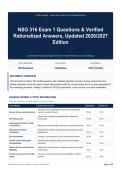
NSG 316 Exam 1 Questions & Verified
Rationalized Answers, Updated 2026/2027
Edition
Comprehensive Examination Question Bank • In-Depth Rationales • Concept Mapping
TOTAL QUESTIONS EXAM TOPICS RATIONALES
150 Questions 12 Modules 100% Verified
DOCUMENT OVERVIEW
This document contains 150 verified questions with detailed rationales covering nursing assessment and
patient evaluation. Each item pairs a board-style question with the correct answer and a concise explanation of
the underlying principles, making it suitable for NCLEX preparation, course review, and rapid remediation.
EXAM BLUEPRINT & TOPIC DISTRIBUTION
Systematic breakdown of subject domains and exam coverage.
Topic Module Scope & Core Focus Questions Share (%)
Focuses on the comprehensive assessment and general
General Survey and Assessment survey of a patient's health. 13 Qs 8.7%
Covers the evaluation and characteristics of acute and
Pain Assessment chronic pain. 13 Qs 8.7%
Instrumental Activities of Daily
Living (IADLs) Measures functional abilities necessary for independent living. 13 Qs 8.7%
Physical Examination Examines the methods and techniques used during physical
Techniques assessments. 13 Qs 8.7%
Skin Assessment Focuses on the evaluation of skin conditions and lesions. 13 Qs 8.7%
Cultural and Environmental Explores factors affecting health promotion and disease
Considerations prevention. 13 Qs 8.7%
Patient History and Information Emphasizes the importance of reliable sources and accurate
Reliability health history. 12 Qs 8.0%
Functional Assessment of Older Focuses on assessing the functional capabilities of elderly
Adults patients. 12 Qs 8.0%
Confidential • Student Study Edition • Practice & Review Guide Page 1 of 39
,STUDENT STUDY & MASTERY EDITION PRACTICE & REVIEW GUIDE
Assessment of Fluid and
Nutritional Status Evaluates hydration status and nutritional needs. 12 Qs 8.0%
Evaluating Caregiver Burden Assesses the impact of caregiving on family members. 12 Qs 8.0%
Pressure Ulcer Assessment Describes the characteristics and stages of pressure ulcers. 12 Qs 8.0%
Analyzes patient behaviors associated with acute and chronic
Behavioral Responses to Pain pain. 12 Qs 8.0%
Total Exam Coverage 12 Integrated Topic Modules 150 Qs 100.0%
Confidential • Student Study Edition • Practice & Review Guide Page 2 of 39
,STUDENT STUDY & MASTERY EDITION PRACTICE & REVIEW GUIDE
TOPIC 1: GENERAL SURVEY AND ASSESSMENT
13 Questions • 8.7% of Exam • Focuses on the comprehensive assessment and general survey of a patient's health.
QUESTION 1
What is a general survey?
Correct Answer: A study of the whole person, covering the general health state and any obvious physical
characteristics.
Rationale: A general survey is a comprehensive assessment that encompasses a person's overall well-being and physical
attributes, allowing for a complete understanding of their health state. This broad approach is necessary to identify any
potential health issues or abnormalities, making a general survey an essential tool in medical and health-related
evaluations.
QUESTION 2
What is included in a general survey?
Correct Answer: Physical appearance, body structure, mobility, and behavior.
Rationale: A general survey typically aims to capture a comprehensive overview of a subject or entity, and including
physical appearance, body structure, mobility, and behavior provides a holistic understanding of an individual or object by
considering both visible and functional
aspects. This broad scope allows researchers to identify patterns, characteristics, and relationships that might not be
apparent through a narrower focus, making it a fundamental component of a general survey.
QUESTION 3
What is a comprehensive assessment (Complete Total Health Assessment)?
Correct Answer: A complete health history and a full physical examination where they describe current and
past health states and form a baseline to measure all future changes (ex. home healthcare setting)
Rationale: A comprehensive assessment is necessary to establish a baseline of an individual's health status, which serves
as a reference point to monitor changes and track the effectiveness of subsequent interventions and treatments over time.
This baseline is crucial in identifying potential health risks, preventing complications, and providing individualized care that
takes into account a person's unique health profile and needs.
Confidential • Student Study Edition • Practice & Review Guide Page 3 of 39
, STUDENT STUDY & MASTERY EDITION PRACTICE & REVIEW GUIDE
QUESTION 4
What is a Follow-Up Database?
Correct Answer: Evaluating the status of all identified problems and noting if changes have occurred (ex.
primary care physician
appointment)
Rationale: A Follow-Up Database is a system that tracks and monitors progress over time, allowing healthcare
professionals to assess changes in patient conditions and treatment outcomes. By evaluating the status of identified
problems and noting changes, such as a primary care physician appointment, the database facilitates informed
decision-making and effective care planning.
QUESTION 5
How does the Health History Sequence go?
Correct Answer: Biographical Data
Source of History
Reason for Seeking Care
Present Health or History of present illness
Past Health
Family History
Review of Systems (ROS)
Functional Assessment (IADL's)
Rationale: The Health History Sequence begins with "Biographical Data" to establish a foundation of the patient's identity,
background, and context for their care, while "Source of History" follows to clarify the source of the patient's information,
such as a family member or the patient themselves. This order sets the stage for gathering more specific and relevant health
information, including medical history, to inform the patient's care plan.
QUESTION 6
What are the base of the fingers or ULNAR surface of the hand used for when
palpating?
Correct Answer: Vibrations.
Rationale: The base of the fingers or ULNAR surface of the hand is used for palpating because it provides a stable and firm
foundation for the palpatory process, allowing the examiner to apply even pressure and sense subtle vibrations in the
underlying tissues. This is due to the fact that these areas of the hand are less sensitive to pain and touch, allowing the
examiner to focus on detecting the subtle changes in texture and consistency that are indicative of underlying tissue
conditions.
Confidential • Student Study Edition • Practice & Review Guide Page 4 of 39
NSG 316 Exam 1 Questions & Verified
Rationalized Answers, Updated 2026/2027
Edition
Comprehensive Examination Question Bank • In-Depth Rationales • Concept Mapping
TOTAL QUESTIONS EXAM TOPICS RATIONALES
150 Questions 12 Modules 100% Verified
DOCUMENT OVERVIEW
This document contains 150 verified questions with detailed rationales covering nursing assessment and
patient evaluation. Each item pairs a board-style question with the correct answer and a concise explanation of
the underlying principles, making it suitable for NCLEX preparation, course review, and rapid remediation.
EXAM BLUEPRINT & TOPIC DISTRIBUTION
Systematic breakdown of subject domains and exam coverage.
Topic Module Scope & Core Focus Questions Share (%)
Focuses on the comprehensive assessment and general
General Survey and Assessment survey of a patient's health. 13 Qs 8.7%
Covers the evaluation and characteristics of acute and
Pain Assessment chronic pain. 13 Qs 8.7%
Instrumental Activities of Daily
Living (IADLs) Measures functional abilities necessary for independent living. 13 Qs 8.7%
Physical Examination Examines the methods and techniques used during physical
Techniques assessments. 13 Qs 8.7%
Skin Assessment Focuses on the evaluation of skin conditions and lesions. 13 Qs 8.7%
Cultural and Environmental Explores factors affecting health promotion and disease
Considerations prevention. 13 Qs 8.7%
Patient History and Information Emphasizes the importance of reliable sources and accurate
Reliability health history. 12 Qs 8.0%
Functional Assessment of Older Focuses on assessing the functional capabilities of elderly
Adults patients. 12 Qs 8.0%
Confidential • Student Study Edition • Practice & Review Guide Page 1 of 39
,STUDENT STUDY & MASTERY EDITION PRACTICE & REVIEW GUIDE
Assessment of Fluid and
Nutritional Status Evaluates hydration status and nutritional needs. 12 Qs 8.0%
Evaluating Caregiver Burden Assesses the impact of caregiving on family members. 12 Qs 8.0%
Pressure Ulcer Assessment Describes the characteristics and stages of pressure ulcers. 12 Qs 8.0%
Analyzes patient behaviors associated with acute and chronic
Behavioral Responses to Pain pain. 12 Qs 8.0%
Total Exam Coverage 12 Integrated Topic Modules 150 Qs 100.0%
Confidential • Student Study Edition • Practice & Review Guide Page 2 of 39
,STUDENT STUDY & MASTERY EDITION PRACTICE & REVIEW GUIDE
TOPIC 1: GENERAL SURVEY AND ASSESSMENT
13 Questions • 8.7% of Exam • Focuses on the comprehensive assessment and general survey of a patient's health.
QUESTION 1
What is a general survey?
Correct Answer: A study of the whole person, covering the general health state and any obvious physical
characteristics.
Rationale: A general survey is a comprehensive assessment that encompasses a person's overall well-being and physical
attributes, allowing for a complete understanding of their health state. This broad approach is necessary to identify any
potential health issues or abnormalities, making a general survey an essential tool in medical and health-related
evaluations.
QUESTION 2
What is included in a general survey?
Correct Answer: Physical appearance, body structure, mobility, and behavior.
Rationale: A general survey typically aims to capture a comprehensive overview of a subject or entity, and including
physical appearance, body structure, mobility, and behavior provides a holistic understanding of an individual or object by
considering both visible and functional
aspects. This broad scope allows researchers to identify patterns, characteristics, and relationships that might not be
apparent through a narrower focus, making it a fundamental component of a general survey.
QUESTION 3
What is a comprehensive assessment (Complete Total Health Assessment)?
Correct Answer: A complete health history and a full physical examination where they describe current and
past health states and form a baseline to measure all future changes (ex. home healthcare setting)
Rationale: A comprehensive assessment is necessary to establish a baseline of an individual's health status, which serves
as a reference point to monitor changes and track the effectiveness of subsequent interventions and treatments over time.
This baseline is crucial in identifying potential health risks, preventing complications, and providing individualized care that
takes into account a person's unique health profile and needs.
Confidential • Student Study Edition • Practice & Review Guide Page 3 of 39
, STUDENT STUDY & MASTERY EDITION PRACTICE & REVIEW GUIDE
QUESTION 4
What is a Follow-Up Database?
Correct Answer: Evaluating the status of all identified problems and noting if changes have occurred (ex.
primary care physician
appointment)
Rationale: A Follow-Up Database is a system that tracks and monitors progress over time, allowing healthcare
professionals to assess changes in patient conditions and treatment outcomes. By evaluating the status of identified
problems and noting changes, such as a primary care physician appointment, the database facilitates informed
decision-making and effective care planning.
QUESTION 5
How does the Health History Sequence go?
Correct Answer: Biographical Data
Source of History
Reason for Seeking Care
Present Health or History of present illness
Past Health
Family History
Review of Systems (ROS)
Functional Assessment (IADL's)
Rationale: The Health History Sequence begins with "Biographical Data" to establish a foundation of the patient's identity,
background, and context for their care, while "Source of History" follows to clarify the source of the patient's information,
such as a family member or the patient themselves. This order sets the stage for gathering more specific and relevant health
information, including medical history, to inform the patient's care plan.
QUESTION 6
What are the base of the fingers or ULNAR surface of the hand used for when
palpating?
Correct Answer: Vibrations.
Rationale: The base of the fingers or ULNAR surface of the hand is used for palpating because it provides a stable and firm
foundation for the palpatory process, allowing the examiner to apply even pressure and sense subtle vibrations in the
underlying tissues. This is due to the fact that these areas of the hand are less sensitive to pain and touch, allowing the
examiner to focus on detecting the subtle changes in texture and consistency that are indicative of underlying tissue
conditions.
Confidential • Student Study Edition • Practice & Review Guide Page 4 of 39