
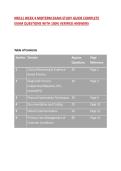
NR511 WEEK 4 MIDTERM EXAM STUDY GUIDE COMPLETE
EXAM QUESTIONS WITH 100% VERIFIED ANSWERS
Table of Contents
Section Domain Approx. Page
Questions Reference
1 Clinical Reasoning & Evidence- 20 Page 1
Based Practice
2 Diagnostic Process 30 Page 3
(Subjective/Objective, HPI,
OLDCARTS)
3 Physical Examination Techniques 30 Page 6
4 Documentation and Coding 20 Page 10
5 Patient Communication 20 Page 12
6 Primary Care Management of 80 Page 14
Common Conditions
,Section 1: Clinical Reasoning & Evidence-Based Practice (Questions 1-
20)
1. Which component of the PICO format describes the patient
population or problem being addressed?
A) I
B) C
C) O
D) P
Correct Answer: D
Rationale: In the PICO framework, P stands for
Patient/Population/Problem, I stands for Intervention, C stands for
Comparison, and O stands for Outcome.
2. A provider uses clinical expertise and the best available research
evidence while considering patient values to make a decision. This is
an example of:
A) Evidence-Based Practice
B) Traditional medicine
C) Cost-effective care
D) Standardized protocols
Correct Answer: A
Rationale: Evidence-Based Practice (EBP) integrates the best research
evidence with clinical expertise and patient values to facilitate clinical
decision-making.
3. Which type of study provides the highest level of evidence for
clinical decision-making?
A) Case-control study
,B) Cohort study
C) Systematic review and meta-analysis
D) Randomized controlled trial
Correct Answer: C
Rationale: Systematic reviews and meta-analyses of randomized
controlled trials sit at the top of the evidence hierarchy.
4. What is the primary purpose of using the "Teach-Back" method in
clinical practice?
A) To test the patient's intelligence
B) To speed up the discharge process
C) To confirm patient understanding of the provided information
D) To document the visit accurately
Correct Answer: C
Rationale: Teach-back is a communication technique used to ensure the
patient understands what they have been told by asking them to
explain it in their own words.
5. A provider notices a patient has a positive test result for a rare
disease, but the patient is asymptomatic. Which principle helps
interpret this result?
A) Sensitivity
B) Specificity
C) Positive Predictive Value (PPV)
D) Negative Predictive Value (NPV)
Correct Answer: C
Rationale: PPV is the probability that a positive test result is truly
positive and is heavily influenced by disease prevalence.
, 6. Which clinical reasoning error occurs when a provider locks onto an
initial diagnosis and fails to consider alternatives?
A) Confirmation bias
B) Anchoring bias
C) Availability heuristic
D) Premature closure
Correct Answer: B
Rationale: Anchoring bias occurs when the provider relies too heavily
on the first piece of information (the anchor) when making decisions.
7. What does the "NNT" measure in clinical research?
A) The number of patients needed to be screened to prevent one death
B) The number of patients who need to be treated to prevent one
additional bad outcome
C) The number needed to harm
D) The total number of patients in a trial
Correct Answer: B
Rationale: Number Needed to Treat (NNT) is the inverse of the absolute
risk reduction and tells the provider how many patients must be treated
to prevent one adverse event.
8. Which of the following is a key component of clinical reasoning in
primary care?
A) Relying solely on patient-reported symptoms
B) Integrating subjective and objective data to formulate a differential
diagnosis
C) Ordering all possible diagnostic tests immediately
D) Avoiding shared decision-making to save time
Correct Answer: B
Rationale: Clinical reasoning involves synthesizing subjective and
EXAM QUESTIONS WITH 100% VERIFIED ANSWERS
Table of Contents
Section Domain Approx. Page
Questions Reference
1 Clinical Reasoning & Evidence- 20 Page 1
Based Practice
2 Diagnostic Process 30 Page 3
(Subjective/Objective, HPI,
OLDCARTS)
3 Physical Examination Techniques 30 Page 6
4 Documentation and Coding 20 Page 10
5 Patient Communication 20 Page 12
6 Primary Care Management of 80 Page 14
Common Conditions
,Section 1: Clinical Reasoning & Evidence-Based Practice (Questions 1-
20)
1. Which component of the PICO format describes the patient
population or problem being addressed?
A) I
B) C
C) O
D) P
Correct Answer: D
Rationale: In the PICO framework, P stands for
Patient/Population/Problem, I stands for Intervention, C stands for
Comparison, and O stands for Outcome.
2. A provider uses clinical expertise and the best available research
evidence while considering patient values to make a decision. This is
an example of:
A) Evidence-Based Practice
B) Traditional medicine
C) Cost-effective care
D) Standardized protocols
Correct Answer: A
Rationale: Evidence-Based Practice (EBP) integrates the best research
evidence with clinical expertise and patient values to facilitate clinical
decision-making.
3. Which type of study provides the highest level of evidence for
clinical decision-making?
A) Case-control study
,B) Cohort study
C) Systematic review and meta-analysis
D) Randomized controlled trial
Correct Answer: C
Rationale: Systematic reviews and meta-analyses of randomized
controlled trials sit at the top of the evidence hierarchy.
4. What is the primary purpose of using the "Teach-Back" method in
clinical practice?
A) To test the patient's intelligence
B) To speed up the discharge process
C) To confirm patient understanding of the provided information
D) To document the visit accurately
Correct Answer: C
Rationale: Teach-back is a communication technique used to ensure the
patient understands what they have been told by asking them to
explain it in their own words.
5. A provider notices a patient has a positive test result for a rare
disease, but the patient is asymptomatic. Which principle helps
interpret this result?
A) Sensitivity
B) Specificity
C) Positive Predictive Value (PPV)
D) Negative Predictive Value (NPV)
Correct Answer: C
Rationale: PPV is the probability that a positive test result is truly
positive and is heavily influenced by disease prevalence.
, 6. Which clinical reasoning error occurs when a provider locks onto an
initial diagnosis and fails to consider alternatives?
A) Confirmation bias
B) Anchoring bias
C) Availability heuristic
D) Premature closure
Correct Answer: B
Rationale: Anchoring bias occurs when the provider relies too heavily
on the first piece of information (the anchor) when making decisions.
7. What does the "NNT" measure in clinical research?
A) The number of patients needed to be screened to prevent one death
B) The number of patients who need to be treated to prevent one
additional bad outcome
C) The number needed to harm
D) The total number of patients in a trial
Correct Answer: B
Rationale: Number Needed to Treat (NNT) is the inverse of the absolute
risk reduction and tells the provider how many patients must be treated
to prevent one adverse event.
8. Which of the following is a key component of clinical reasoning in
primary care?
A) Relying solely on patient-reported symptoms
B) Integrating subjective and objective data to formulate a differential
diagnosis
C) Ordering all possible diagnostic tests immediately
D) Avoiding shared decision-making to save time
Correct Answer: B
Rationale: Clinical reasoning involves synthesizing subjective and


