

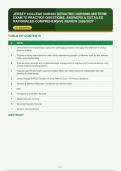
JERSEY COLLEGE NUR202 GERIATRIC NURSING MIDTERM
EXAM 75 PRACTICE QUESTIONS, ANSWERS & DETAILED
RATIONALES COMPREHENSIVE REVIEW 2026/2027
147 QUESTIONS
TABLE OF CONTENTS
# TOPIC
1 Differentiate normal physiologic aging from pathologic processes and apply this distinction to clinical
decision-making
2 Prioritize nursing interventions for older adults experiencing geriatric syndromes such as falls, delirium,
frailty, and polypharmacy
3 Evaluate pharmacologic and nonpharmacologic management of cognitive and functional decline using
current evidence-based guidelines
4 Integrate age-friendly health system principles (4Ms) and interprofessional collaboration into care
planning for older adults
5 Jersey College NUR202 Geriatric Nursing Midterm Exam 75 Practice Questions
6 Answers & Detailed Rationales Comprehensive Review 2026
7 2027
8 Foundations of Geriatric Nursing
9 Applied Geriatric Nursing
10 Advanced Geriatric Nursing
11 Geriatric Nursing Review
ABSTRACT
Page 1
,This study document brings together 147 carefully worded exam questions drawn from Jersey
College NUR202 Geriatric Nursing Midterm Exam 75 Practice Questions, Answers & Detailed
Rationales Comprehensive Review 2026/2027, with the strongest emphasis placed on Differentiate
normal physiologic aging from pathologic processes and apply this distinction to clinical
decision-making, Prioritize nursing interventions for older adults experiencing geriatric syndromes
such as falls, delirium, frailty, and polypharmacy and Evaluate pharmacologic and
nonpharmacologic management of cognitive and functional decline using current evidence-based
guidelines. Every item follows the wording style and level of reasoning you meet in the real paper,
and each one is paired with a clear rationale so the correct choice is never a guess. Work through
the set at your own pace, mark the questions that slow you down, then come back to them until the
reasoning feels automatic. Learners who revise this way walk into the exam room recognising the
pattern behind the questions instead of meeting them for the first time. Keep going - steady, honest
practice is what turns a difficult paper into a comfortable pass.
Q1 DIFFERENTIATE NORMAL PHYSIOLOGIC AGING FROM PATHOLOGIC PROCESSES AND
APPLY THIS DISTINCTION TO CLINICAL DECISION-MAKING
Which physiologic change of aging most directly explains why an older adult can
have a normal oral temperature while mounting a serious systemic infection?
A. Reduced cutaneous vasoconstriction capacity
B. Blunted hypothalamic thermoregulatory set-point response CORRECT
C. Decreased skeletal muscle mass and shivering thermogenesis
D. Impaired sweat gland function and evaporative cooling
RATIONALE: Aging blunts the hypothalamic set-point response, so infection may not trigger fever
despite serious illness. Reduced vasoconstriction, sarcopenia, and impaired sweating affect heat
conservation or cooling but do not explain the absence of a febrile response. Recognizing this
atypical presentation prevents delayed treatment of infection.
Page 2
,Q2 DIFFERENTIATE NORMAL PHYSIOLOGIC AGING FROM PATHOLOGIC PROCESSES AND
APPLY THIS DISTINCTION TO CLINICAL DECISION-MAKING
An older adult with heart failure is prescribed furosemide. Which assessment
finding best indicates a potentially life-threatening complication requiring
immediate intervention?
A. Serum potassium of 3.1 mEq/L with new-onset confusion CORRECT
B. Urine output of 40 mL/hr with mild thirst
C. Weight loss of 0.5 kg over 24 hours
D. Blood pressure of 118/70 mm Hg with dizziness on standing
RATIONALE: Loop diuretics cause hypokalemia, and a potassium of 3.1 mEq/L with new
confusion suggests possible arrhythmia or cerebral hypoperfusion, demanding immediate action.
Mild thirst, modest weight loss, and orthostatic dizziness are expected or less urgent. The
combination of hypokalemia and neurologic change signals a life-threatening electrolyte
disturbance.
Q3 DIFFERENTIATE NORMAL PHYSIOLOGIC AGING FROM PATHOLOGIC PROCESSES AND
APPLY THIS DISTINCTION TO CLINICAL DECISION-MAKING
Which statement best reflects the concept of 'geriatric frailty' as currently defined
in clinical practice?
A. A syndrome of increased vulnerability from decreased physiologic reserve and multisystem
dysregulation CORRECT
B. A normal consequence of aging characterized by gradual weight loss and weakness
C. A reversible condition caused primarily by deconditioning after acute illness
D. A diagnosis of exclusion when no specific disease explains functional decline
RATIONALE: Frailty is a distinct syndrome of decreased reserve and multisystem dysregulation,
not a normal aging change or simply deconditioning. It is not a diagnosis of exclusion but a
measurable clinical state. This definition guides targeted interventions such as exercise and
nutrition.
Page 3
, Q4 DIFFERENTIATE NORMAL PHYSIOLOGIC AGING FROM PATHOLOGIC PROCESSES AND
APPLY THIS DISTINCTION TO CLINICAL DECISION-MAKING
An older adult is admitted with sudden onset of inattention, disorganized thinking,
and altered level of consciousness that fluctuates over hours. Which intervention
should the nurse prioritize first?
A. Administer a benzodiazepine to manage agitation
B. Obtain a urine sample for culture and sensitivity
C. Initiate a delirium screening tool and identify underlying causes CORRECT
D. Apply physical restraints to prevent falls
RATIONALE: Delirium is a medical emergency; the priority is to screen and identify reversible
causes such as infection, medications, or metabolic derangements. Benzodiazepines and
restraints can worsen delirium. Urine culture is one part of the workup but not the first action.
Q5 DIFFERENTIATE NORMAL PHYSIOLOGIC AGING FROM PATHOLOGIC PROCESSES AND
APPLY THIS DISTINCTION TO CLINICAL DECISION-MAKING
Which factor most increases the risk of adverse drug events in older adults
receiving multiple medications?
A. Increased hepatic first-pass metabolism
B. Decreased glomerular filtration rate and altered volume of distribution CORRECT
C. Enhanced gastric motility and rapid absorption
D. Increased serum albumin binding capacity
RATIONALE: Age-related decline in renal clearance and changes in body composition prolong
drug half-life and increase adverse effects. Hepatic metabolism and gastric motility are generally
decreased, not increased, and albumin is often lower. These pharmacokinetic changes underlie
the need for dose adjustments.
Page 4
EXAM 75 PRACTICE QUESTIONS, ANSWERS & DETAILED
RATIONALES COMPREHENSIVE REVIEW 2026/2027
147 QUESTIONS
TABLE OF CONTENTS
# TOPIC
1 Differentiate normal physiologic aging from pathologic processes and apply this distinction to clinical
decision-making
2 Prioritize nursing interventions for older adults experiencing geriatric syndromes such as falls, delirium,
frailty, and polypharmacy
3 Evaluate pharmacologic and nonpharmacologic management of cognitive and functional decline using
current evidence-based guidelines
4 Integrate age-friendly health system principles (4Ms) and interprofessional collaboration into care
planning for older adults
5 Jersey College NUR202 Geriatric Nursing Midterm Exam 75 Practice Questions
6 Answers & Detailed Rationales Comprehensive Review 2026
7 2027
8 Foundations of Geriatric Nursing
9 Applied Geriatric Nursing
10 Advanced Geriatric Nursing
11 Geriatric Nursing Review
ABSTRACT
Page 1
,This study document brings together 147 carefully worded exam questions drawn from Jersey
College NUR202 Geriatric Nursing Midterm Exam 75 Practice Questions, Answers & Detailed
Rationales Comprehensive Review 2026/2027, with the strongest emphasis placed on Differentiate
normal physiologic aging from pathologic processes and apply this distinction to clinical
decision-making, Prioritize nursing interventions for older adults experiencing geriatric syndromes
such as falls, delirium, frailty, and polypharmacy and Evaluate pharmacologic and
nonpharmacologic management of cognitive and functional decline using current evidence-based
guidelines. Every item follows the wording style and level of reasoning you meet in the real paper,
and each one is paired with a clear rationale so the correct choice is never a guess. Work through
the set at your own pace, mark the questions that slow you down, then come back to them until the
reasoning feels automatic. Learners who revise this way walk into the exam room recognising the
pattern behind the questions instead of meeting them for the first time. Keep going - steady, honest
practice is what turns a difficult paper into a comfortable pass.
Q1 DIFFERENTIATE NORMAL PHYSIOLOGIC AGING FROM PATHOLOGIC PROCESSES AND
APPLY THIS DISTINCTION TO CLINICAL DECISION-MAKING
Which physiologic change of aging most directly explains why an older adult can
have a normal oral temperature while mounting a serious systemic infection?
A. Reduced cutaneous vasoconstriction capacity
B. Blunted hypothalamic thermoregulatory set-point response CORRECT
C. Decreased skeletal muscle mass and shivering thermogenesis
D. Impaired sweat gland function and evaporative cooling
RATIONALE: Aging blunts the hypothalamic set-point response, so infection may not trigger fever
despite serious illness. Reduced vasoconstriction, sarcopenia, and impaired sweating affect heat
conservation or cooling but do not explain the absence of a febrile response. Recognizing this
atypical presentation prevents delayed treatment of infection.
Page 2
,Q2 DIFFERENTIATE NORMAL PHYSIOLOGIC AGING FROM PATHOLOGIC PROCESSES AND
APPLY THIS DISTINCTION TO CLINICAL DECISION-MAKING
An older adult with heart failure is prescribed furosemide. Which assessment
finding best indicates a potentially life-threatening complication requiring
immediate intervention?
A. Serum potassium of 3.1 mEq/L with new-onset confusion CORRECT
B. Urine output of 40 mL/hr with mild thirst
C. Weight loss of 0.5 kg over 24 hours
D. Blood pressure of 118/70 mm Hg with dizziness on standing
RATIONALE: Loop diuretics cause hypokalemia, and a potassium of 3.1 mEq/L with new
confusion suggests possible arrhythmia or cerebral hypoperfusion, demanding immediate action.
Mild thirst, modest weight loss, and orthostatic dizziness are expected or less urgent. The
combination of hypokalemia and neurologic change signals a life-threatening electrolyte
disturbance.
Q3 DIFFERENTIATE NORMAL PHYSIOLOGIC AGING FROM PATHOLOGIC PROCESSES AND
APPLY THIS DISTINCTION TO CLINICAL DECISION-MAKING
Which statement best reflects the concept of 'geriatric frailty' as currently defined
in clinical practice?
A. A syndrome of increased vulnerability from decreased physiologic reserve and multisystem
dysregulation CORRECT
B. A normal consequence of aging characterized by gradual weight loss and weakness
C. A reversible condition caused primarily by deconditioning after acute illness
D. A diagnosis of exclusion when no specific disease explains functional decline
RATIONALE: Frailty is a distinct syndrome of decreased reserve and multisystem dysregulation,
not a normal aging change or simply deconditioning. It is not a diagnosis of exclusion but a
measurable clinical state. This definition guides targeted interventions such as exercise and
nutrition.
Page 3
, Q4 DIFFERENTIATE NORMAL PHYSIOLOGIC AGING FROM PATHOLOGIC PROCESSES AND
APPLY THIS DISTINCTION TO CLINICAL DECISION-MAKING
An older adult is admitted with sudden onset of inattention, disorganized thinking,
and altered level of consciousness that fluctuates over hours. Which intervention
should the nurse prioritize first?
A. Administer a benzodiazepine to manage agitation
B. Obtain a urine sample for culture and sensitivity
C. Initiate a delirium screening tool and identify underlying causes CORRECT
D. Apply physical restraints to prevent falls
RATIONALE: Delirium is a medical emergency; the priority is to screen and identify reversible
causes such as infection, medications, or metabolic derangements. Benzodiazepines and
restraints can worsen delirium. Urine culture is one part of the workup but not the first action.
Q5 DIFFERENTIATE NORMAL PHYSIOLOGIC AGING FROM PATHOLOGIC PROCESSES AND
APPLY THIS DISTINCTION TO CLINICAL DECISION-MAKING
Which factor most increases the risk of adverse drug events in older adults
receiving multiple medications?
A. Increased hepatic first-pass metabolism
B. Decreased glomerular filtration rate and altered volume of distribution CORRECT
C. Enhanced gastric motility and rapid absorption
D. Increased serum albumin binding capacity
RATIONALE: Age-related decline in renal clearance and changes in body composition prolong
drug half-life and increase adverse effects. Hepatic metabolism and gastric motility are generally
decreased, not increased, and albumin is often lower. These pharmacokinetic changes underlie
the need for dose adjustments.
Page 4


