
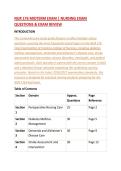
NUR 176 MIDTERM EXAM | NURSING EXAM
QUESTIONS & EXAM REVIEW
INTRODUCTION
This comprehensive study guide features verified multiple-choice
questions covering the most frequently tested topics on the NUR 176
Final Examination at Hondros College of Nursing, including diabetes
mellitus management, dementia and Alzheimer’s disease care, stroke
assessment and intervention, seizure disorders, meningitis, and patient
safety protocols. Each question is paired with the correct answer in bold
and a detailed clinical rationale explaining the underlying nursing
principles. Based on the latest 2026/2027 examination standards, this
resource is designed for practical nursing students preparing for the
NUR 176 Final Exam.
Table of Contents
Section Domain Approx. Page
Questions Reference
Section Perioperative Nursing Care 25 Page 2
1
Section Diabetes Mellitus 30 Page 5
2 Management
Section Dementia and Alzheimer's 30 Page 9
3 Disease Care
Section Stroke Assessment and 30 Page 13
4 Intervention
,Section Seizure Disorders 25 Page 17
5
Section Meningitis 20 Page 20
6
Section Patient Safety Protocols 40 Page 22
7
SECTION 1: PERIOPERATIVE NURSING CARE (Q1-25)
1. A nurse is caring for a patient scheduled for surgery. Which finding
requires immediate notification of the surgeon?
A) Blood pressure 130/80 mmHg
B) Temperature 101.2°F
C) Heart rate 88 bpm
D) Respiratory rate 18 breaths/min
Correct Answer: B
Rationale: An elevated temperature may indicate an active infection,
which can increase the risk of surgical complications and warrants
immediate medical evaluation to determine if the surgery should be
postponed. Vital signs within normal limits (A, C, D) do not require
immediate notification.
2. A nurse is providing preoperative teaching to a patient. Which
statement by the patient indicates a need for further teaching?
A) "I will not eat or drink anything after midnight."
B) "I will take my daily aspirin with a sip of water the morning of
surgery."
C) "I will shower with the antiseptic soap the night before and the
,morning of surgery."
D) "I will remove my jewelry and contact lenses before going to the
operating room."
Correct Answer: B
Rationale: Aspirin is an anticoagulant and can increase the risk of
bleeding during surgery. Patients are typically instructed to hold aspirin
and other blood thinners before surgery unless specifically directed
otherwise by the surgeon. The other statements are correct
preoperative instructions.
3. A postoperative patient is exhibiting signs of malignant
hyperthermia. Which medication should the nurse anticipate
administering?
A) Atropine
B) Epinephrine
C) Dantrolene
D) Narcan
Correct Answer: C
Rationale: Malignant hyperthermia is a severe reaction to certain
anesthetic agents. Dantrolene is the specific antidote used to treat this
condition by inhibiting calcium release in the muscle cells. Atropine,
Epinephrine, and Narcan are not used to treat malignant hyperthermia.
4. A nurse is assessing a patient in the PACU. Which assessment
finding is the highest priority?
A) The patient's oxygen saturation is 88% on room air.
B) The patient reports incisional pain at a level of 6/10.
C) The patient's urinary output is 30 mL/hr.
D) The patient has a dry and intact surgical dressing.
Correct Answer: A
, Rationale: Using the ABC (Airway, Breathing, Circulation) priority
framework, airway and breathing are always the highest priority. An
oxygen saturation of 88% indicates hypoxemia and requires immediate
intervention. Pain, urinary output, and dressing integrity are important
but secondary to oxygenation.
5. A nurse is preparing a patient for surgery. Who is responsible for
obtaining the patient's informed consent?
A) The admitting nurse
B) The circulating nurse
C) The surgeon performing the procedure
D) The anesthesiologist
Correct Answer: C
Rationale: The surgeon is responsible for obtaining informed consent, as
they are the ones who will perform the procedure and can explain the
risks, benefits, and alternatives. The nurse's role is to witness the
signature and ensure the patient understands the information provided.
6. A patient is scheduled for surgery and asks the nurse why they must
stop taking their herbal supplements. Which response by the nurse is
best?
A) "Herbal supplements are not regulated by the FDA."
B) "They can interact with your anesthesia and cause complications."
C) "Some herbal supplements can increase your risk for bleeding or
interact with anesthesia."
D) "You need to stop them because they will interfere with your lab
results."
Correct Answer: C
Rationale: Many herbal supplements (e.g., ginkgo, garlic, ginseng) can
increase the risk of bleeding or interact with anesthetic agents. The
QUESTIONS & EXAM REVIEW
INTRODUCTION
This comprehensive study guide features verified multiple-choice
questions covering the most frequently tested topics on the NUR 176
Final Examination at Hondros College of Nursing, including diabetes
mellitus management, dementia and Alzheimer’s disease care, stroke
assessment and intervention, seizure disorders, meningitis, and patient
safety protocols. Each question is paired with the correct answer in bold
and a detailed clinical rationale explaining the underlying nursing
principles. Based on the latest 2026/2027 examination standards, this
resource is designed for practical nursing students preparing for the
NUR 176 Final Exam.
Table of Contents
Section Domain Approx. Page
Questions Reference
Section Perioperative Nursing Care 25 Page 2
1
Section Diabetes Mellitus 30 Page 5
2 Management
Section Dementia and Alzheimer's 30 Page 9
3 Disease Care
Section Stroke Assessment and 30 Page 13
4 Intervention
,Section Seizure Disorders 25 Page 17
5
Section Meningitis 20 Page 20
6
Section Patient Safety Protocols 40 Page 22
7
SECTION 1: PERIOPERATIVE NURSING CARE (Q1-25)
1. A nurse is caring for a patient scheduled for surgery. Which finding
requires immediate notification of the surgeon?
A) Blood pressure 130/80 mmHg
B) Temperature 101.2°F
C) Heart rate 88 bpm
D) Respiratory rate 18 breaths/min
Correct Answer: B
Rationale: An elevated temperature may indicate an active infection,
which can increase the risk of surgical complications and warrants
immediate medical evaluation to determine if the surgery should be
postponed. Vital signs within normal limits (A, C, D) do not require
immediate notification.
2. A nurse is providing preoperative teaching to a patient. Which
statement by the patient indicates a need for further teaching?
A) "I will not eat or drink anything after midnight."
B) "I will take my daily aspirin with a sip of water the morning of
surgery."
C) "I will shower with the antiseptic soap the night before and the
,morning of surgery."
D) "I will remove my jewelry and contact lenses before going to the
operating room."
Correct Answer: B
Rationale: Aspirin is an anticoagulant and can increase the risk of
bleeding during surgery. Patients are typically instructed to hold aspirin
and other blood thinners before surgery unless specifically directed
otherwise by the surgeon. The other statements are correct
preoperative instructions.
3. A postoperative patient is exhibiting signs of malignant
hyperthermia. Which medication should the nurse anticipate
administering?
A) Atropine
B) Epinephrine
C) Dantrolene
D) Narcan
Correct Answer: C
Rationale: Malignant hyperthermia is a severe reaction to certain
anesthetic agents. Dantrolene is the specific antidote used to treat this
condition by inhibiting calcium release in the muscle cells. Atropine,
Epinephrine, and Narcan are not used to treat malignant hyperthermia.
4. A nurse is assessing a patient in the PACU. Which assessment
finding is the highest priority?
A) The patient's oxygen saturation is 88% on room air.
B) The patient reports incisional pain at a level of 6/10.
C) The patient's urinary output is 30 mL/hr.
D) The patient has a dry and intact surgical dressing.
Correct Answer: A
, Rationale: Using the ABC (Airway, Breathing, Circulation) priority
framework, airway and breathing are always the highest priority. An
oxygen saturation of 88% indicates hypoxemia and requires immediate
intervention. Pain, urinary output, and dressing integrity are important
but secondary to oxygenation.
5. A nurse is preparing a patient for surgery. Who is responsible for
obtaining the patient's informed consent?
A) The admitting nurse
B) The circulating nurse
C) The surgeon performing the procedure
D) The anesthesiologist
Correct Answer: C
Rationale: The surgeon is responsible for obtaining informed consent, as
they are the ones who will perform the procedure and can explain the
risks, benefits, and alternatives. The nurse's role is to witness the
signature and ensure the patient understands the information provided.
6. A patient is scheduled for surgery and asks the nurse why they must
stop taking their herbal supplements. Which response by the nurse is
best?
A) "Herbal supplements are not regulated by the FDA."
B) "They can interact with your anesthesia and cause complications."
C) "Some herbal supplements can increase your risk for bleeding or
interact with anesthesia."
D) "You need to stop them because they will interfere with your lab
results."
Correct Answer: C
Rationale: Many herbal supplements (e.g., ginkgo, garlic, ginseng) can
increase the risk of bleeding or interact with anesthetic agents. The


