

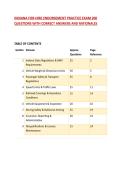
INDIANA FOR-HIRE ENDORSEMENT PRACTICE EXAM 200
QUESTIONS WITH CORRECT ANSWERS AND RATIONALES
TABLE OF CONTENTS
Section Domain Approx. Page
Questions Reference
1 Indiana State Regulations & BMV 25 2
Requirements
2 Vehicle Weight & Dimension Limits 30 5
3 Passenger Safety & Transport 25 8
Regulations
4 Speed Limits & Traffic Laws 25 11
5 Railroad Crossings & Hazardous 15 14
Conditions
6 Vehicle Equipment & Inspection 20 16
7 Driving Safety & Defensive Driving 25 19
8 Insurance, Reporting & 20 22
Administrative
9 Disqualifications & License 15 24
Maintenance
,SECTION 1: INDIANA STATE REGULATIONS & BMV REQUIREMENTS
1. What is the primary purpose of the Indiana For-Hire endorsement
on a driver's license?
A. To authorize operation of any vehicle weighing over 26,000 pounds
B. To permit the transportation of passengers or property for
compensation within Indiana
C. To operate a school bus on designated routes only
D. To drive farm equipment on public highways
Correct Answer: B — The Indiana For-Hire endorsement, governed by
Indiana Code Title 9, specifically authorizes drivers to operate vehicles
for compensation, including taxis, limousines, and certain delivery
services. Option A is incorrect because weight-based authorization falls
under Commercial Driver's License (CDL) classifications. Option C is
incorrect because school bus operation requires a separate School Bus
endorsement. Option D is incorrect because farm equipment operation
is exempt from For-Hire requirements under Indiana agricultural
exemptions.
2. Under Indiana Code Title 9, which of the following operations
requires a driver to hold a valid For-Hire endorsement?
A. A farmer transporting personal livestock to a local market
B. A volunteer driver transporting seniors for a non-profit organization
without compensation
C. A courier service driver delivering packages for a fee within
Indianapolis
D. A person moving their own household goods in a rented truck
Correct Answer: C — Any operation transporting property or
passengers for compensation requires the For-Hire endorsement.
,Option A is incorrect because personal agricultural transport is exempt.
Option B is incorrect because volunteer operations without
compensation do not trigger For-Hire requirements. Option D is
incorrect because transporting one's own property is not a for-hire
operation.
3. What is the minimum age required to obtain a For-Hire
endorsement for intrastate operation in Indiana?
A. 16 years old
B. 18 years old
C. 21 years old
D. 25 years old
Correct Answer: B — Indiana allows drivers aged 18 and older to obtain
a For-Hire endorsement for intrastate operations. Option A is incorrect
because 16-year-olds are restricted to standard passenger vehicle
operation. Option C is incorrect because 21 is the federal minimum for
interstate commerce. Option D is incorrect because 25 is not a statutory
age requirement.
4. An Indiana-based driver with a For-Hire endorsement picks up a
load in Fort Wayne and delivers it to Chicago, Illinois. Which
regulatory framework primarily governs this operation?
A. Indiana Code Title 9 exclusively
B. Federal Motor Carrier Safety Regulations (FMCSR)
C. Illinois state traffic laws exclusively
D. Local municipal ordinances only
Correct Answer: B — Once a commercial operation crosses state lines,
it becomes interstate commerce and is subject to FMCSR regardless of
the state of origin. Option A is incorrect because Indiana Code does not
, exclusively govern interstate movements. Option C is incorrect because
while Illinois traffic laws apply to the route, the operational and safety
regulations are federal. Option D is incorrect because municipal
ordinances do not supersede federal motor carrier regulations.
5. How long is a For-Hire endorsement valid in Indiana?
A. 1 year
B. 3 years
C. 4 years
D. 5 years
Correct Answer: C — The For-Hire endorsement is valid for the same
period as the driver's license, which is typically 4 years for an Indiana
credential. Options A, B, and D do not align with the standard Indiana
driver's license renewal cycle.
6. What is the minimum required insurance coverage for a taxicab
transporting passengers in Indiana?
A. $25,000/$50,000/$25,000
B. $50,000/$100,000/$25,000
C. $300,000 combined single limit
D. $1,000,000 combined single limit
Correct Answer: C — Indiana Code 9-18-4-2 specifies a $300,000
combined single limit for taxicabs. Options A and B represent lower
coverage amounts that do not meet Indiana's statutory requirement for
taxicabs. Option D exceeds the minimum requirement.
7. A passenger leaves a briefcase in your vehicle. According to Indiana
law, how long must you attempt to locate the owner before the item
is considered abandoned?
A. 24 hours
QUESTIONS WITH CORRECT ANSWERS AND RATIONALES
TABLE OF CONTENTS
Section Domain Approx. Page
Questions Reference
1 Indiana State Regulations & BMV 25 2
Requirements
2 Vehicle Weight & Dimension Limits 30 5
3 Passenger Safety & Transport 25 8
Regulations
4 Speed Limits & Traffic Laws 25 11
5 Railroad Crossings & Hazardous 15 14
Conditions
6 Vehicle Equipment & Inspection 20 16
7 Driving Safety & Defensive Driving 25 19
8 Insurance, Reporting & 20 22
Administrative
9 Disqualifications & License 15 24
Maintenance
,SECTION 1: INDIANA STATE REGULATIONS & BMV REQUIREMENTS
1. What is the primary purpose of the Indiana For-Hire endorsement
on a driver's license?
A. To authorize operation of any vehicle weighing over 26,000 pounds
B. To permit the transportation of passengers or property for
compensation within Indiana
C. To operate a school bus on designated routes only
D. To drive farm equipment on public highways
Correct Answer: B — The Indiana For-Hire endorsement, governed by
Indiana Code Title 9, specifically authorizes drivers to operate vehicles
for compensation, including taxis, limousines, and certain delivery
services. Option A is incorrect because weight-based authorization falls
under Commercial Driver's License (CDL) classifications. Option C is
incorrect because school bus operation requires a separate School Bus
endorsement. Option D is incorrect because farm equipment operation
is exempt from For-Hire requirements under Indiana agricultural
exemptions.
2. Under Indiana Code Title 9, which of the following operations
requires a driver to hold a valid For-Hire endorsement?
A. A farmer transporting personal livestock to a local market
B. A volunteer driver transporting seniors for a non-profit organization
without compensation
C. A courier service driver delivering packages for a fee within
Indianapolis
D. A person moving their own household goods in a rented truck
Correct Answer: C — Any operation transporting property or
passengers for compensation requires the For-Hire endorsement.
,Option A is incorrect because personal agricultural transport is exempt.
Option B is incorrect because volunteer operations without
compensation do not trigger For-Hire requirements. Option D is
incorrect because transporting one's own property is not a for-hire
operation.
3. What is the minimum age required to obtain a For-Hire
endorsement for intrastate operation in Indiana?
A. 16 years old
B. 18 years old
C. 21 years old
D. 25 years old
Correct Answer: B — Indiana allows drivers aged 18 and older to obtain
a For-Hire endorsement for intrastate operations. Option A is incorrect
because 16-year-olds are restricted to standard passenger vehicle
operation. Option C is incorrect because 21 is the federal minimum for
interstate commerce. Option D is incorrect because 25 is not a statutory
age requirement.
4. An Indiana-based driver with a For-Hire endorsement picks up a
load in Fort Wayne and delivers it to Chicago, Illinois. Which
regulatory framework primarily governs this operation?
A. Indiana Code Title 9 exclusively
B. Federal Motor Carrier Safety Regulations (FMCSR)
C. Illinois state traffic laws exclusively
D. Local municipal ordinances only
Correct Answer: B — Once a commercial operation crosses state lines,
it becomes interstate commerce and is subject to FMCSR regardless of
the state of origin. Option A is incorrect because Indiana Code does not
, exclusively govern interstate movements. Option C is incorrect because
while Illinois traffic laws apply to the route, the operational and safety
regulations are federal. Option D is incorrect because municipal
ordinances do not supersede federal motor carrier regulations.
5. How long is a For-Hire endorsement valid in Indiana?
A. 1 year
B. 3 years
C. 4 years
D. 5 years
Correct Answer: C — The For-Hire endorsement is valid for the same
period as the driver's license, which is typically 4 years for an Indiana
credential. Options A, B, and D do not align with the standard Indiana
driver's license renewal cycle.
6. What is the minimum required insurance coverage for a taxicab
transporting passengers in Indiana?
A. $25,000/$50,000/$25,000
B. $50,000/$100,000/$25,000
C. $300,000 combined single limit
D. $1,000,000 combined single limit
Correct Answer: C — Indiana Code 9-18-4-2 specifies a $300,000
combined single limit for taxicabs. Options A and B represent lower
coverage amounts that do not meet Indiana's statutory requirement for
taxicabs. Option D exceeds the minimum requirement.
7. A passenger leaves a briefcase in your vehicle. According to Indiana
law, how long must you attempt to locate the owner before the item
is considered abandoned?
A. 24 hours


