

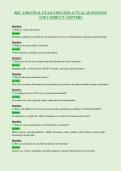
REC 2100 FINAL EXAM UPDATED ACTUAL QUESTIONS
AND CORRECT ANSWERS
Question:
1. What are visitor attractions?
Answer:
Permanent, publicly accessible sites for education, interest, or entertainment, requiring no prior booking.
Question:
2. What are the three pillars of tourism?
Answer:
Visitor attractions, transport, and accommodation.
Question:
3. What types of sites are excluded from the definition of visitor attractions?
Answer:
Shopping malls, events/festivals, film/TV locations, and local cultural elements.
Question:
4. Why do attractions matter in tourism?
Answer:
They drive economic development, local spending, job creation, and shape destination image and identity.
Question:
5. According to Pearce (1991), how is an attraction defined?
Answer:
As a named site with a specific feature, either natural or human-made.
Question:
6. What is the difference between an attraction and a destination according to Swarbrooke (2002)?
Answer:
An attraction is a single site, while a destination is a cluster of attractions and services.
Question:
7. What are some classifications of attractions by core product?
Answer:
Historic houses, museums/galleries, wildlife attractions, castles, gardens, steam railways, leisure parks,
national/provincial parks.
Question:
8. How can attractions be classified by physical environment?
Answer:
Natural (e.g., forests, mountains) and built (adapted or purpose-built structures for tourism).
,Question:
9. What are key characteristics of visitor attractions?
Answer:
Ownership, perception, admission policy, appeal, size & capacity, composition, degree of permanence,
visitor numbers, and organizational risk.
Question:
10. What factors contribute to the success of visitor attractions?
Answer:
Development, marketing, visitor experience, and strong onsite interpretation.
Question:
11. What is the importance of strategic planning for attractions?
Answer:
It prevents decline and financial failure through long-term planning.
Question:
12. What are some visitor management tools for attractions?
Answer:
Supply-led (opening hours, queue management) and demand-led (pricing, promotions).
Question:
13. What is carrying capacity in the context of attractions?
Answer:
Physical limits of space and perceptual thresholds for visitor comfort.
Question:
14. What are some solutions to seasonality issues in attractions?
Answer:
Off-season training, winter festivals, and digital/virtual engagement.
Question:
15. What is the benefit of collaboration and clustering among attractions?
Answer:
Creates critical mass, shared branding, and reduced costs.
Question:
16. How does diversification help attractions?
Answer:
It keeps attractions relevant and reduces risk.
Question:
17. What is the lifecycle of attractions according to Lennon (2001)?
Answer:
Attractions follow a growth, maturity, and decline cycle.
, Question:
18. What are some economic impacts of attractions?
Answer:
They generate significant economic benefits, such as the Mardi Gras impact of US$332M.
Question:
19. What are some environmental impacts of visitor attractions?
Answer:
Erosion, damage to infrastructure, and sanitation issues.
Question:
20. What is an example of conservation-led planning in attractions?
Answer:
Assiniboine Park Conservancy.
Question:
21. What does the hospitality sector encompass?
Answer:
Food, drink, and accommodations consumed away from home.
Question:
22. What are the two main characteristics of the accommodation sector?
Answer:
Capital-intensive (buildings, infrastructure) and labour-intensive (high staffing needs).
Question:
23. What are the five elements of the accommodation product according to Medlik & Ingram (2000)?
Answer:
1. Location 2. Facilities 3. Services 4. Pricing 5. Marketing
Question:
24. What historical event marked the beginning of organized lodging?
Answer:
The Roman Empire.
Question:
25. What significant development in tourist accommodations occurred in 1282?
Answer:
The establishment of the first innkeeper's guild.
Question:
26. What was the first purpose-built hotel and when was it established?
Answer:
The first purpose-built hotel was established in 1831.
AND CORRECT ANSWERS
Question:
1. What are visitor attractions?
Answer:
Permanent, publicly accessible sites for education, interest, or entertainment, requiring no prior booking.
Question:
2. What are the three pillars of tourism?
Answer:
Visitor attractions, transport, and accommodation.
Question:
3. What types of sites are excluded from the definition of visitor attractions?
Answer:
Shopping malls, events/festivals, film/TV locations, and local cultural elements.
Question:
4. Why do attractions matter in tourism?
Answer:
They drive economic development, local spending, job creation, and shape destination image and identity.
Question:
5. According to Pearce (1991), how is an attraction defined?
Answer:
As a named site with a specific feature, either natural or human-made.
Question:
6. What is the difference between an attraction and a destination according to Swarbrooke (2002)?
Answer:
An attraction is a single site, while a destination is a cluster of attractions and services.
Question:
7. What are some classifications of attractions by core product?
Answer:
Historic houses, museums/galleries, wildlife attractions, castles, gardens, steam railways, leisure parks,
national/provincial parks.
Question:
8. How can attractions be classified by physical environment?
Answer:
Natural (e.g., forests, mountains) and built (adapted or purpose-built structures for tourism).
,Question:
9. What are key characteristics of visitor attractions?
Answer:
Ownership, perception, admission policy, appeal, size & capacity, composition, degree of permanence,
visitor numbers, and organizational risk.
Question:
10. What factors contribute to the success of visitor attractions?
Answer:
Development, marketing, visitor experience, and strong onsite interpretation.
Question:
11. What is the importance of strategic planning for attractions?
Answer:
It prevents decline and financial failure through long-term planning.
Question:
12. What are some visitor management tools for attractions?
Answer:
Supply-led (opening hours, queue management) and demand-led (pricing, promotions).
Question:
13. What is carrying capacity in the context of attractions?
Answer:
Physical limits of space and perceptual thresholds for visitor comfort.
Question:
14. What are some solutions to seasonality issues in attractions?
Answer:
Off-season training, winter festivals, and digital/virtual engagement.
Question:
15. What is the benefit of collaboration and clustering among attractions?
Answer:
Creates critical mass, shared branding, and reduced costs.
Question:
16. How does diversification help attractions?
Answer:
It keeps attractions relevant and reduces risk.
Question:
17. What is the lifecycle of attractions according to Lennon (2001)?
Answer:
Attractions follow a growth, maturity, and decline cycle.
, Question:
18. What are some economic impacts of attractions?
Answer:
They generate significant economic benefits, such as the Mardi Gras impact of US$332M.
Question:
19. What are some environmental impacts of visitor attractions?
Answer:
Erosion, damage to infrastructure, and sanitation issues.
Question:
20. What is an example of conservation-led planning in attractions?
Answer:
Assiniboine Park Conservancy.
Question:
21. What does the hospitality sector encompass?
Answer:
Food, drink, and accommodations consumed away from home.
Question:
22. What are the two main characteristics of the accommodation sector?
Answer:
Capital-intensive (buildings, infrastructure) and labour-intensive (high staffing needs).
Question:
23. What are the five elements of the accommodation product according to Medlik & Ingram (2000)?
Answer:
1. Location 2. Facilities 3. Services 4. Pricing 5. Marketing
Question:
24. What historical event marked the beginning of organized lodging?
Answer:
The Roman Empire.
Question:
25. What significant development in tourist accommodations occurred in 1282?
Answer:
The establishment of the first innkeeper's guild.
Question:
26. What was the first purpose-built hotel and when was it established?
Answer:
The first purpose-built hotel was established in 1831.


