

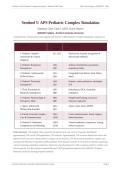
Sentinel U APS Pediatric Complex Simulation - Madison Clark Case 100% Score Report | 2026/2027 - NKU
Sentinel U APS Pediatric Complex Simulation
Madison Clark Case | 100% Score Report
2026/2027 Update - Northern Kentucky University
Comprehensive 110-Question Exam aligned with Sentinel U APS Pediatric Complex Simulation competencies
Section Question Topic Focus
Range
1. Pediatric Complex Q1 - Q15 Head-to-toe, focused, recognition of
Assessment & Clinical deterioration (PEWS)
Judgment
2. Pediatric Respiratory Q16 - Asthma, bronchiolitis, pneumonia,
Emergencies Q30 respiratory failure
3. Pediatric Cardiovascular Q31 - Congenital heart defects, heart failure,
& Shock States Q43 shock
4. Pediatric Neurologic Q44 - Seizures, status epilepticus, meningitis,
Emergencies Q55 ICP
5. Fluid, Electrolyte & Q56 - Dehydration, DKA, electrolyte
Metabolic Emergencies Q68 imbalances
6. Pediatric Pharmacology & Q69 - Weight-based dosing, vasoactive
Emergency Meds Q80 infusions, high-alert
7. Sepsis, Infection & Q81 - Sepsis, septic shock, MODS
Multisystem Disorders Q91
8. Family-Centered Complex Q92 - Crisis communication, family support,
Care & Communication Q100 shared decisions
9. Sentinel U Simulation Q101 - Virtual simulation, competency scoring,
Competencies & Debriefing Q110 reflective practice
Exam structure: 110 multiple-choice questions (4 options each, one correct). Cognitive distribution
approximately 25% recall, 50% application, 25% analysis. Approximately 75% scenario-based items tied to the
Madison Clark case and related pediatric complex care scenarios; 25% direct recall of pediatric complex care
concepts and PALS/Surviving Sepsis/AAP guidelines. Each question includes a 2-4 sentence rationale explaining
clinical reasoning, simulation competency alignment, and why distractors reflect common pediatric complex care
misconceptions. Use this exam for targeted Sentinel U APS preparation aligned to the 2026/2027 Northern
Kentucky University nursing program standards.
Northern Kentucky University | Advanced Practice Series Page 1
,Sentinel U APS Pediatric Complex Simulation - Madison Clark Case 100% Score Report | 2026/2027 - NKU
Section 1: Pediatric Complex Assessment and Clinical Judgment (Head-to-Toe,
Focused Assessment, & Recognition of Deterioration)
Q1: Madison Clark, a 4-year-old admitted with respiratory distress, has a respiratory rate of 48,
SpO2 90% on room air, mild intercostal retractions, and is alert and interactive. Using the Pediatric
Early Warning Score (PEWS) framework, which finding most strongly warrants immediate
escalation?
A. Respiratory rate of 48, because tachypnea in a 4-year-old exceeds the 95th percentile threshold for
age
B. SpO2 of 90% on room air with retractions, indicating moderate-to-severe respiratory
compromise requiring provider notification and escalation [CORRECT]
C. Alert and interactive mental status, which suggests stability
D. Mild intercostal retractions alone, which are benign in young children
Correct Answer: B
Rationale: SpO2 of 90% with retractions signals moderate-to-severe respiratory compromise and triggers PEWS
escalation. Tachypnea alone (A) is concerning but less specific than hypoxemia with increased work of breathing.
Alertness (C) does not negate physiologic deterioration. Mild retractions (D) are not benign when paired with
hypoxemia. Sentinel U expects the learner to integrate multiple findings rather than treating any one in isolation.
Q2: When performing a pediatric rapid assessment using the ABCDE approach on Madison Clark,
which finding during the 'Circulation' phase is the most sensitive early indicator of shock in a child?
A. Prolonged capillary refill time (>2 seconds) with cool extremities, indicating compensatory
shock with peripheral vasoconstriction [CORRECT]
B. A single blood pressure reading at the 50th percentile for age
C. Equal central and peripheral pulses
D. Pink, warm extremities
Correct Answer: A
Rationale: Children compensate for shock via tachycardia and vasoconstriction; prolonged capillary refill and cool
extremities are early signs, whereas blood pressure is preserved until late (decompensated) shock. A normal BP (B)
does not rule out compensated shock. Equal pulses (C) and pink warm extremities (D) are reassuring findings
inconsistent with early shock. Sentinel U scoring rewards early shock recognition before hypotension.
Northern Kentucky University | Advanced Practice Series Page 2
,Sentinel U APS Pediatric Complex Simulation - Madison Clark Case 100% Score Report | 2026/2027 - NKU
Q3: Madison Clark's mother reports the child has been 'breathing funny' and 'less responsive' over
the past hour. On assessment, you note grunting respirations, nasal flaring, and lethargy. Which
action aligns with the Sentinel U clinical judgment competency?
A. Document the findings and reassess in 1 hour to establish a trend
B. Recognize these as signs of impending respiratory failure, escalate immediately via rapid
response, and prepare for airway support [CORRECT]
C. Administer oral fluids because lethargy suggests dehydration
D. Continue routine vital signs every 4 hours per unit protocol
Correct Answer: B
Rationale: Grunting, nasal flaring, and lethargy indicate impending respiratory failure requiring immediate escalation
and airway preparation. Waiting 1 hour (A) delays critical intervention. Oral fluids (C) are contraindicated in an
impending respiratory failure scenario due to aspiration risk. Routine vitals (D) ignore red-flag deterioration. Sentinel
U expects rapid escalation when deterioration signs cluster.
Q4: In the Madison Clark case, the learner completes a head-to-toe assessment. Which assessment
sequence reflects the pediatric-focused approach endorsed by the Sentinel U APS framework?
A. Approach least invasive components first (auscultation, observation), saving painful or
invasive assessments (ears, throat, palpation of tender areas) for last to preserve cooperation
[CORRECT]
B. Begin with painful ear and throat examination to 'get it over with'
C. Perform palpation of the abdomen before auscultation in all cases
D. Complete the neurological exam first because it is the most important system
Correct Answer: A
Rationale: Pediatric assessment sequences least-invasive components first to maintain the child's cooperation,
deferring painful or invasive steps until last. Beginning with painful exams (B) distresses the child and ruins
cooperation. Palpating before auscultating the abdomen (C) alters bowel sounds. The neuro exam (D) is important but
is not always sequenced first. Sentinel U scoring values developmentally appropriate assessment sequencing.
Q5: Which capillary refill time in Madison Clark (4 years old) should be interpreted as abnormal and
prompt further evaluation of perfusion?
A. Greater than 2 seconds, suggesting impaired peripheral perfusion and possible early shock
[CORRECT]
B. Less than 1 second, which is always abnormal
C. Exactly 1.5 seconds, the upper limit of normal in all children
D. Capillary refill is unreliable in children and should never be used
Correct Answer: A
Rationale: Capillary refill >2 seconds suggests impaired perfusion and warrants evaluation for shock or dehydration.
Less than 1 second (B) is typically normal or reflects fever/vasodilation. Exactly 1.5 seconds (C) is within normal
range. While capillary refill has limitations (D), it remains a useful bedside perfusion indicator when integrated with
other findings in pediatric assessment.
Northern Kentucky University | Advanced Practice Series Page 3
, Sentinel U APS Pediatric Complex Simulation - Madison Clark Case 100% Score Report | 2026/2027 - NKU
Q6: Madison Clark is assessed using the PAT (Pediatric Assessment Triangle). Appearance, Work of
Breathing, and Circulation to Skin are the three components. Which PAT profile indicates the highest
acuity requiring immediate intervention?
A. Abnormal appearance (lethargy), increased work of breathing, pale/mottled skin - indicating
physiologic failure across all three triangle components [CORRECT]
B. Normal appearance, normal work of breathing, normal skin color
C. Normal appearance, mild increased work of breathing, normal skin color
D. Alert appearance, normal breathing, pink skin
Correct Answer: A
Rationale: Abnormalities across all three PAT components (appearance, work of breathing, circulation) signal the
highest acuity and physiologic failure. The other profiles are stable or low-acuity. The PAT provides a rapid 30-second
cross-check that Sentinel U uses to triage escalation priority in the Madison Clark simulation.
Q7: A PEWS score of 6 for Madison Clark most accurately indicates which level of clinical urgency?
A. High risk of deterioration requiring immediate physician notification and possible PICU
transfer [CORRECT]
B. Low risk; reassess in 4 hours
C. Moderate risk; notify charge nurse only
D. No risk; continue routine monitoring
Correct Answer: A
Rationale: A PEWS of 6 represents high risk requiring immediate physician notification and consideration of PICU
transfer. PEWS thresholds vary by institution but generally scores >=4 require escalation, and >=6 indicate high risk.
The lower-intensity responses (B, C, D) under-escalate a high-risk score and would be scored as errors in Sentinel U.
Q8: When assessing Madison Clark's respiratory effort, which finding is the most specific indicator of
moderate-to-severe distress that should be documented in the Sentinel U activity report?
A. Accessory muscle use with retractions (intercostal, subcostal, suprasternal), indicating
moderate-to-severe distress [CORRECT]
B. Occasional cough without changes in breathing pattern
C. Respiratory rate at the 50th percentile for age
D. Bilateral equal breath sounds without adventitious sounds
Correct Answer: A
Rationale: Accessory muscle use with retractions indicates moderate-to-severe respiratory distress and should be
documented. A cough alone (B) is not specific for distress. A 50th-percentile RR (C) is normal. Equal breath sounds
(D) are reassuring. Sentinel U scoring rewards documenting level of distress using specific, observable signs rather
than vague descriptors.
Northern Kentucky University | Advanced Practice Series Page 4
Sentinel U APS Pediatric Complex Simulation
Madison Clark Case | 100% Score Report
2026/2027 Update - Northern Kentucky University
Comprehensive 110-Question Exam aligned with Sentinel U APS Pediatric Complex Simulation competencies
Section Question Topic Focus
Range
1. Pediatric Complex Q1 - Q15 Head-to-toe, focused, recognition of
Assessment & Clinical deterioration (PEWS)
Judgment
2. Pediatric Respiratory Q16 - Asthma, bronchiolitis, pneumonia,
Emergencies Q30 respiratory failure
3. Pediatric Cardiovascular Q31 - Congenital heart defects, heart failure,
& Shock States Q43 shock
4. Pediatric Neurologic Q44 - Seizures, status epilepticus, meningitis,
Emergencies Q55 ICP
5. Fluid, Electrolyte & Q56 - Dehydration, DKA, electrolyte
Metabolic Emergencies Q68 imbalances
6. Pediatric Pharmacology & Q69 - Weight-based dosing, vasoactive
Emergency Meds Q80 infusions, high-alert
7. Sepsis, Infection & Q81 - Sepsis, septic shock, MODS
Multisystem Disorders Q91
8. Family-Centered Complex Q92 - Crisis communication, family support,
Care & Communication Q100 shared decisions
9. Sentinel U Simulation Q101 - Virtual simulation, competency scoring,
Competencies & Debriefing Q110 reflective practice
Exam structure: 110 multiple-choice questions (4 options each, one correct). Cognitive distribution
approximately 25% recall, 50% application, 25% analysis. Approximately 75% scenario-based items tied to the
Madison Clark case and related pediatric complex care scenarios; 25% direct recall of pediatric complex care
concepts and PALS/Surviving Sepsis/AAP guidelines. Each question includes a 2-4 sentence rationale explaining
clinical reasoning, simulation competency alignment, and why distractors reflect common pediatric complex care
misconceptions. Use this exam for targeted Sentinel U APS preparation aligned to the 2026/2027 Northern
Kentucky University nursing program standards.
Northern Kentucky University | Advanced Practice Series Page 1
,Sentinel U APS Pediatric Complex Simulation - Madison Clark Case 100% Score Report | 2026/2027 - NKU
Section 1: Pediatric Complex Assessment and Clinical Judgment (Head-to-Toe,
Focused Assessment, & Recognition of Deterioration)
Q1: Madison Clark, a 4-year-old admitted with respiratory distress, has a respiratory rate of 48,
SpO2 90% on room air, mild intercostal retractions, and is alert and interactive. Using the Pediatric
Early Warning Score (PEWS) framework, which finding most strongly warrants immediate
escalation?
A. Respiratory rate of 48, because tachypnea in a 4-year-old exceeds the 95th percentile threshold for
age
B. SpO2 of 90% on room air with retractions, indicating moderate-to-severe respiratory
compromise requiring provider notification and escalation [CORRECT]
C. Alert and interactive mental status, which suggests stability
D. Mild intercostal retractions alone, which are benign in young children
Correct Answer: B
Rationale: SpO2 of 90% with retractions signals moderate-to-severe respiratory compromise and triggers PEWS
escalation. Tachypnea alone (A) is concerning but less specific than hypoxemia with increased work of breathing.
Alertness (C) does not negate physiologic deterioration. Mild retractions (D) are not benign when paired with
hypoxemia. Sentinel U expects the learner to integrate multiple findings rather than treating any one in isolation.
Q2: When performing a pediatric rapid assessment using the ABCDE approach on Madison Clark,
which finding during the 'Circulation' phase is the most sensitive early indicator of shock in a child?
A. Prolonged capillary refill time (>2 seconds) with cool extremities, indicating compensatory
shock with peripheral vasoconstriction [CORRECT]
B. A single blood pressure reading at the 50th percentile for age
C. Equal central and peripheral pulses
D. Pink, warm extremities
Correct Answer: A
Rationale: Children compensate for shock via tachycardia and vasoconstriction; prolonged capillary refill and cool
extremities are early signs, whereas blood pressure is preserved until late (decompensated) shock. A normal BP (B)
does not rule out compensated shock. Equal pulses (C) and pink warm extremities (D) are reassuring findings
inconsistent with early shock. Sentinel U scoring rewards early shock recognition before hypotension.
Northern Kentucky University | Advanced Practice Series Page 2
,Sentinel U APS Pediatric Complex Simulation - Madison Clark Case 100% Score Report | 2026/2027 - NKU
Q3: Madison Clark's mother reports the child has been 'breathing funny' and 'less responsive' over
the past hour. On assessment, you note grunting respirations, nasal flaring, and lethargy. Which
action aligns with the Sentinel U clinical judgment competency?
A. Document the findings and reassess in 1 hour to establish a trend
B. Recognize these as signs of impending respiratory failure, escalate immediately via rapid
response, and prepare for airway support [CORRECT]
C. Administer oral fluids because lethargy suggests dehydration
D. Continue routine vital signs every 4 hours per unit protocol
Correct Answer: B
Rationale: Grunting, nasal flaring, and lethargy indicate impending respiratory failure requiring immediate escalation
and airway preparation. Waiting 1 hour (A) delays critical intervention. Oral fluids (C) are contraindicated in an
impending respiratory failure scenario due to aspiration risk. Routine vitals (D) ignore red-flag deterioration. Sentinel
U expects rapid escalation when deterioration signs cluster.
Q4: In the Madison Clark case, the learner completes a head-to-toe assessment. Which assessment
sequence reflects the pediatric-focused approach endorsed by the Sentinel U APS framework?
A. Approach least invasive components first (auscultation, observation), saving painful or
invasive assessments (ears, throat, palpation of tender areas) for last to preserve cooperation
[CORRECT]
B. Begin with painful ear and throat examination to 'get it over with'
C. Perform palpation of the abdomen before auscultation in all cases
D. Complete the neurological exam first because it is the most important system
Correct Answer: A
Rationale: Pediatric assessment sequences least-invasive components first to maintain the child's cooperation,
deferring painful or invasive steps until last. Beginning with painful exams (B) distresses the child and ruins
cooperation. Palpating before auscultating the abdomen (C) alters bowel sounds. The neuro exam (D) is important but
is not always sequenced first. Sentinel U scoring values developmentally appropriate assessment sequencing.
Q5: Which capillary refill time in Madison Clark (4 years old) should be interpreted as abnormal and
prompt further evaluation of perfusion?
A. Greater than 2 seconds, suggesting impaired peripheral perfusion and possible early shock
[CORRECT]
B. Less than 1 second, which is always abnormal
C. Exactly 1.5 seconds, the upper limit of normal in all children
D. Capillary refill is unreliable in children and should never be used
Correct Answer: A
Rationale: Capillary refill >2 seconds suggests impaired perfusion and warrants evaluation for shock or dehydration.
Less than 1 second (B) is typically normal or reflects fever/vasodilation. Exactly 1.5 seconds (C) is within normal
range. While capillary refill has limitations (D), it remains a useful bedside perfusion indicator when integrated with
other findings in pediatric assessment.
Northern Kentucky University | Advanced Practice Series Page 3
, Sentinel U APS Pediatric Complex Simulation - Madison Clark Case 100% Score Report | 2026/2027 - NKU
Q6: Madison Clark is assessed using the PAT (Pediatric Assessment Triangle). Appearance, Work of
Breathing, and Circulation to Skin are the three components. Which PAT profile indicates the highest
acuity requiring immediate intervention?
A. Abnormal appearance (lethargy), increased work of breathing, pale/mottled skin - indicating
physiologic failure across all three triangle components [CORRECT]
B. Normal appearance, normal work of breathing, normal skin color
C. Normal appearance, mild increased work of breathing, normal skin color
D. Alert appearance, normal breathing, pink skin
Correct Answer: A
Rationale: Abnormalities across all three PAT components (appearance, work of breathing, circulation) signal the
highest acuity and physiologic failure. The other profiles are stable or low-acuity. The PAT provides a rapid 30-second
cross-check that Sentinel U uses to triage escalation priority in the Madison Clark simulation.
Q7: A PEWS score of 6 for Madison Clark most accurately indicates which level of clinical urgency?
A. High risk of deterioration requiring immediate physician notification and possible PICU
transfer [CORRECT]
B. Low risk; reassess in 4 hours
C. Moderate risk; notify charge nurse only
D. No risk; continue routine monitoring
Correct Answer: A
Rationale: A PEWS of 6 represents high risk requiring immediate physician notification and consideration of PICU
transfer. PEWS thresholds vary by institution but generally scores >=4 require escalation, and >=6 indicate high risk.
The lower-intensity responses (B, C, D) under-escalate a high-risk score and would be scored as errors in Sentinel U.
Q8: When assessing Madison Clark's respiratory effort, which finding is the most specific indicator of
moderate-to-severe distress that should be documented in the Sentinel U activity report?
A. Accessory muscle use with retractions (intercostal, subcostal, suprasternal), indicating
moderate-to-severe distress [CORRECT]
B. Occasional cough without changes in breathing pattern
C. Respiratory rate at the 50th percentile for age
D. Bilateral equal breath sounds without adventitious sounds
Correct Answer: A
Rationale: Accessory muscle use with retractions indicates moderate-to-severe respiratory distress and should be
documented. A cough alone (B) is not specific for distress. A 50th-percentile RR (C) is normal. Equal breath sounds
(D) are reassuring. Sentinel U scoring rewards documenting level of distress using specific, observable signs rather
than vague descriptors.
Northern Kentucky University | Advanced Practice Series Page 4


