
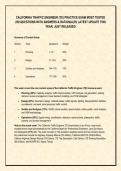
CALIFORNIA TRAFFIC ENGINEER (TE) PRACTICE EXAM MOST TESTED
250 QUESTIONS WITH ANSWERS & RATIONALES LATEST UPDATE THIS
YEAR. JUST RELEASED
Summary of Content Areas:
Section Topic Questions Weight
1 Planning 1–70 28%
2 Design 71–143 29%
3 Studies and Analyses 144–176 13%
4 Operations 177–250 30%
This exam covers the core content areas of the California Traffic Engineer (TE) licensure exam:
Planning (28%): Capacity analysis, traffic impact studies, VMT analysis, trip generation, parking
demand, access management, travel demand modeling, and TDM strategies
Design (29%): Geometric design, roadside safety, traffic signals, lighting, bike/pedestrian facilities,
roundabouts, and work zone temporary traffic control
Studies and Analyses (13%): Traffic volume studies, speed studies, safety audits, crash analysis,
and HSM methodology
Operations (30%): Signal timing, coordination, detection, transit priority, preemption, traffic
calming, and access management
Note on the actual exam: The California Traffic Engineer (TE) examination is an 8-hour, open-book,
multiple-choice exam administered by the California Board for Professional Engineers, Land Surveyors,
and Geologists (BPELSG). The exam consists of 120 questions weighted across the four domains above.
Key references include the Highway Capacity Manual (7th Edition), California MUTCD (2026 Edition),
Caltrans Highway Design Manual (7th Edition), ITE Trip Generation (12th Edition), ITE Parking Generation
(6th Edition), and NCHRP 812 Signal Timing
,SECTION 1: PLANNING (Questions 1–70) — 28% Weight
1. In the four-step travel demand modeling process, which step follows trip
generation?
A) Trip assignment
B) Mode choice
C) Trip distribution
D) Route selection
Answer: C – Trip distribution
Rationale: The four-step process is: (1) Trip generation, (2) Trip distribution, (3) Mode
choice, and (4) Trip assignment.
2. A new 200-unit single-family residential development is proposed. Using ITE Trip
Generation (12th Edition), which independent variable is most commonly used for
Land Use Code 210?
A) Gross floor area
B) Dwelling units
C) Number of employees
D) Parking spaces
,Answer: B – Dwelling units
Rationale: Single-family detached housing trip generation rates are based on dwelling units.
3. What is the primary purpose of a Traffic Impact Study (TIS)?
A) To design roadway geometry
B) To assess a development's effect on traffic operations and identify mitigation measures
C) To set speed limits
D) To determine construction costs
Answer: B – To assess a development's effect on traffic operations and identify
mitigation measures
Rationale: A TIS evaluates how a proposed development affects nearby traffic conditions
and recommends mitigation.
4. Under California law (SB 743), what metric has replaced auto delay-based Level of
Service (LOS) for CEQA analysis?
A) Volume-to-capacity ratio
B) Vehicle Miles Traveled (VMT)
C) Peak Hour Factor
D) Level of Service
, Answer: B – Vehicle Miles Traveled (VMT)
Rationale: SB 743 requires VMT as the primary metric for evaluating transportation impacts
under CEQA, replacing auto LOS.
5. What does the "D" factor represent in trip generation analysis?
A) Directional distribution
B) Density factor
C) Delay factor
D) Design speed
Answer: A – Directional distribution
Rationale: The D factor represents the percentage of trips in the peak direction (e.g.,
inbound vs. outbound).
6. A 50,000-square-foot office building is expected to generate trips. Which ITE land
use code is most appropriate?
A) 210 (Single-Family Detached Housing)
B) 710 (General Office Building)
C) 820 (Shopping Center)
D) 934 (Fast-Food Restaurant)
250 QUESTIONS WITH ANSWERS & RATIONALES LATEST UPDATE THIS
YEAR. JUST RELEASED
Summary of Content Areas:
Section Topic Questions Weight
1 Planning 1–70 28%
2 Design 71–143 29%
3 Studies and Analyses 144–176 13%
4 Operations 177–250 30%
This exam covers the core content areas of the California Traffic Engineer (TE) licensure exam:
Planning (28%): Capacity analysis, traffic impact studies, VMT analysis, trip generation, parking
demand, access management, travel demand modeling, and TDM strategies
Design (29%): Geometric design, roadside safety, traffic signals, lighting, bike/pedestrian facilities,
roundabouts, and work zone temporary traffic control
Studies and Analyses (13%): Traffic volume studies, speed studies, safety audits, crash analysis,
and HSM methodology
Operations (30%): Signal timing, coordination, detection, transit priority, preemption, traffic
calming, and access management
Note on the actual exam: The California Traffic Engineer (TE) examination is an 8-hour, open-book,
multiple-choice exam administered by the California Board for Professional Engineers, Land Surveyors,
and Geologists (BPELSG). The exam consists of 120 questions weighted across the four domains above.
Key references include the Highway Capacity Manual (7th Edition), California MUTCD (2026 Edition),
Caltrans Highway Design Manual (7th Edition), ITE Trip Generation (12th Edition), ITE Parking Generation
(6th Edition), and NCHRP 812 Signal Timing
,SECTION 1: PLANNING (Questions 1–70) — 28% Weight
1. In the four-step travel demand modeling process, which step follows trip
generation?
A) Trip assignment
B) Mode choice
C) Trip distribution
D) Route selection
Answer: C – Trip distribution
Rationale: The four-step process is: (1) Trip generation, (2) Trip distribution, (3) Mode
choice, and (4) Trip assignment.
2. A new 200-unit single-family residential development is proposed. Using ITE Trip
Generation (12th Edition), which independent variable is most commonly used for
Land Use Code 210?
A) Gross floor area
B) Dwelling units
C) Number of employees
D) Parking spaces
,Answer: B – Dwelling units
Rationale: Single-family detached housing trip generation rates are based on dwelling units.
3. What is the primary purpose of a Traffic Impact Study (TIS)?
A) To design roadway geometry
B) To assess a development's effect on traffic operations and identify mitigation measures
C) To set speed limits
D) To determine construction costs
Answer: B – To assess a development's effect on traffic operations and identify
mitigation measures
Rationale: A TIS evaluates how a proposed development affects nearby traffic conditions
and recommends mitigation.
4. Under California law (SB 743), what metric has replaced auto delay-based Level of
Service (LOS) for CEQA analysis?
A) Volume-to-capacity ratio
B) Vehicle Miles Traveled (VMT)
C) Peak Hour Factor
D) Level of Service
, Answer: B – Vehicle Miles Traveled (VMT)
Rationale: SB 743 requires VMT as the primary metric for evaluating transportation impacts
under CEQA, replacing auto LOS.
5. What does the "D" factor represent in trip generation analysis?
A) Directional distribution
B) Density factor
C) Delay factor
D) Design speed
Answer: A – Directional distribution
Rationale: The D factor represents the percentage of trips in the peak direction (e.g.,
inbound vs. outbound).
6. A 50,000-square-foot office building is expected to generate trips. Which ITE land
use code is most appropriate?
A) 210 (Single-Family Detached Housing)
B) 710 (General Office Building)
C) 820 (Shopping Center)
D) 934 (Fast-Food Restaurant)


