
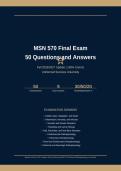
MSN 570 Final Exam
50 Questions and Answers USU
Fall 2026/2027 Update | 100% Correct
Uniformed Services University
50 9 30/50/20
Total Questions Exam Sections Recall/App/Analysis %
EXAMINATION DOMAINS
Cellular Injury, Adaptation, and Death
Inflammation, Immunity, and Infection
Genetics and Genetic Disorders
Neoplasia and Cancer Biology
Fluid, Electrolyte, and Acid-Base Disorders
Cardiovascular Pathophysiology
Pulmonary Pathophysiology
Renal and Genitourinary Pathophysiology
Endocrine and Neurologic Pathophysiology
Aligned with the USU Graduate School of Nursing MSN 570 Advanced Pathophysiology curriculum.
,MSN 570 Final Exam | Fall 2026/2027 Update USU | Advanced Pathophysiology
Verified Correct Answers with Mechanism-Level Rationales
MSN 570 Advanced Pathophysiology | 50 Questions | 100% Correct Page 2
, MSN 570 Final Exam | Fall 2026/2027 Update USU | Advanced Pathophysiology
EXAMINATION OVERVIEW
This comprehensive final examination assesses mastery of advanced pathophysiology concepts aligned with the
Uniformed Services University (USU) Graduate School of Nursing MSN 570 curriculum. The exam consists of
exactly 50 multiple-choice questions distributed across nine content domains spanning cellular and molecular
mechanisms through systemic pathophysiology of cardiovascular, pulmonary, renal, endocrine, and neurologic
systems. Each item is accompanied by a verified correct answer and a detailed mechanism-level rationale suitable
for use as a study guide. Content reflects Fall 2026/2027 updates aligned with current pathophysiological research
and USU course competencies.
Cognitive level distribution: approximately 30% of items assess direct recall of mechanisms, definitions, and
laboratory values; 50% require application of pathophysiological principles to clinical scenarios; and 20% demand
analysis integrating multiple mechanisms or discriminating between commonly confused concept pairs (e.g.,
necrosis vs. apoptosis, innate vs. adaptive immunity, autosomal dominant vs. recessive inheritance, respiratory vs.
metabolic acidosis, systolic vs. diastolic heart failure, obstructive vs. restrictive lung disease, nephrotic vs. nephritic
syndrome, and type 1 vs. type 2 diabetes). Approximately 70% of items are scenario-based.
SECTION STRUCTURE
Section Domain Questions
1 Cellular Injury, Adaptation, and Death Q1 - Q6
2 Inflammation, Immunity, and Infection Q7 - Q13
3 Genetics and Genetic Disorders Q14 - Q19
4 Neoplasia and Cancer Biology Q20 - Q25
5 Fluid, Electrolyte, and Acid-Base Disorders Q26 - Q32
6 Cardiovascular Pathophysiology Q33 - Q38
7 Pulmonary Pathophysiology Q39 - Q43
8 Renal and Genitourinary Pathophysiology Q44 - Q47
9 Endocrine and Neurologic Pathophysiology Q48 - Q50
HOW TO USE THIS EXAMINATION
Each question is presented with four response options (A through D). The verified correct answer is identified by the
[CORRECT] tag in bold green and restated in the "Correct Answer" line. A detailed rationale follows every question
explaining the mechanism-level reasoning for the correct answer and why the distractors are incorrect, integrating
pathophysiology, clinical correlation, and laboratory interpretation. Graduate nursing students preparing for the
MSN 570 final examination should review both correct and incorrect rationales to reinforce mechanism-level
understanding across all body systems.
MSN 570 Advanced Pathophysiology | 50 Questions | 100% Correct Page 3
50 Questions and Answers USU
Fall 2026/2027 Update | 100% Correct
Uniformed Services University
50 9 30/50/20
Total Questions Exam Sections Recall/App/Analysis %
EXAMINATION DOMAINS
Cellular Injury, Adaptation, and Death
Inflammation, Immunity, and Infection
Genetics and Genetic Disorders
Neoplasia and Cancer Biology
Fluid, Electrolyte, and Acid-Base Disorders
Cardiovascular Pathophysiology
Pulmonary Pathophysiology
Renal and Genitourinary Pathophysiology
Endocrine and Neurologic Pathophysiology
Aligned with the USU Graduate School of Nursing MSN 570 Advanced Pathophysiology curriculum.
,MSN 570 Final Exam | Fall 2026/2027 Update USU | Advanced Pathophysiology
Verified Correct Answers with Mechanism-Level Rationales
MSN 570 Advanced Pathophysiology | 50 Questions | 100% Correct Page 2
, MSN 570 Final Exam | Fall 2026/2027 Update USU | Advanced Pathophysiology
EXAMINATION OVERVIEW
This comprehensive final examination assesses mastery of advanced pathophysiology concepts aligned with the
Uniformed Services University (USU) Graduate School of Nursing MSN 570 curriculum. The exam consists of
exactly 50 multiple-choice questions distributed across nine content domains spanning cellular and molecular
mechanisms through systemic pathophysiology of cardiovascular, pulmonary, renal, endocrine, and neurologic
systems. Each item is accompanied by a verified correct answer and a detailed mechanism-level rationale suitable
for use as a study guide. Content reflects Fall 2026/2027 updates aligned with current pathophysiological research
and USU course competencies.
Cognitive level distribution: approximately 30% of items assess direct recall of mechanisms, definitions, and
laboratory values; 50% require application of pathophysiological principles to clinical scenarios; and 20% demand
analysis integrating multiple mechanisms or discriminating between commonly confused concept pairs (e.g.,
necrosis vs. apoptosis, innate vs. adaptive immunity, autosomal dominant vs. recessive inheritance, respiratory vs.
metabolic acidosis, systolic vs. diastolic heart failure, obstructive vs. restrictive lung disease, nephrotic vs. nephritic
syndrome, and type 1 vs. type 2 diabetes). Approximately 70% of items are scenario-based.
SECTION STRUCTURE
Section Domain Questions
1 Cellular Injury, Adaptation, and Death Q1 - Q6
2 Inflammation, Immunity, and Infection Q7 - Q13
3 Genetics and Genetic Disorders Q14 - Q19
4 Neoplasia and Cancer Biology Q20 - Q25
5 Fluid, Electrolyte, and Acid-Base Disorders Q26 - Q32
6 Cardiovascular Pathophysiology Q33 - Q38
7 Pulmonary Pathophysiology Q39 - Q43
8 Renal and Genitourinary Pathophysiology Q44 - Q47
9 Endocrine and Neurologic Pathophysiology Q48 - Q50
HOW TO USE THIS EXAMINATION
Each question is presented with four response options (A through D). The verified correct answer is identified by the
[CORRECT] tag in bold green and restated in the "Correct Answer" line. A detailed rationale follows every question
explaining the mechanism-level reasoning for the correct answer and why the distractors are incorrect, integrating
pathophysiology, clinical correlation, and laboratory interpretation. Graduate nursing students preparing for the
MSN 570 final examination should review both correct and incorrect rationales to reinforce mechanism-level
understanding across all body systems.
MSN 570 Advanced Pathophysiology | 50 Questions | 100% Correct Page 3


