
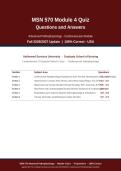
MSN 570 Module 4 Quiz
Questions and Answers
Advanced Pathophysiology - Cardiovascular Module
Fall 2026/2027 Update | 100% Correct - USU
Uniformed Services University - Graduate School of Nursing
Comprehensive 70-Question Module 4 Quiz - Cardiovascular Pathophysiology
Section Subject Area Questions
Section 1 Cardiovascular Pathophysiology Foundations (Cardiac Function, Hemodynamics, &Q1
Vascular
- Q12Biology)
Section 2 Atherosclerosis, Coronary Artery Disease, and Ischemic Injury (Plaque, ACS, & MI)
Q13 - Q24
Section 3 Hypertension and Vascular Disorders (Primary/Secondary HTN, Aneurysms, & PVD)
Q25 - Q35
Section 4 Heart Failure and Cardiomyopathies (Systolic/Diastolic Dysfunction & Cardiomyopathies)
Q36 - Q47
Section 5 Dysrhythmias and Conduction Disorders (Electrophysiology & Arrhythmias) Q48 - Q58
Section 6 Valvular, Pericardial, and Inflammatory Cardiac Disorders Q59 - Q70
MSN 570 Advanced Pathophysiology - Module 4 Quiz - 70 Questions - 100% Correct
Aligned with USU Graduate Nursing Curriculum and Fall 2026/2027 Cardiovascular Pathophysiology Standards
,MSN 570 Advanced Pathophysiology - Module 4 Quiz | Fall 2026/2027 Update | 100% Correct - USU Edition Fall 2026/2027
MSN 570 Module 4 Quiz - Questions and
Answers
Advanced Pathophysiology - Cardiovascular Pathophysiology
Fall 2026/2027 Update | 100% Correct - USU
This Module 4 quiz presents 70 practice questions aligned with the MSN 570 Advanced Pathophysiology curriculum at the
Uniformed Services University (USU) Graduate School of Nursing. The quiz covers the complete cardiovascular
pathophysiology domain in six sections: (1) Cardiovascular Foundations - cardiac function, hemodynamics, and vascular
biology; (2) Atherosclerosis, Coronary Artery Disease, and Ischemic Injury; (3) Hypertension and Vascular Disorders; (4)
Heart Failure and Cardiomyopathies; (5) Dysrhythmias and Conduction Disorders; and (6) Valvular, Pericardial, and
Inflammatory Cardiac Disorders. Each question is multiple choice with one correct answer; rationales include
mechanism-level explanations, clinical correlations, and diagnostic interpretation aligned with current graduate-level
cardiovascular pathophysiology. Approximately 70% of questions are scenario-based, requiring application of
pathophysiologic principles to patient presentation; 30% test direct recall of mechanisms, definitions, and diagnostic values.
The Fall 2026/2027 update reflects current cardiovascular pathophysiology research and USU curriculum standards.
Section 1
Section 1: Cardiovascular Pathophysiology Foundations (Cardiac Function,
Hemodynamics, & Vascular Biology)
Questions: Q1 - Q12 | Focus: Cardiac output, stroke volume, preload/afterload/contractility; endothelial function, vascular
tone, microcirculation; hemodynamic parameters
Q1: A 58-year-old male in the ICU has a heart rate of 90 bpm, stroke volume of 60 mL, and body surface
area of 2.0 m2. What is his cardiac index (CI)?
A. 2.7 L/min/m2 [CORRECT]
B. 3.0 L/min/m2
C. 4.5 L/min/m2
D. 5.4 L/min/m2
Correct Answer: A
Rationale: Cardiac output (CO) = HR x SV = 90 x 60 = 5,400 mL/min = 5.4 L/min. Cardiac index = CO / BSA = 5..0 = 2.7
L/min/m2, which is low-normal (normal CI range 2.5-4.0 L/min/m2). Choice B (3.0) incorrectly uses 6.0 L/min. Choice C (4.5)
uses BSA of 1.2. Choice D (5.4) is the CO, not CI.
Q2: A patient with sepsis has a pulmonary artery occlusion pressure (PAOP) of 6 mmHg and stroke volume
of 50 mL. According to the Frank-Starling mechanism, what intervention is most physiologically
appropriate to improve cardiac output?
A. Administer a beta-blocker to reduce heart rate
B. Administer IV fluids to increase preload (ventricular filling) [CORRECT]
C. Administer nitroprusside to reduce afterload
Uniformed Services University - Graduate School of Nursing Page 2
, D. Administer furosemide to reduce preload
Correct Answer: B
Rationale: Frank-Starling law states that increasing ventricular preload (end-diastolic volume) stretches sarcomeres toward
optimal length, increasing the force of contraction and stroke volume. The low PAOP (6 mmHg; normal 8-12) indicates
hypovolemia; volume expansion raises preload and improves CO. Choice A reduces HR, lowering CO. Choice C reduces
afterload but does not address the primary problem (low preload). Choice D further reduces preload.
Q3: Which of the following best describes afterload at the cellular level?
A. The degree of sarcomere stretch at end-diastole
B. The wall stress the ventricle must overcome to eject blood, primarily determined by ventricular
radius and arterial pressure [CORRECT]
C. The intrinsic contractile force independent of preload and afterload
D. The volume of blood ejected per beat
Correct Answer: B
Rationale: Afterload is the wall stress opposing ejection; by the Laplace relationship (wall stress = P x r / 2h), it is
determined by ventricular pressure (systolic BP/afterload pressure), ventricular radius, and wall thickness. Choice A defines
preload. Choice C defines contractility. Choice D defines stroke volume.
Q4: A 67-year-old patient on dobutamine for acute decompensated heart failure demonstrates increased
stroke volume without a change in preload or afterload. This improvement is best explained by:
A. Increased venous return
B. Increased intracellular calcium availability enhancing contractility (positive inotropy) [CORRECT]
C. Decreased systemic vascular resistance
D. Decreased heart rate improving filling time
Correct Answer: B
Rationale: Dobutamine is a beta-1 agonist that increases contractility (positive inotropic effect) by activating adenylate
cyclase, increasing cAMP, and enhancing intracellular calcium cycling in cardiomyocytes. This is independent of
preload/afterload changes. Choice A describes increased preload. Choice C describes decreased afterload. Choice D is not
consistent with beta-1 effects (which increase HR).
Q5: An echocardiogram reveals a left ventricular end-diastolic volume (LVEDV) of 150 mL and
end-systolic volume (LVESV) of 60 mL. What is the ejection fraction?
A. 40%
B. 50%
C. 60% [CORRECT]
D. 75%
Correct Answer: C
Rationale: Ejection fraction (EF) = (LVEDV - LVESV) / LVEDV = (150 - 60) / 150 = 90/150 = 0.60 = 60%. This is normal
(preserved EF; normal range 55-70%). Choice A (40%) is reduced EF consistent with systolic dysfunction. Choice B (50%)
is borderline. Choice D (75%) would require LVESV of 37.5 mL.
Q6: A healthy endothelium produces a vasoactive substance that diffuses to underlying vascular smooth
muscle and activates guanylyl cyclase, producing cGMP and causing vasodilation. This substance is:
A. Endothelin-1
B. Nitric oxide (NO) [CORRECT]
Questions and Answers
Advanced Pathophysiology - Cardiovascular Module
Fall 2026/2027 Update | 100% Correct - USU
Uniformed Services University - Graduate School of Nursing
Comprehensive 70-Question Module 4 Quiz - Cardiovascular Pathophysiology
Section Subject Area Questions
Section 1 Cardiovascular Pathophysiology Foundations (Cardiac Function, Hemodynamics, &Q1
Vascular
- Q12Biology)
Section 2 Atherosclerosis, Coronary Artery Disease, and Ischemic Injury (Plaque, ACS, & MI)
Q13 - Q24
Section 3 Hypertension and Vascular Disorders (Primary/Secondary HTN, Aneurysms, & PVD)
Q25 - Q35
Section 4 Heart Failure and Cardiomyopathies (Systolic/Diastolic Dysfunction & Cardiomyopathies)
Q36 - Q47
Section 5 Dysrhythmias and Conduction Disorders (Electrophysiology & Arrhythmias) Q48 - Q58
Section 6 Valvular, Pericardial, and Inflammatory Cardiac Disorders Q59 - Q70
MSN 570 Advanced Pathophysiology - Module 4 Quiz - 70 Questions - 100% Correct
Aligned with USU Graduate Nursing Curriculum and Fall 2026/2027 Cardiovascular Pathophysiology Standards
,MSN 570 Advanced Pathophysiology - Module 4 Quiz | Fall 2026/2027 Update | 100% Correct - USU Edition Fall 2026/2027
MSN 570 Module 4 Quiz - Questions and
Answers
Advanced Pathophysiology - Cardiovascular Pathophysiology
Fall 2026/2027 Update | 100% Correct - USU
This Module 4 quiz presents 70 practice questions aligned with the MSN 570 Advanced Pathophysiology curriculum at the
Uniformed Services University (USU) Graduate School of Nursing. The quiz covers the complete cardiovascular
pathophysiology domain in six sections: (1) Cardiovascular Foundations - cardiac function, hemodynamics, and vascular
biology; (2) Atherosclerosis, Coronary Artery Disease, and Ischemic Injury; (3) Hypertension and Vascular Disorders; (4)
Heart Failure and Cardiomyopathies; (5) Dysrhythmias and Conduction Disorders; and (6) Valvular, Pericardial, and
Inflammatory Cardiac Disorders. Each question is multiple choice with one correct answer; rationales include
mechanism-level explanations, clinical correlations, and diagnostic interpretation aligned with current graduate-level
cardiovascular pathophysiology. Approximately 70% of questions are scenario-based, requiring application of
pathophysiologic principles to patient presentation; 30% test direct recall of mechanisms, definitions, and diagnostic values.
The Fall 2026/2027 update reflects current cardiovascular pathophysiology research and USU curriculum standards.
Section 1
Section 1: Cardiovascular Pathophysiology Foundations (Cardiac Function,
Hemodynamics, & Vascular Biology)
Questions: Q1 - Q12 | Focus: Cardiac output, stroke volume, preload/afterload/contractility; endothelial function, vascular
tone, microcirculation; hemodynamic parameters
Q1: A 58-year-old male in the ICU has a heart rate of 90 bpm, stroke volume of 60 mL, and body surface
area of 2.0 m2. What is his cardiac index (CI)?
A. 2.7 L/min/m2 [CORRECT]
B. 3.0 L/min/m2
C. 4.5 L/min/m2
D. 5.4 L/min/m2
Correct Answer: A
Rationale: Cardiac output (CO) = HR x SV = 90 x 60 = 5,400 mL/min = 5.4 L/min. Cardiac index = CO / BSA = 5..0 = 2.7
L/min/m2, which is low-normal (normal CI range 2.5-4.0 L/min/m2). Choice B (3.0) incorrectly uses 6.0 L/min. Choice C (4.5)
uses BSA of 1.2. Choice D (5.4) is the CO, not CI.
Q2: A patient with sepsis has a pulmonary artery occlusion pressure (PAOP) of 6 mmHg and stroke volume
of 50 mL. According to the Frank-Starling mechanism, what intervention is most physiologically
appropriate to improve cardiac output?
A. Administer a beta-blocker to reduce heart rate
B. Administer IV fluids to increase preload (ventricular filling) [CORRECT]
C. Administer nitroprusside to reduce afterload
Uniformed Services University - Graduate School of Nursing Page 2
, D. Administer furosemide to reduce preload
Correct Answer: B
Rationale: Frank-Starling law states that increasing ventricular preload (end-diastolic volume) stretches sarcomeres toward
optimal length, increasing the force of contraction and stroke volume. The low PAOP (6 mmHg; normal 8-12) indicates
hypovolemia; volume expansion raises preload and improves CO. Choice A reduces HR, lowering CO. Choice C reduces
afterload but does not address the primary problem (low preload). Choice D further reduces preload.
Q3: Which of the following best describes afterload at the cellular level?
A. The degree of sarcomere stretch at end-diastole
B. The wall stress the ventricle must overcome to eject blood, primarily determined by ventricular
radius and arterial pressure [CORRECT]
C. The intrinsic contractile force independent of preload and afterload
D. The volume of blood ejected per beat
Correct Answer: B
Rationale: Afterload is the wall stress opposing ejection; by the Laplace relationship (wall stress = P x r / 2h), it is
determined by ventricular pressure (systolic BP/afterload pressure), ventricular radius, and wall thickness. Choice A defines
preload. Choice C defines contractility. Choice D defines stroke volume.
Q4: A 67-year-old patient on dobutamine for acute decompensated heart failure demonstrates increased
stroke volume without a change in preload or afterload. This improvement is best explained by:
A. Increased venous return
B. Increased intracellular calcium availability enhancing contractility (positive inotropy) [CORRECT]
C. Decreased systemic vascular resistance
D. Decreased heart rate improving filling time
Correct Answer: B
Rationale: Dobutamine is a beta-1 agonist that increases contractility (positive inotropic effect) by activating adenylate
cyclase, increasing cAMP, and enhancing intracellular calcium cycling in cardiomyocytes. This is independent of
preload/afterload changes. Choice A describes increased preload. Choice C describes decreased afterload. Choice D is not
consistent with beta-1 effects (which increase HR).
Q5: An echocardiogram reveals a left ventricular end-diastolic volume (LVEDV) of 150 mL and
end-systolic volume (LVESV) of 60 mL. What is the ejection fraction?
A. 40%
B. 50%
C. 60% [CORRECT]
D. 75%
Correct Answer: C
Rationale: Ejection fraction (EF) = (LVEDV - LVESV) / LVEDV = (150 - 60) / 150 = 90/150 = 0.60 = 60%. This is normal
(preserved EF; normal range 55-70%). Choice A (40%) is reduced EF consistent with systolic dysfunction. Choice B (50%)
is borderline. Choice D (75%) would require LVESV of 37.5 mL.
Q6: A healthy endothelium produces a vasoactive substance that diffuses to underlying vascular smooth
muscle and activates guanylyl cyclase, producing cGMP and causing vasodilation. This substance is:
A. Endothelin-1
B. Nitric oxide (NO) [CORRECT]


