
HCQM Final Exam — Healthcare Quality Management & Administration 2026/2027 Brand New Version
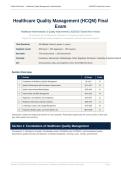
Healthcare Quality Management (HCQM) Final
Exam
Healthcare Administration & Quality Improvement | 2026/2027 Brand New Version
100 Questions with Comprehensive Rationales • 8 Competency-Aligned Sections
Aligned with current healthcare quality management competencies and final examination blueprint
Total Questions 100 Multiple Choice (4 options, 1 correct)
Cognitive Levels 30% Recall • 50% Application • 20% Analysis
Item Style 75% Scenario-based • 25% Direct Recall
Coverage Foundations, Measurement, Methodologies, Safety, Regulation, Informatics, Leadership, Population Health &
Use Self-assessment, study, and competency review for HCQM Final Exam
Section Overview
# Section Q Range Count
1 Foundations of Healthcare Quality Management Q1–Q12 12
2 Quality Measurement and Performance Improvement Q13–Q25 13
3 Quality Improvement Methodologies Q26–Q40 15
4 Patient Safety and Risk Management Q41–Q54 14
5 Regulatory, Accreditation, and Compliance Q55–Q67 13
6 Healthcare Informatics and Data Analytics Q68–Q78 11
7 Leadership, Culture, and Change Management Q79–Q88 10
8 Population Health, Equity, and Value-Based Care Q89–Q100 12
Instructions: Select the single best answer for each question. Rationales explain why the correct choice is best and
why other options are incorrect.
Section 1: Foundations of Healthcare Quality Management
Competency 1: Definitions of quality, Donabedian model, IOM/NAM aims (STEEEP), and foundational quality
frameworks; quality theorists and pioneers including Donabedian, Deming, Juran, Crosby, and Berwick.
Aligned with HCQM Final Examination Competencies • Healthcare Administration & Quality Improvement Page 1
,HCQM Final Exam — Healthcare Quality Management & Administration 2026/2027 Brand New Version
Q1: A hospital CEO asks the new quality director to define 'quality' in a way that aligns with the Institute of
Medicine's landmark framework. Which definition is most accurate?
A. Quality is the degree to which health services minimize cost regardless of patient outcomes.
B. Quality is the degree to which health services for individuals and populations increase the likelihood of
desired health outcomes and are consistent with current professional knowledge. [CORRECT]
C. Quality is compliance with all regulatory accreditation standards at the lowest cost.
D. Quality is the absence of medical errors and adverse events.
Correct Answer: B
Rationale: The IOM (now National Academy of Medicine) defines healthcare quality as 'the degree to which health services
for individuals and populations increase the likelihood of desired health outcomes and are consistent with current professional
knowledge.' This definition emphasizes outcomes, evidence, and populations; it is not reducible to cost, compliance, or mere
absence of error.
Q2: A quality director wants to evaluate a clinic by examining the availability of EHR systems,
nurse-to-patient ratios, and clinician credentials. Under Donabedian's model, these represent which type of
measure?
A. Process measures, because they reflect care delivery activities.
B. Outcome measures, because they reflect results of care.
C. Structure measures, because they capture the setting, resources, and attributes in which care is delivered.
[CORRECT]
D. Balancing measures, because they prevent overemphasis on one domain.
Correct Answer: C
Rationale: Donabedian's structure-process-outcome triad classifies EHR availability, staffing ratios, and credentials as
structure measures, since they describe the infrastructure and attributes of the care setting. Process measures reflect what is
done (e.g., administering a vaccine), and outcome measures reflect results (e.g., mortality, satisfaction). Balancing measures
are an IHI QI concept, not part of Donabedian's original triad.
Q3: A health system aims to redesign care to be Safe, Timely, Effective, Efficient, Equitable, and
Patient-centered. This framework is best known as:
A. The Baldrige Framework for Performance Excellence.
B. The IOM/NAM STEEEP aims, which operationalize six dimensions of healthcare quality. [CORRECT]
C. Lean Thinking's five principles of value.
D. Deming's System of Profound Knowledge.
Correct Answer: B
Rationale: The IOM/NAM aims are commonly remembered as STEEEP: Safe, Timely, Effective, Efficient, Equitable,
Patient-centered. The Baldrige Framework is an organizational performance excellence model. Lean principles concern value,
value stream, flow, pull, and perfection. Deming's System of Profound Knowledge comprises appreciation for a system,
knowledge about variation, theory of knowledge, and psychology.
Aligned with HCQM Final Examination Competencies • Healthcare Administration & Quality Improvement Page 2
,HCQM Final Exam — Healthcare Quality Management & Administration 2026/2027 Brand New Version
Q4: A quality leader cites W. Edwards Deming's work to advocate that 85% of quality problems are
attributable to the system, not the worker. Which Deming concept does this reflect?
A. The 80/20 rule, originally formulated by Deming.
B. Deming's view that the system (rather than individual employees) is responsible for the majority of
variation and that management must improve the system, not blame workers. [CORRECT]
C. Deming's 14 points, which focus exclusively on financial incentives.
D. Deming's PDCA cycle, which is identical to the PDSA cycle.
Correct Answer: B
Rationale: Deming argued that ~85% of quality problems stem from common-cause variation in the system, requiring
management action rather than blaming frontline workers. The 80/20 rule is Pareto's. Deming's 14 points emphasize
leadership, constancy of purpose, and driving out fear, not financial incentives. PDCA (Deming/Shewhart) is the predecessor
of PDSA, but they are not strictly identical.
Q5: Which statement best distinguishes Joseph Juran's contribution from Philip Crosby's contribution to
quality management?
A. Juran emphasized 'quality is free' and zero defects; Crosby emphasized the quality trilogy of planning, control, and
improvement.
B. Juran emphasized the quality trilogy (planning, control, improvement) and the vital few; Crosby
emphasized 'conformance to requirements' and 'zero defects.' [CORRECT]
C. Both emphasized statistical process control over management philosophy.
D. Both rejected the role of leadership in quality.
Correct Answer: B
Rationale: Juran's quality trilogy (quality planning, quality control, quality improvement) and his focus on the 'vital few'
(Pareto principle) emphasize managerial responsibility. Crosby defined quality as 'conformance to requirements' and
championed 'zero defects' and 'quality is free.' The two contributions are distinct; conflating them is a common error.
Q6: Donald Berwick is best known in healthcare quality for:
A. Founding Six Sigma as a healthcare-specific methodology.
B. Leading the Institute for Healthcare Improvement (IHI) and advocating the 'Triple Aim' of better care,
better health, and lower cost. [CORRECT]
C. Authoring the original CMS Conditions of Participation.
D. Developing the Donabedian model of structure-process-outcome.
Correct Answer: B
Rationale: Donald Berwick led IHI and advanced the Triple Aim: improving the individual experience of care, improving the
health of populations, and reducing per-capita costs. Six Sigma originated at Motorola (not healthcare). CMS Conditions of
Participation were developed by CMS. The Donabedian model was developed by Avedis Donabedian.
Aligned with HCQM Final Examination Competencies • Healthcare Administration & Quality Improvement Page 3
, HCQM Final Exam — Healthcare Quality Management & Administration 2026/2027 Brand New Version
Q7: A quality committee debates whether their current activities constitute quality assurance (QA) or quality
improvement (QI). Which statement best captures the difference?
A. QA focuses on continuous, proactive system redesign to achieve new levels of performance; QI focuses on
inspecting outcomes against fixed standards.
B. QA is retrospective inspection to assure compliance with standards and identify outliers; QI is proactive
and continuous, using data to redesign systems and improve performance. [CORRECT]
C. QA and QI are synonymous and interchangeable in current practice.
D. QA is used only in outpatient settings; QI is used only in hospitals.
Correct Answer: B
Rationale: Quality assurance (QA) is traditionally retrospective and inspection-oriented, assuring minimum standards are met
by identifying outliers. Quality improvement (QI) is proactive, continuous, data-driven, and focused on system redesign to
achieve new performance levels. They are not synonymous, and both apply across care settings.
Q8: Which scenario best represents continuous quality improvement (CQI) in a hospital setting?
A. Conducting a one-time chart audit to identify outliers and punishing responsible staff.
B. Establishing iterative, multidisciplinary teams that use data to test changes, measure results, and
standardize improvements across cycles. [CORRECT]
C. Meeting minimum Joint Commission standards and ceasing improvement work until the next survey.
D. Outsourcing all quality measurement to an external vendor without internal review.
Correct Answer: B
Rationale: CQI is iterative, multidisciplinary, data-driven, and continuous: teams test changes, measure results, standardize
improvements, and continue cycles. One-time audits, meeting minimums, or outsourcing without internal engagement do not
reflect CQI's iterative, system-focused nature.
Q9: Avedis Donabedian's contributions to healthcare quality include all of the following EXCEPT:
A. The structure-process-outcome framework for evaluating quality.
B. The concept that quality has technical and interpersonal dimensions.
C. The seven pillars of quality used by the Joint Commission. [CORRECT]
D. The view that quality must consider accessibility, effectiveness, and patient satisfaction.
Correct Answer: C
Rationale: Donabedian contributed the structure-process-outcome framework, recognized technical and interpersonal
dimensions of care, and emphasized accessibility, effectiveness, and satisfaction. The 'seven pillars of quality' is not a
Donabedian concept; this is a distractor. The Joint Commission uses standards aligned with STEEEP and other frameworks
rather than a 'seven pillars' model.
Aligned with HCQM Final Examination Competencies • Healthcare Administration & Quality Improvement Page 4
Healthcare Quality Management (HCQM) Final
Exam
Healthcare Administration & Quality Improvement | 2026/2027 Brand New Version
100 Questions with Comprehensive Rationales • 8 Competency-Aligned Sections
Aligned with current healthcare quality management competencies and final examination blueprint
Total Questions 100 Multiple Choice (4 options, 1 correct)
Cognitive Levels 30% Recall • 50% Application • 20% Analysis
Item Style 75% Scenario-based • 25% Direct Recall
Coverage Foundations, Measurement, Methodologies, Safety, Regulation, Informatics, Leadership, Population Health &
Use Self-assessment, study, and competency review for HCQM Final Exam
Section Overview
# Section Q Range Count
1 Foundations of Healthcare Quality Management Q1–Q12 12
2 Quality Measurement and Performance Improvement Q13–Q25 13
3 Quality Improvement Methodologies Q26–Q40 15
4 Patient Safety and Risk Management Q41–Q54 14
5 Regulatory, Accreditation, and Compliance Q55–Q67 13
6 Healthcare Informatics and Data Analytics Q68–Q78 11
7 Leadership, Culture, and Change Management Q79–Q88 10
8 Population Health, Equity, and Value-Based Care Q89–Q100 12
Instructions: Select the single best answer for each question. Rationales explain why the correct choice is best and
why other options are incorrect.
Section 1: Foundations of Healthcare Quality Management
Competency 1: Definitions of quality, Donabedian model, IOM/NAM aims (STEEEP), and foundational quality
frameworks; quality theorists and pioneers including Donabedian, Deming, Juran, Crosby, and Berwick.
Aligned with HCQM Final Examination Competencies • Healthcare Administration & Quality Improvement Page 1
,HCQM Final Exam — Healthcare Quality Management & Administration 2026/2027 Brand New Version
Q1: A hospital CEO asks the new quality director to define 'quality' in a way that aligns with the Institute of
Medicine's landmark framework. Which definition is most accurate?
A. Quality is the degree to which health services minimize cost regardless of patient outcomes.
B. Quality is the degree to which health services for individuals and populations increase the likelihood of
desired health outcomes and are consistent with current professional knowledge. [CORRECT]
C. Quality is compliance with all regulatory accreditation standards at the lowest cost.
D. Quality is the absence of medical errors and adverse events.
Correct Answer: B
Rationale: The IOM (now National Academy of Medicine) defines healthcare quality as 'the degree to which health services
for individuals and populations increase the likelihood of desired health outcomes and are consistent with current professional
knowledge.' This definition emphasizes outcomes, evidence, and populations; it is not reducible to cost, compliance, or mere
absence of error.
Q2: A quality director wants to evaluate a clinic by examining the availability of EHR systems,
nurse-to-patient ratios, and clinician credentials. Under Donabedian's model, these represent which type of
measure?
A. Process measures, because they reflect care delivery activities.
B. Outcome measures, because they reflect results of care.
C. Structure measures, because they capture the setting, resources, and attributes in which care is delivered.
[CORRECT]
D. Balancing measures, because they prevent overemphasis on one domain.
Correct Answer: C
Rationale: Donabedian's structure-process-outcome triad classifies EHR availability, staffing ratios, and credentials as
structure measures, since they describe the infrastructure and attributes of the care setting. Process measures reflect what is
done (e.g., administering a vaccine), and outcome measures reflect results (e.g., mortality, satisfaction). Balancing measures
are an IHI QI concept, not part of Donabedian's original triad.
Q3: A health system aims to redesign care to be Safe, Timely, Effective, Efficient, Equitable, and
Patient-centered. This framework is best known as:
A. The Baldrige Framework for Performance Excellence.
B. The IOM/NAM STEEEP aims, which operationalize six dimensions of healthcare quality. [CORRECT]
C. Lean Thinking's five principles of value.
D. Deming's System of Profound Knowledge.
Correct Answer: B
Rationale: The IOM/NAM aims are commonly remembered as STEEEP: Safe, Timely, Effective, Efficient, Equitable,
Patient-centered. The Baldrige Framework is an organizational performance excellence model. Lean principles concern value,
value stream, flow, pull, and perfection. Deming's System of Profound Knowledge comprises appreciation for a system,
knowledge about variation, theory of knowledge, and psychology.
Aligned with HCQM Final Examination Competencies • Healthcare Administration & Quality Improvement Page 2
,HCQM Final Exam — Healthcare Quality Management & Administration 2026/2027 Brand New Version
Q4: A quality leader cites W. Edwards Deming's work to advocate that 85% of quality problems are
attributable to the system, not the worker. Which Deming concept does this reflect?
A. The 80/20 rule, originally formulated by Deming.
B. Deming's view that the system (rather than individual employees) is responsible for the majority of
variation and that management must improve the system, not blame workers. [CORRECT]
C. Deming's 14 points, which focus exclusively on financial incentives.
D. Deming's PDCA cycle, which is identical to the PDSA cycle.
Correct Answer: B
Rationale: Deming argued that ~85% of quality problems stem from common-cause variation in the system, requiring
management action rather than blaming frontline workers. The 80/20 rule is Pareto's. Deming's 14 points emphasize
leadership, constancy of purpose, and driving out fear, not financial incentives. PDCA (Deming/Shewhart) is the predecessor
of PDSA, but they are not strictly identical.
Q5: Which statement best distinguishes Joseph Juran's contribution from Philip Crosby's contribution to
quality management?
A. Juran emphasized 'quality is free' and zero defects; Crosby emphasized the quality trilogy of planning, control, and
improvement.
B. Juran emphasized the quality trilogy (planning, control, improvement) and the vital few; Crosby
emphasized 'conformance to requirements' and 'zero defects.' [CORRECT]
C. Both emphasized statistical process control over management philosophy.
D. Both rejected the role of leadership in quality.
Correct Answer: B
Rationale: Juran's quality trilogy (quality planning, quality control, quality improvement) and his focus on the 'vital few'
(Pareto principle) emphasize managerial responsibility. Crosby defined quality as 'conformance to requirements' and
championed 'zero defects' and 'quality is free.' The two contributions are distinct; conflating them is a common error.
Q6: Donald Berwick is best known in healthcare quality for:
A. Founding Six Sigma as a healthcare-specific methodology.
B. Leading the Institute for Healthcare Improvement (IHI) and advocating the 'Triple Aim' of better care,
better health, and lower cost. [CORRECT]
C. Authoring the original CMS Conditions of Participation.
D. Developing the Donabedian model of structure-process-outcome.
Correct Answer: B
Rationale: Donald Berwick led IHI and advanced the Triple Aim: improving the individual experience of care, improving the
health of populations, and reducing per-capita costs. Six Sigma originated at Motorola (not healthcare). CMS Conditions of
Participation were developed by CMS. The Donabedian model was developed by Avedis Donabedian.
Aligned with HCQM Final Examination Competencies • Healthcare Administration & Quality Improvement Page 3
, HCQM Final Exam — Healthcare Quality Management & Administration 2026/2027 Brand New Version
Q7: A quality committee debates whether their current activities constitute quality assurance (QA) or quality
improvement (QI). Which statement best captures the difference?
A. QA focuses on continuous, proactive system redesign to achieve new levels of performance; QI focuses on
inspecting outcomes against fixed standards.
B. QA is retrospective inspection to assure compliance with standards and identify outliers; QI is proactive
and continuous, using data to redesign systems and improve performance. [CORRECT]
C. QA and QI are synonymous and interchangeable in current practice.
D. QA is used only in outpatient settings; QI is used only in hospitals.
Correct Answer: B
Rationale: Quality assurance (QA) is traditionally retrospective and inspection-oriented, assuring minimum standards are met
by identifying outliers. Quality improvement (QI) is proactive, continuous, data-driven, and focused on system redesign to
achieve new performance levels. They are not synonymous, and both apply across care settings.
Q8: Which scenario best represents continuous quality improvement (CQI) in a hospital setting?
A. Conducting a one-time chart audit to identify outliers and punishing responsible staff.
B. Establishing iterative, multidisciplinary teams that use data to test changes, measure results, and
standardize improvements across cycles. [CORRECT]
C. Meeting minimum Joint Commission standards and ceasing improvement work until the next survey.
D. Outsourcing all quality measurement to an external vendor without internal review.
Correct Answer: B
Rationale: CQI is iterative, multidisciplinary, data-driven, and continuous: teams test changes, measure results, standardize
improvements, and continue cycles. One-time audits, meeting minimums, or outsourcing without internal engagement do not
reflect CQI's iterative, system-focused nature.
Q9: Avedis Donabedian's contributions to healthcare quality include all of the following EXCEPT:
A. The structure-process-outcome framework for evaluating quality.
B. The concept that quality has technical and interpersonal dimensions.
C. The seven pillars of quality used by the Joint Commission. [CORRECT]
D. The view that quality must consider accessibility, effectiveness, and patient satisfaction.
Correct Answer: C
Rationale: Donabedian contributed the structure-process-outcome framework, recognized technical and interpersonal
dimensions of care, and emphasized accessibility, effectiveness, and satisfaction. The 'seven pillars of quality' is not a
Donabedian concept; this is a distractor. The Joint Commission uses standards aligned with STEEEP and other frameworks
rather than a 'seven pillars' model.
Aligned with HCQM Final Examination Competencies • Healthcare Administration & Quality Improvement Page 4


