
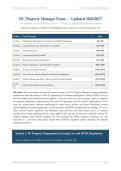
DC Property Manager Exam — Updated 2026/2027 Verified & Aligned with DCRA Requirements
DC Property Manager Exam — Updated 2026/2027
150 Questions with 100% Correct Answers — Verified & Aligned with DCRA Requirements
Generated: September 17, 2026 | Format: Multiple Choice (4 options, one correct) | Total Items: 150
Section Topic Coverage Items
Section 1 DC Property Management Licensing Law and DCRA Regulations Q1–Q18
Section 2 Landlord-Tenant Law in the District of Columbia Q19–Q38
Section 3 Fair Housing Laws Q39–Q54
Section 4 Leasing and Rental Operations Q55–Q70
Section 5 Rent Control and Rent Stabilization Q71–Q84
Section 6 Property Maintenance and Habitability Standards Q85–Q100
Section 7 Eviction and Legal Proceedings Q101–Q115
Section 8 Trust Accounts, Security Deposits, and Financial Management Q116–Q130
Section 9 Property Management Ethics, Agency, and Professional Standards Q131–Q140
Section
Safety, Risk Management, and Insurance Q141–Q150
10
Directions: This exam mirrors the rigor and content coverage of the DC Property Manager licensing examination
administered under the authority of the DC Department of Consumer and Regulatory Affairs (DCRA). Each of
the 150 multiple-choice items presents four options (A–D) with exactly one correct response. Items are calibrated
to a cognitive distribution of approximately 35% recall, 45% application, and 20% analysis. Approximately 75% of
items are scenario-based, requiring identification of correct notice periods, rent control calculations, security
deposit handling, fair housing application, eviction procedure, and DCRA-compliant decision-making; 25% assess
direct recall of statutes, regulations, and definitions. After each item, the correct answer and a 2–4 sentence
rationale are provided explaining why the correct option is best and why the distractors represent common DC
Property Manager Exam pitfalls, including DC Code citations and DCRA regulatory references. Use this
document as a self-check study guide aligned with 2026/2027 legislative updates affecting DC property
management practice.
Section 1: DC Property Management Licensing Law and DCRA Regulations
Licensure Requirements, DCRA Oversight, and Compliance | Items Q1–Q18
DCRA Property Management Licensing Examination Preparation Page 1
,DC Property Manager Exam — Updated 2026/2027 Verified & Aligned with DCRA Requirements
Q1.
A real estate firm hires an unlicensed individual to show vacant rental units, accept applications, and execute leases
on behalf of property owners. Under DC law and DCRA regulations, which statement is most accurate?
A. Showing units and executing leases for compensation requires a DC real estate license; the firm and
individual face DCRA penalties for unlicensed activity [CORRECT]
B. Only the firm's principal broker needs a license; staff performing leasing tasks are exempt as employees
C. Property management activities are unregulated in DC and require no real estate license
D. A business license from DCRA alone is sufficient; no real estate license is required
Correct Answer: A
Rationale: Under DC Code § 47-2853.14 and DCRA regulations, individuals who, for compensation, engage in leasing,
renting, or managing real property for others must hold a DC real estate license (broker or salesperson). Property
management is a regulated real estate activity. The principal broker's license does not extend to unlicensed staff
performing licensable acts, and DCRA may impose fines and license actions for unlicensed practice.
Q2.
Which DCRA-recognized license category authorizes an individual to independently operate a property
management business and supervise licensed salespersons?
A. Property manager license
B. Real estate broker license [CORRECT]
C. Real estate salesperson license
D. DCRA business registration only
Correct Answer: B
Rationale: DC does not issue a separate "property manager license." Property managers must hold a real estate broker
license (or a salesperson license operating under a broker). Only a broker may operate independently, supervise
salespersons, and maintain a trust account. A salesperson (C) must work under a broker; business registration alone (D)
does not authorize licensable activity.
Q3.
A DC property manager's real estate license expired six months ago. Under DCRA reinstatement rules, the
manager must:
A. automatically renew online with no additional requirements
B. submit a reinstatement application, pay reinstatement fees, and complete any missed continuing
education before resuming licensed activity [CORRECT]
C. wait one full year before applying for a new license
D. re-take the full pre-licensing coursework but skip the examination
Correct Answer: B
Rationale: DCRA allows reinstatement of an expired real estate license within a defined grace period upon submission
of a reinstatement application, payment of reinstatement fees, and completion of any delinquent CE. Practicing with an
expired license constitutes unlicensed activity. Full re-licensing from scratch is generally required only after the
reinstatement window closes.
DCRA Property Management Licensing Examination Preparation Page 2
,DC Property Manager Exam — Updated 2026/2027 Verified & Aligned with DCRA Requirements
Q4.
DC real estate licensees engaged in property management must complete continuing education (CE) for license
renewal. Which statement most accurately reflects current DCRA CE requirements?
A. 15 hours of CE per renewal cycle, including required core topics such as fair housing and DC
landlord-tenant law [CORRECT]
B. 30 hours of CE every two years, all electives
C. No CE is required if the licensee has 10+ years of experience
D. 3 hours of CE every five years
Correct Answer: A
Rationale: DCRA requires real estate licensees to complete 15 hours of CE per renewal cycle, including mandated
topics such as fair housing, DC landlord-tenant law, and DC real estate license law. Continuing education verifies
ongoing competency. Experience does not waive CE, and 3 hours every five years is far below the actual requirement.
Q5.
A property manager deposits a tenant's security deposit into the firm's operating account to cover payroll. Under
DCRA and DC real estate license law, this conduct most likely constitutes:
A. an acceptable practice if documented, since deposits are firm assets
B. commingling and conversion, grounds for license suspension or revocation and possible criminal
prosecution [CORRECT]
C. a minor bookkeeping error remedied by reimbursement
D. permissible if the deposit is replaced before the tenant moves out
Correct Answer: B
Rationale: DC real estate license law and DCRA regulations prohibit commingling of client/trust funds with operating
funds; depositing a tenant's security deposit into an operating account for the firm's use is commingling and may
constitute conversion. Such conduct is grounds for license suspension or revocation and possible criminal charges.
Reimbursement after the fact does not cure the violation.
Q6.
DCRA's enforcement authority over licensed property managers includes all of the following EXCEPT:
A. investigating consumer complaints and imposing civil fines
B. suspending or revoking a real estate license after notice and hearing
C. issuing cease-and-desist orders against unlicensed practitioners
D. summarily imprisoning a licensee without court process for trust account violations [CORRECT]
Correct Answer: D
Rationale: DCRA may investigate complaints, impose civil fines, suspend or revoke licenses after due process, and
issue cease-and-desist orders. However, DCRA cannot summarily imprison a licensee without court process; criminal
prosecution, if warranted, is handled by the Office of the Attorney General through the courts. Due process protections
apply to all license actions.
DCRA Property Management Licensing Examination Preparation Page 3
, DC Property Manager Exam — Updated 2026/2027 Verified & Aligned with DCRA Requirements
Q7.
A prospective property manager applies for a DC real estate salesperson license. Which set of requirements must
be satisfied before DCRA issues the license?
A. Be at least 18 years old, complete 60 hours of approved pre-licensing education, pass the DC portion of
the licensing exam, and pass a background check [CORRECT]
B. Hold a college degree in business and complete 120 hours of coursework
C. Be at least 21 years old and have two years of property management experience
D. Complete 30 hours of training through any real estate firm
Correct Answer: A
Rationale: DCRA requires salesperson license applicants to be at least 18, complete 60 hours of board-approved
pre-licensing education, pass both the national and DC portions of the licensing exam, and pass a background check. A
college degree and prior experience are not required for the salesperson license. Pre-licensing education must be
board-approved, not firm-internal.
Q8.
A property management firm's advertising states "No License Needed — We Manage DC Properties." Under
DCRA advertising rules, this advertisement is:
A. permissible if the firm has a basic business license
B. misleading and potentially unlawful; DC property management advertising must include the broker's
name and license information, and unlicensed practice is prohibited [CORRECT]
C. permissible for residential property only
D. permissible if disclaimers are added in small print
Correct Answer: B
Rationale: DC real estate license law requires advertising to identify the broker/firm and license information; claiming
a license is not needed is misleading and supports a finding of unlicensed practice. A basic business license does not
substitute for the required real estate license. Disclaimers cannot cure misleading content. DCRA may impose fines and
license sanctions.
Q9.
Which of the following is a recognized ground for DCRA discipline against a property manager's real estate
license?
A. Failing to maintain a passing score on the original licensing exam indefinitely
B. Commingling client funds, dishonest dealing, or demonstrating negligence or incompetence in a
transaction [CORRECT]
C. Charging less than the prevailing market commission rate
D. Working with tenants who later default on rent
Correct Answer: B
Rationale: DC real estate license law authorizes discipline for commingling, dishonesty, fraud, negligence,
incompetence, and similar misconduct. Once licensed, licensees need not maintain exam scores. Commission rates are
negotiable and not regulated, and tenant default does not, by itself, constitute grounds for discipline absent licensee
misconduct.
DCRA Property Management Licensing Examination Preparation Page 4
DC Property Manager Exam — Updated 2026/2027
150 Questions with 100% Correct Answers — Verified & Aligned with DCRA Requirements
Generated: September 17, 2026 | Format: Multiple Choice (4 options, one correct) | Total Items: 150
Section Topic Coverage Items
Section 1 DC Property Management Licensing Law and DCRA Regulations Q1–Q18
Section 2 Landlord-Tenant Law in the District of Columbia Q19–Q38
Section 3 Fair Housing Laws Q39–Q54
Section 4 Leasing and Rental Operations Q55–Q70
Section 5 Rent Control and Rent Stabilization Q71–Q84
Section 6 Property Maintenance and Habitability Standards Q85–Q100
Section 7 Eviction and Legal Proceedings Q101–Q115
Section 8 Trust Accounts, Security Deposits, and Financial Management Q116–Q130
Section 9 Property Management Ethics, Agency, and Professional Standards Q131–Q140
Section
Safety, Risk Management, and Insurance Q141–Q150
10
Directions: This exam mirrors the rigor and content coverage of the DC Property Manager licensing examination
administered under the authority of the DC Department of Consumer and Regulatory Affairs (DCRA). Each of
the 150 multiple-choice items presents four options (A–D) with exactly one correct response. Items are calibrated
to a cognitive distribution of approximately 35% recall, 45% application, and 20% analysis. Approximately 75% of
items are scenario-based, requiring identification of correct notice periods, rent control calculations, security
deposit handling, fair housing application, eviction procedure, and DCRA-compliant decision-making; 25% assess
direct recall of statutes, regulations, and definitions. After each item, the correct answer and a 2–4 sentence
rationale are provided explaining why the correct option is best and why the distractors represent common DC
Property Manager Exam pitfalls, including DC Code citations and DCRA regulatory references. Use this
document as a self-check study guide aligned with 2026/2027 legislative updates affecting DC property
management practice.
Section 1: DC Property Management Licensing Law and DCRA Regulations
Licensure Requirements, DCRA Oversight, and Compliance | Items Q1–Q18
DCRA Property Management Licensing Examination Preparation Page 1
,DC Property Manager Exam — Updated 2026/2027 Verified & Aligned with DCRA Requirements
Q1.
A real estate firm hires an unlicensed individual to show vacant rental units, accept applications, and execute leases
on behalf of property owners. Under DC law and DCRA regulations, which statement is most accurate?
A. Showing units and executing leases for compensation requires a DC real estate license; the firm and
individual face DCRA penalties for unlicensed activity [CORRECT]
B. Only the firm's principal broker needs a license; staff performing leasing tasks are exempt as employees
C. Property management activities are unregulated in DC and require no real estate license
D. A business license from DCRA alone is sufficient; no real estate license is required
Correct Answer: A
Rationale: Under DC Code § 47-2853.14 and DCRA regulations, individuals who, for compensation, engage in leasing,
renting, or managing real property for others must hold a DC real estate license (broker or salesperson). Property
management is a regulated real estate activity. The principal broker's license does not extend to unlicensed staff
performing licensable acts, and DCRA may impose fines and license actions for unlicensed practice.
Q2.
Which DCRA-recognized license category authorizes an individual to independently operate a property
management business and supervise licensed salespersons?
A. Property manager license
B. Real estate broker license [CORRECT]
C. Real estate salesperson license
D. DCRA business registration only
Correct Answer: B
Rationale: DC does not issue a separate "property manager license." Property managers must hold a real estate broker
license (or a salesperson license operating under a broker). Only a broker may operate independently, supervise
salespersons, and maintain a trust account. A salesperson (C) must work under a broker; business registration alone (D)
does not authorize licensable activity.
Q3.
A DC property manager's real estate license expired six months ago. Under DCRA reinstatement rules, the
manager must:
A. automatically renew online with no additional requirements
B. submit a reinstatement application, pay reinstatement fees, and complete any missed continuing
education before resuming licensed activity [CORRECT]
C. wait one full year before applying for a new license
D. re-take the full pre-licensing coursework but skip the examination
Correct Answer: B
Rationale: DCRA allows reinstatement of an expired real estate license within a defined grace period upon submission
of a reinstatement application, payment of reinstatement fees, and completion of any delinquent CE. Practicing with an
expired license constitutes unlicensed activity. Full re-licensing from scratch is generally required only after the
reinstatement window closes.
DCRA Property Management Licensing Examination Preparation Page 2
,DC Property Manager Exam — Updated 2026/2027 Verified & Aligned with DCRA Requirements
Q4.
DC real estate licensees engaged in property management must complete continuing education (CE) for license
renewal. Which statement most accurately reflects current DCRA CE requirements?
A. 15 hours of CE per renewal cycle, including required core topics such as fair housing and DC
landlord-tenant law [CORRECT]
B. 30 hours of CE every two years, all electives
C. No CE is required if the licensee has 10+ years of experience
D. 3 hours of CE every five years
Correct Answer: A
Rationale: DCRA requires real estate licensees to complete 15 hours of CE per renewal cycle, including mandated
topics such as fair housing, DC landlord-tenant law, and DC real estate license law. Continuing education verifies
ongoing competency. Experience does not waive CE, and 3 hours every five years is far below the actual requirement.
Q5.
A property manager deposits a tenant's security deposit into the firm's operating account to cover payroll. Under
DCRA and DC real estate license law, this conduct most likely constitutes:
A. an acceptable practice if documented, since deposits are firm assets
B. commingling and conversion, grounds for license suspension or revocation and possible criminal
prosecution [CORRECT]
C. a minor bookkeeping error remedied by reimbursement
D. permissible if the deposit is replaced before the tenant moves out
Correct Answer: B
Rationale: DC real estate license law and DCRA regulations prohibit commingling of client/trust funds with operating
funds; depositing a tenant's security deposit into an operating account for the firm's use is commingling and may
constitute conversion. Such conduct is grounds for license suspension or revocation and possible criminal charges.
Reimbursement after the fact does not cure the violation.
Q6.
DCRA's enforcement authority over licensed property managers includes all of the following EXCEPT:
A. investigating consumer complaints and imposing civil fines
B. suspending or revoking a real estate license after notice and hearing
C. issuing cease-and-desist orders against unlicensed practitioners
D. summarily imprisoning a licensee without court process for trust account violations [CORRECT]
Correct Answer: D
Rationale: DCRA may investigate complaints, impose civil fines, suspend or revoke licenses after due process, and
issue cease-and-desist orders. However, DCRA cannot summarily imprison a licensee without court process; criminal
prosecution, if warranted, is handled by the Office of the Attorney General through the courts. Due process protections
apply to all license actions.
DCRA Property Management Licensing Examination Preparation Page 3
, DC Property Manager Exam — Updated 2026/2027 Verified & Aligned with DCRA Requirements
Q7.
A prospective property manager applies for a DC real estate salesperson license. Which set of requirements must
be satisfied before DCRA issues the license?
A. Be at least 18 years old, complete 60 hours of approved pre-licensing education, pass the DC portion of
the licensing exam, and pass a background check [CORRECT]
B. Hold a college degree in business and complete 120 hours of coursework
C. Be at least 21 years old and have two years of property management experience
D. Complete 30 hours of training through any real estate firm
Correct Answer: A
Rationale: DCRA requires salesperson license applicants to be at least 18, complete 60 hours of board-approved
pre-licensing education, pass both the national and DC portions of the licensing exam, and pass a background check. A
college degree and prior experience are not required for the salesperson license. Pre-licensing education must be
board-approved, not firm-internal.
Q8.
A property management firm's advertising states "No License Needed — We Manage DC Properties." Under
DCRA advertising rules, this advertisement is:
A. permissible if the firm has a basic business license
B. misleading and potentially unlawful; DC property management advertising must include the broker's
name and license information, and unlicensed practice is prohibited [CORRECT]
C. permissible for residential property only
D. permissible if disclaimers are added in small print
Correct Answer: B
Rationale: DC real estate license law requires advertising to identify the broker/firm and license information; claiming
a license is not needed is misleading and supports a finding of unlicensed practice. A basic business license does not
substitute for the required real estate license. Disclaimers cannot cure misleading content. DCRA may impose fines and
license sanctions.
Q9.
Which of the following is a recognized ground for DCRA discipline against a property manager's real estate
license?
A. Failing to maintain a passing score on the original licensing exam indefinitely
B. Commingling client funds, dishonest dealing, or demonstrating negligence or incompetence in a
transaction [CORRECT]
C. Charging less than the prevailing market commission rate
D. Working with tenants who later default on rent
Correct Answer: B
Rationale: DC real estate license law authorizes discipline for commingling, dishonesty, fraud, negligence,
incompetence, and similar misconduct. Once licensed, licensees need not maintain exam scores. Commission rates are
negotiable and not regulated, and tenant default does not, by itself, constitute grounds for discipline absent licensee
misconduct.
DCRA Property Management Licensing Examination Preparation Page 4


