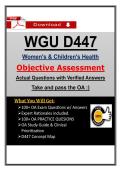
WGU D447
Women's & Children's Health
Objective Assessment
Actual Questions with Verified Answers
Take and pass the OA :)
What You Will Get:
➢100+ OA Exam Questions w/ Answers
➢Expert Rationales included.
➢100+ OA PRACTICE QUESIONS
➢OA Study Guide & Clinical
Prioritization
➢D447 Concept Map
,PREVIEW PAGES BELOW
Get the Complete
PDF After Purchase
NEED HELP OR MORE RESOURCES?
?
"If you require further clarification or in need of
any study resources, feel free to Message me."
,Table of Contents
D447 OA EXAM ...........................................................2
D447 OA PRACTICE TEST ...........................................88
D447 OA STUDY GUIDE .........................................129
D447 Concept Map ..................................................139
D447 OA EXAM
1. A 4-year-old is diagnosed with nephrotic syndrome and is being treated in the
hospital. The child presents with periorbital edema, proteinuria, and
hypoalbuminemia. Which of the following are appropriate interventions for a
child with nephrotic syndrome? (Select all that apply)
A. Administer corticosteroids to reduce inflammation and proteinuria
B. Monitor urine output for signs of fluid retention
C. Measure the child's weight daily to assess for fluid status
D. Restrict sodium intake
Correct Answers: A, B, C, D
Expert Rationale: Nephrotic syndrome is characterized by massive proteinuria
(>40 mg/m²/hr), hypoalbuminemia (<2.5 g/dL), hyperlipidemia, and edema.
Minimal change disease (MCD) is the most common cause in children.
• A. Corticosteroids: Prednisone is first-line therapy for MCD; 90% of children
respond within 4 weeks.
, • B. Monitor urine output: Oliguria indicates worsening renal function or fluid
overload.
• C. Daily weights: The most reliable indicator of fluid status; same scale,
same time, same clothing.
• D. Sodium restriction: Reduces fluid retention and edema; typically <2
mEq/kg/day.
Complications to monitor: Infection (loss of immunoglobulins), thrombosis
(hypercoagulability from loss of antithrombin III), and acute kidney injury.
2. A 13-year-old male presents to the emergency department with sudden onset
of severe testicular pain and swelling in the right scrotum. He reports that the
pain began during a basketball game. He appears distressed, and upon
examination, the affected testicle is elevated, with a tender, hard mass present.
The cremasteric reflex is absent on the affected side.
Which of the following are the expected findings in a child with testicular torsion?
(Select all that apply)
A. Severe unilateral testicular pain that starts suddenly
B. Scrotal swelling and redness
C. Absence of the cremasteric reflex on affected side
D. Nausea and vomiting
E. Feelings of embarrassment or anxiety
Correct Answers: A, B, C, D
Table
Finding Rationale
A. Severe unilateral Testicular torsion causes sudden, severe pain due to
testicular pain twisting of the spermatic cord, cutting off blood supply.
Women's & Children's Health
Objective Assessment
Actual Questions with Verified Answers
Take and pass the OA :)
What You Will Get:
➢100+ OA Exam Questions w/ Answers
➢Expert Rationales included.
➢100+ OA PRACTICE QUESIONS
➢OA Study Guide & Clinical
Prioritization
➢D447 Concept Map
,PREVIEW PAGES BELOW
Get the Complete
PDF After Purchase
NEED HELP OR MORE RESOURCES?
?
"If you require further clarification or in need of
any study resources, feel free to Message me."
,Table of Contents
D447 OA EXAM ...........................................................2
D447 OA PRACTICE TEST ...........................................88
D447 OA STUDY GUIDE .........................................129
D447 Concept Map ..................................................139
D447 OA EXAM
1. A 4-year-old is diagnosed with nephrotic syndrome and is being treated in the
hospital. The child presents with periorbital edema, proteinuria, and
hypoalbuminemia. Which of the following are appropriate interventions for a
child with nephrotic syndrome? (Select all that apply)
A. Administer corticosteroids to reduce inflammation and proteinuria
B. Monitor urine output for signs of fluid retention
C. Measure the child's weight daily to assess for fluid status
D. Restrict sodium intake
Correct Answers: A, B, C, D
Expert Rationale: Nephrotic syndrome is characterized by massive proteinuria
(>40 mg/m²/hr), hypoalbuminemia (<2.5 g/dL), hyperlipidemia, and edema.
Minimal change disease (MCD) is the most common cause in children.
• A. Corticosteroids: Prednisone is first-line therapy for MCD; 90% of children
respond within 4 weeks.
, • B. Monitor urine output: Oliguria indicates worsening renal function or fluid
overload.
• C. Daily weights: The most reliable indicator of fluid status; same scale,
same time, same clothing.
• D. Sodium restriction: Reduces fluid retention and edema; typically <2
mEq/kg/day.
Complications to monitor: Infection (loss of immunoglobulins), thrombosis
(hypercoagulability from loss of antithrombin III), and acute kidney injury.
2. A 13-year-old male presents to the emergency department with sudden onset
of severe testicular pain and swelling in the right scrotum. He reports that the
pain began during a basketball game. He appears distressed, and upon
examination, the affected testicle is elevated, with a tender, hard mass present.
The cremasteric reflex is absent on the affected side.
Which of the following are the expected findings in a child with testicular torsion?
(Select all that apply)
A. Severe unilateral testicular pain that starts suddenly
B. Scrotal swelling and redness
C. Absence of the cremasteric reflex on affected side
D. Nausea and vomiting
E. Feelings of embarrassment or anxiety
Correct Answers: A, B, C, D
Table
Finding Rationale
A. Severe unilateral Testicular torsion causes sudden, severe pain due to
testicular pain twisting of the spermatic cord, cutting off blood supply.