[STUDY GUIDE] • HIGH-YIELD PRACTICE & REVIEW EDITION
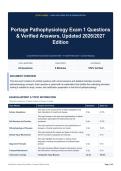
Portage Pathophysiology Exam 1 Questions
& Verified Answers, Updated 2026/2027
Edition
Comprehensive Examination Question Bank • In-Depth Rationales • Concept Mapping
TOTAL QUESTIONS EXAM TOPICS RATIONALES
22 Questions 6 Modules 100% Verified
DOCUMENT OVERVIEW
This document contains 22 verified questions with correct answers and detailed rationales covering
pathophysiology concepts. Each question is paired with an explanation that clarifies the underlying principles,
making it suitable for study, review, and certification preparation in the field of pathophysiology.
EXAM BLUEPRINT & TOPIC DISTRIBUTION
Systematic breakdown of subject domains and exam coverage.
Topic Module Scope & Core Focus Questions Share (%)
This topic covers various forms of cellular adaptations and
Cellular Adaptations their implications for health and disease. 6 Qs 27.3%
This topic focuses on the roles and characteristics of cellular
components, particularly the mitochondria and cell
Cell Structure and Function membrane. 6 Qs 27.3%
This topic explores the mechanisms and classifications of
Pathophysiology of Diseases diseases, including hypertension and cancer. 4 Qs 18.2%
This topic examines the causes and types of cell injury, along
Cellular Injury Mechanisms with the concepts of apoptosis and necrosis. 2 Qs 9.1%
This topic highlights key principles in making clinical
diagnoses, including the significance of evidence-based
Diagnostic Principles practice. 2 Qs 9.1%
This topic discusses different transport mechanisms across
Transport Mechanisms cell membranes, including osmosis and active transport. 2 Qs 9.1%
Total Exam Coverage 6 Integrated Topic Modules 22 Qs 100.0%
Confidential • Student Study Edition • Practice & Review Guide Page 1 of 9
, STUDENT STUDY & MASTERY EDITION PRACTICE & REVIEW GUIDE
TOPIC 1: CELLULAR ADAPTATIONS
6 Questions • 27.3% of Exam • This topic covers various forms of cellular adaptations and their implications for health and disease.
QUESTION 1
True/False: Persistent metaplasia can lead to dysplasia.
Correct Answer: True.
Rationale: Persistent metaplasia occurs when a normal cell type is replaced by an abnormal cell type that is not typical for
the tissue, leading to a chronic disruption in normal cellular function. Over time, this disruption can increase the risk of
genetic mutations that can progress to dysplasia, a precursor to cancer.
QUESTION 2
True/False: Barrett esophagus is an example of dysplasia.
Correct Answer: False (Barrett's esophagus is METAplasia)
Rationale: Barrett's esophagus is an example of metaplasia, a change in the type of cells lining the esophagus, whereas
dysplasia refers to an abnormal development of cells within the same tissue type. In Barrett's esophagus, the normal
squamous epithelium is replaced by columnar epithelium, making it a classic case of metaplasia rather than dysplasia.
QUESTION 3
True/False: Persistent dysplasia eventually results in cancer.
Correct Answer: True.
Rationale: Persistent dysplasia is a type of abnormal cell growth that, if left untreated, can continue to progress and
eventually develop into cancer due to accumulating genetic mutations. This gradual process demonstrates the malignant
transformation of dysplastic cells as they progress towards a fully malignant phenotype, resulting in cancer.
Confidential • Student Study Edition • Practice & Review Guide Page 2 of 9
Portage Pathophysiology Exam 1 Questions
& Verified Answers, Updated 2026/2027
Edition
Comprehensive Examination Question Bank • In-Depth Rationales • Concept Mapping
TOTAL QUESTIONS EXAM TOPICS RATIONALES
22 Questions 6 Modules 100% Verified
DOCUMENT OVERVIEW
This document contains 22 verified questions with correct answers and detailed rationales covering
pathophysiology concepts. Each question is paired with an explanation that clarifies the underlying principles,
making it suitable for study, review, and certification preparation in the field of pathophysiology.
EXAM BLUEPRINT & TOPIC DISTRIBUTION
Systematic breakdown of subject domains and exam coverage.
Topic Module Scope & Core Focus Questions Share (%)
This topic covers various forms of cellular adaptations and
Cellular Adaptations their implications for health and disease. 6 Qs 27.3%
This topic focuses on the roles and characteristics of cellular
components, particularly the mitochondria and cell
Cell Structure and Function membrane. 6 Qs 27.3%
This topic explores the mechanisms and classifications of
Pathophysiology of Diseases diseases, including hypertension and cancer. 4 Qs 18.2%
This topic examines the causes and types of cell injury, along
Cellular Injury Mechanisms with the concepts of apoptosis and necrosis. 2 Qs 9.1%
This topic highlights key principles in making clinical
diagnoses, including the significance of evidence-based
Diagnostic Principles practice. 2 Qs 9.1%
This topic discusses different transport mechanisms across
Transport Mechanisms cell membranes, including osmosis and active transport. 2 Qs 9.1%
Total Exam Coverage 6 Integrated Topic Modules 22 Qs 100.0%
Confidential • Student Study Edition • Practice & Review Guide Page 1 of 9
, STUDENT STUDY & MASTERY EDITION PRACTICE & REVIEW GUIDE
TOPIC 1: CELLULAR ADAPTATIONS
6 Questions • 27.3% of Exam • This topic covers various forms of cellular adaptations and their implications for health and disease.
QUESTION 1
True/False: Persistent metaplasia can lead to dysplasia.
Correct Answer: True.
Rationale: Persistent metaplasia occurs when a normal cell type is replaced by an abnormal cell type that is not typical for
the tissue, leading to a chronic disruption in normal cellular function. Over time, this disruption can increase the risk of
genetic mutations that can progress to dysplasia, a precursor to cancer.
QUESTION 2
True/False: Barrett esophagus is an example of dysplasia.
Correct Answer: False (Barrett's esophagus is METAplasia)
Rationale: Barrett's esophagus is an example of metaplasia, a change in the type of cells lining the esophagus, whereas
dysplasia refers to an abnormal development of cells within the same tissue type. In Barrett's esophagus, the normal
squamous epithelium is replaced by columnar epithelium, making it a classic case of metaplasia rather than dysplasia.
QUESTION 3
True/False: Persistent dysplasia eventually results in cancer.
Correct Answer: True.
Rationale: Persistent dysplasia is a type of abnormal cell growth that, if left untreated, can continue to progress and
eventually develop into cancer due to accumulating genetic mutations. This gradual process demonstrates the malignant
transformation of dysplastic cells as they progress towards a fully malignant phenotype, resulting in cancer.
Confidential • Student Study Edition • Practice & Review Guide Page 2 of 9