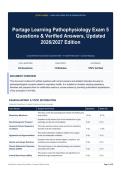
[STUDY GUIDE] • HIGH-YIELD PRACTICE & REVIEW EDITION
Portage Learning Pathophysiology Exam 5
Questions & Verified Answers, Updated
2026/2027 Edition
Comprehensive Examination Question Bank • In-Depth Rationales • Concept Mapping
TOTAL QUESTIONS EXAM TOPICS RATIONALES
62 Questions 12 Modules 100% Verified
DOCUMENT OVERVIEW
This document contains 62 verified questions with correct answers and detailed rationales focused on
pathophysiological concepts related to respiratory health. It is suitable for students studying respiratory
diseases and prepares them for certification exams or course reviews by providing authoritative explanations
of key principles in this field.
EXAM BLUEPRINT & TOPIC DISTRIBUTION
Systematic breakdown of subject domains and exam coverage.
Topic Module Scope & Core Focus Questions Share (%)
This topic covers the physiological processes of breathing and
Respiratory Mechanics lung function. 10 Qs 16.1%
Questions in this section focus on the mechanisms of gas
Gas Exchange and Transport exchange and the role of hemoglobin. 5 Qs 8.1%
Acute and Chronic Respiratory This topic examines various acute and chronic respiratory
Conditions disorders and their implications. 7 Qs 11.3%
This section addresses conditions related to low oxygen
Hypoxemia and Hypoventilation levels and inadequate ventilation. 5 Qs 8.1%
Questions here discuss asthma triggers, symptoms, and
Asthma and Allergic Reactions underlying immunological mechanisms. 5 Qs 8.1%
Chronic Obstructive Pulmonary This topic focuses on the pathophysiology and symptoms
Disease (COPD) associated with COPD. 5 Qs 8.1%
This section covers the interpretation and significance of
Arterial Blood Gases (ABGs) arterial blood gas measurements. 5 Qs 8.1%
Confidential • Student Study Edition • Practice & Review Guide Page 1 of 22
,STUDENT STUDY & MASTERY EDITION PRACTICE & REVIEW GUIDE
Questions in this topic focus on the histological and
Lung Pathology pathological changes in various lung diseases. 4 Qs 6.5%
This section addresses the relationship between ventilation
Ventilation-Perfusion Coupling and perfusion in lung function. 4 Qs 6.5%
Questions in this topic delve into the mechanics of breathing
Respiratory Physiology and lung compliance. 4 Qs 6.5%
Pulmonary Emboli and This section examines the causes and effects of pulmonary
Complications embolism and related complications. 4 Qs 6.5%
Questions here explore the relationship between respiratory
Acid-Base Balance function and acid-base balance. 4 Qs 6.5%
Total Exam Coverage 12 Integrated Topic Modules 62 Qs 100.0%
Confidential • Student Study Edition • Practice & Review Guide Page 2 of 22
, STUDENT STUDY & MASTERY EDITION PRACTICE & REVIEW GUIDE
TOPIC 1: RESPIRATORY MECHANICS
10 Questions • 16.1% of Exam • This topic covers the physiological processes of breathing and lung function.
QUESTION 1
Expiration is an active process, whereas inspiration is largely passive?
Correct Answer: False.
Rationale: The statement is incorrect because expiration is also largely a passive process, as it involves the elastic recoil of
the lungs and the airways, rather than an active process requiring muscle contraction. The primary active process involved
in breathing is inspiration, which requires the contraction of the diaphragm and intercostal muscles to expand the lungs and
draw air in.
QUESTION 2
Both carbon dioxide and oxygen are able to bind with hemoglobin?
Correct Answer: True.
Rationale: Carbon dioxide binds to hemoglobin through a process called carbaminohemoglobin formation, where carbon
dioxide combines with the amino groups of the hemoglobin molecule. Oxygen also competes with carbon dioxide for these
binding sites, but hemoglobin's affinity for oxygen is greater than its affinity for carbon dioxide, allowing it to release oxygen
to tissues while binding carbon dioxide for transport.
QUESTION 3
There are _____ in the actual sites of gas exchange between the air and blood
Correct Answer: Alveoli.
Rationale: The correct answer is "alveoli" because they are tiny sacs located at the end of the bronchioles in the lungs
where oxygen from the air diffuses into the bloodstream and carbon dioxide diffuses out, facilitating gas exchange. This
process is essential for the respiratory system to function properly, enabling the body to receive oxygen and remove carbon
dioxide.
Confidential • Student Study Edition • Practice & Review Guide Page 3 of 22
Portage Learning Pathophysiology Exam 5
Questions & Verified Answers, Updated
2026/2027 Edition
Comprehensive Examination Question Bank • In-Depth Rationales • Concept Mapping
TOTAL QUESTIONS EXAM TOPICS RATIONALES
62 Questions 12 Modules 100% Verified
DOCUMENT OVERVIEW
This document contains 62 verified questions with correct answers and detailed rationales focused on
pathophysiological concepts related to respiratory health. It is suitable for students studying respiratory
diseases and prepares them for certification exams or course reviews by providing authoritative explanations
of key principles in this field.
EXAM BLUEPRINT & TOPIC DISTRIBUTION
Systematic breakdown of subject domains and exam coverage.
Topic Module Scope & Core Focus Questions Share (%)
This topic covers the physiological processes of breathing and
Respiratory Mechanics lung function. 10 Qs 16.1%
Questions in this section focus on the mechanisms of gas
Gas Exchange and Transport exchange and the role of hemoglobin. 5 Qs 8.1%
Acute and Chronic Respiratory This topic examines various acute and chronic respiratory
Conditions disorders and their implications. 7 Qs 11.3%
This section addresses conditions related to low oxygen
Hypoxemia and Hypoventilation levels and inadequate ventilation. 5 Qs 8.1%
Questions here discuss asthma triggers, symptoms, and
Asthma and Allergic Reactions underlying immunological mechanisms. 5 Qs 8.1%
Chronic Obstructive Pulmonary This topic focuses on the pathophysiology and symptoms
Disease (COPD) associated with COPD. 5 Qs 8.1%
This section covers the interpretation and significance of
Arterial Blood Gases (ABGs) arterial blood gas measurements. 5 Qs 8.1%
Confidential • Student Study Edition • Practice & Review Guide Page 1 of 22
,STUDENT STUDY & MASTERY EDITION PRACTICE & REVIEW GUIDE
Questions in this topic focus on the histological and
Lung Pathology pathological changes in various lung diseases. 4 Qs 6.5%
This section addresses the relationship between ventilation
Ventilation-Perfusion Coupling and perfusion in lung function. 4 Qs 6.5%
Questions in this topic delve into the mechanics of breathing
Respiratory Physiology and lung compliance. 4 Qs 6.5%
Pulmonary Emboli and This section examines the causes and effects of pulmonary
Complications embolism and related complications. 4 Qs 6.5%
Questions here explore the relationship between respiratory
Acid-Base Balance function and acid-base balance. 4 Qs 6.5%
Total Exam Coverage 12 Integrated Topic Modules 62 Qs 100.0%
Confidential • Student Study Edition • Practice & Review Guide Page 2 of 22
, STUDENT STUDY & MASTERY EDITION PRACTICE & REVIEW GUIDE
TOPIC 1: RESPIRATORY MECHANICS
10 Questions • 16.1% of Exam • This topic covers the physiological processes of breathing and lung function.
QUESTION 1
Expiration is an active process, whereas inspiration is largely passive?
Correct Answer: False.
Rationale: The statement is incorrect because expiration is also largely a passive process, as it involves the elastic recoil of
the lungs and the airways, rather than an active process requiring muscle contraction. The primary active process involved
in breathing is inspiration, which requires the contraction of the diaphragm and intercostal muscles to expand the lungs and
draw air in.
QUESTION 2
Both carbon dioxide and oxygen are able to bind with hemoglobin?
Correct Answer: True.
Rationale: Carbon dioxide binds to hemoglobin through a process called carbaminohemoglobin formation, where carbon
dioxide combines with the amino groups of the hemoglobin molecule. Oxygen also competes with carbon dioxide for these
binding sites, but hemoglobin's affinity for oxygen is greater than its affinity for carbon dioxide, allowing it to release oxygen
to tissues while binding carbon dioxide for transport.
QUESTION 3
There are _____ in the actual sites of gas exchange between the air and blood
Correct Answer: Alveoli.
Rationale: The correct answer is "alveoli" because they are tiny sacs located at the end of the bronchioles in the lungs
where oxygen from the air diffuses into the bloodstream and carbon dioxide diffuses out, facilitating gas exchange. This
process is essential for the respiratory system to function properly, enabling the body to receive oxygen and remove carbon
dioxide.
Confidential • Student Study Edition • Practice & Review Guide Page 3 of 22