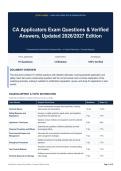
[STUDY GUIDE] • HIGH-YIELD PRACTICE & REVIEW EDITION
CA Applicators Exam Questions & Verified
Answers, Updated 2026/2027 Edition
Comprehensive Examination Question Bank • In-Depth Rationales • Concept Mapping
TOTAL QUESTIONS EXAM TOPICS RATIONALES
91 Questions 12 Modules 100% Verified
DOCUMENT OVERVIEW
This document contains 91 verified questions with detailed rationales covering pesticide application and
safety. Each item pairs a board-style question with the correct answer and a concise explanation of the
underlying principle, making it suitable for certification preparation, review, and study for applicators in pest
control.
EXAM BLUEPRINT & TOPIC DISTRIBUTION
Systematic breakdown of subject domains and exam coverage.
Topic Module Scope & Core Focus Questions Share (%)
Covers fundamental concepts about pesticides, including
Pesticide Basics trade names and formulations. 14 Qs 15.4%
Safety Measures and Focuses on safety protocols, signal words, and regulatory
Regulations requirements for pesticide use. 7 Qs 7.7%
Explains various methods and equipment used for pesticide
Application Techniques application. 8 Qs 8.8%
Examines the properties of different pesticides and their
Chemical Properties and Effects toxicological effects. 7 Qs 7.7%
Environmental Impact and Discusses the environmental considerations and integrated
Management pest management strategies. 7 Qs 7.7%
Details procedures for handling pesticide spills and acute
Emergency Procedures exposure. 7 Qs 7.7%
Describes various pest control techniques, including baiting
Pest Control Methods and fumigation. 7 Qs 7.7%
Outlines proper practices for pesticide container disposal and
Pesticide Disposal and Storage safe storage. 7 Qs 7.7%
Confidential • Student Study Edition • Practice & Review Guide Page 1 of 32
,STUDENT STUDY & MASTERY EDITION PRACTICE & REVIEW GUIDE
Explains classifications of pesticides based on their chemical
Pesticide Classification structure and action. 7 Qs 7.7%
Covers licensing requirements and regulations governing pest
License and Board Regulations control applicators. 7 Qs 7.7%
Discusses various equipment used in pesticide application
Equipment and Mechanisms and their functions. 7 Qs 7.7%
Insect Growth Regulators and Focuses on biological pest control methods and insect growth
Biologicals regulators. 6 Qs 6.6%
Total Exam Coverage 12 Integrated Topic Modules 91 Qs 100.0%
Confidential • Student Study Edition • Practice & Review Guide Page 2 of 32
,STUDENT STUDY & MASTERY EDITION PRACTICE & REVIEW GUIDE
TOPIC 1: PESTICIDE BASICS
14 Questions • 15.4% of Exam • Covers fundamental concepts about pesticides, including trade names and formulations.
QUESTION 1
What is a Trade Name
Correct Answer: The name given to the product by the manufacture.
Rationale: A Trade Name specifically refers to the brand identity or trademarked name assigned to a product by its
manufacturer, differentiating it from its generic or chemical name. This distinction highlights the unique aspect of a Trade
Name, emphasizing its role in identifying a product through its trademarked name rather than its chemical composition.
QUESTION 2
What are Inert Ingredients
Correct Answer: Ingredients with no pesticide action.
Rationale: Inert ingredients are additives in pesticides that do not directly kill pests or have any pesticide action, but rather
serve to enhance the performance, stability, and shelf life of the active pesticide. This means their primary function is not to
eliminate pests, but rather to support the overall formulation and effectiveness of the pesticide product.
QUESTION 3
What are Pesticide Formulations
Correct Answer: These reflect the way a pesticide is manufactured, where it is applied, and what type of
application equipment is required.
Rationale: Pesticide formulations refer to the physical and chemical form in which a pesticide is presented for use, which is
directly influenced by how it is manufactured, applied, and the equipment required for application. This understanding is
rooted in the concept that different formulations are designed to optimize the effectiveness and efficiency of pesticide
application, taking into account various factors such as target pest, application method, and environmental conditions.
Confidential • Student Study Edition • Practice & Review Guide Page 3 of 32
, STUDENT STUDY & MASTERY EDITION PRACTICE & REVIEW GUIDE
QUESTION 4
What are Emulsifiable Concentrates
Correct Answer: Formulations with emulsifiers or detergents which enable petroleum based active
ingredients to mix with, and suspend in water.
Rationale: Emulsifiable Concentrates are a type of formulation that enables the mixture of petroleum-based active
ingredients with water due to the presence of emulsifiers or detergents, which facilitate the suspension of otherwise
insoluble components. This characteristic is a direct result of the emulsifiers' ability to break down the surface tension of
water, allowing petroleum-based ingredients to mix and remain suspended within the water-based solution.
QUESTION 5
What are Bait Gels.
Correct Answer: Active ingredient carried in the form of toothpaste like gel; active ingredient is mixed with
an attractant.
Rationale: Bait gels are a form of pest control that utilizes a toothpaste-like gel texture to carry the active ingredient,
allowing for a smooth and even application to targeted areas. The use of an attractant mixed with the active ingredient in the
gel is a key feature that enhances the effectiveness of the bait gel by drawing pests towards the area where the gel is
applied.
QUESTION 6
What are Insect Growth Regulators (IGR's)
Correct Answer: A material that interrupts an insects lifecycle and reproductive ability in Cockroaches and
Fleas.
Rationale: Insect Growth Regulators (IGRs) work by interfering with the normal physiological processes that control an
insect's development, reproduction, and growth, thereby preventing them from reaching adulthood and reproducing. This
mechanism targets the insect's lifecycle and reproductive ability, effectively disrupting their ability to thrive and multiply,
which is why the given description accurately describes IGRs, particularly in the context of Cockroaches and Fleas.
Confidential • Student Study Edition • Practice & Review Guide Page 4 of 32
CA Applicators Exam Questions & Verified
Answers, Updated 2026/2027 Edition
Comprehensive Examination Question Bank • In-Depth Rationales • Concept Mapping
TOTAL QUESTIONS EXAM TOPICS RATIONALES
91 Questions 12 Modules 100% Verified
DOCUMENT OVERVIEW
This document contains 91 verified questions with detailed rationales covering pesticide application and
safety. Each item pairs a board-style question with the correct answer and a concise explanation of the
underlying principle, making it suitable for certification preparation, review, and study for applicators in pest
control.
EXAM BLUEPRINT & TOPIC DISTRIBUTION
Systematic breakdown of subject domains and exam coverage.
Topic Module Scope & Core Focus Questions Share (%)
Covers fundamental concepts about pesticides, including
Pesticide Basics trade names and formulations. 14 Qs 15.4%
Safety Measures and Focuses on safety protocols, signal words, and regulatory
Regulations requirements for pesticide use. 7 Qs 7.7%
Explains various methods and equipment used for pesticide
Application Techniques application. 8 Qs 8.8%
Examines the properties of different pesticides and their
Chemical Properties and Effects toxicological effects. 7 Qs 7.7%
Environmental Impact and Discusses the environmental considerations and integrated
Management pest management strategies. 7 Qs 7.7%
Details procedures for handling pesticide spills and acute
Emergency Procedures exposure. 7 Qs 7.7%
Describes various pest control techniques, including baiting
Pest Control Methods and fumigation. 7 Qs 7.7%
Outlines proper practices for pesticide container disposal and
Pesticide Disposal and Storage safe storage. 7 Qs 7.7%
Confidential • Student Study Edition • Practice & Review Guide Page 1 of 32
,STUDENT STUDY & MASTERY EDITION PRACTICE & REVIEW GUIDE
Explains classifications of pesticides based on their chemical
Pesticide Classification structure and action. 7 Qs 7.7%
Covers licensing requirements and regulations governing pest
License and Board Regulations control applicators. 7 Qs 7.7%
Discusses various equipment used in pesticide application
Equipment and Mechanisms and their functions. 7 Qs 7.7%
Insect Growth Regulators and Focuses on biological pest control methods and insect growth
Biologicals regulators. 6 Qs 6.6%
Total Exam Coverage 12 Integrated Topic Modules 91 Qs 100.0%
Confidential • Student Study Edition • Practice & Review Guide Page 2 of 32
,STUDENT STUDY & MASTERY EDITION PRACTICE & REVIEW GUIDE
TOPIC 1: PESTICIDE BASICS
14 Questions • 15.4% of Exam • Covers fundamental concepts about pesticides, including trade names and formulations.
QUESTION 1
What is a Trade Name
Correct Answer: The name given to the product by the manufacture.
Rationale: A Trade Name specifically refers to the brand identity or trademarked name assigned to a product by its
manufacturer, differentiating it from its generic or chemical name. This distinction highlights the unique aspect of a Trade
Name, emphasizing its role in identifying a product through its trademarked name rather than its chemical composition.
QUESTION 2
What are Inert Ingredients
Correct Answer: Ingredients with no pesticide action.
Rationale: Inert ingredients are additives in pesticides that do not directly kill pests or have any pesticide action, but rather
serve to enhance the performance, stability, and shelf life of the active pesticide. This means their primary function is not to
eliminate pests, but rather to support the overall formulation and effectiveness of the pesticide product.
QUESTION 3
What are Pesticide Formulations
Correct Answer: These reflect the way a pesticide is manufactured, where it is applied, and what type of
application equipment is required.
Rationale: Pesticide formulations refer to the physical and chemical form in which a pesticide is presented for use, which is
directly influenced by how it is manufactured, applied, and the equipment required for application. This understanding is
rooted in the concept that different formulations are designed to optimize the effectiveness and efficiency of pesticide
application, taking into account various factors such as target pest, application method, and environmental conditions.
Confidential • Student Study Edition • Practice & Review Guide Page 3 of 32
, STUDENT STUDY & MASTERY EDITION PRACTICE & REVIEW GUIDE
QUESTION 4
What are Emulsifiable Concentrates
Correct Answer: Formulations with emulsifiers or detergents which enable petroleum based active
ingredients to mix with, and suspend in water.
Rationale: Emulsifiable Concentrates are a type of formulation that enables the mixture of petroleum-based active
ingredients with water due to the presence of emulsifiers or detergents, which facilitate the suspension of otherwise
insoluble components. This characteristic is a direct result of the emulsifiers' ability to break down the surface tension of
water, allowing petroleum-based ingredients to mix and remain suspended within the water-based solution.
QUESTION 5
What are Bait Gels.
Correct Answer: Active ingredient carried in the form of toothpaste like gel; active ingredient is mixed with
an attractant.
Rationale: Bait gels are a form of pest control that utilizes a toothpaste-like gel texture to carry the active ingredient,
allowing for a smooth and even application to targeted areas. The use of an attractant mixed with the active ingredient in the
gel is a key feature that enhances the effectiveness of the bait gel by drawing pests towards the area where the gel is
applied.
QUESTION 6
What are Insect Growth Regulators (IGR's)
Correct Answer: A material that interrupts an insects lifecycle and reproductive ability in Cockroaches and
Fleas.
Rationale: Insect Growth Regulators (IGRs) work by interfering with the normal physiological processes that control an
insect's development, reproduction, and growth, thereby preventing them from reaching adulthood and reproducing. This
mechanism targets the insect's lifecycle and reproductive ability, effectively disrupting their ability to thrive and multiply,
which is why the given description accurately describes IGRs, particularly in the context of Cockroaches and Fleas.
Confidential • Student Study Edition • Practice & Review Guide Page 4 of 32