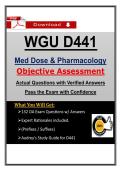
WGU D441
Med Dose & Pharmacology
Objective Assessment
Actual Questions with Verified Answers
Pass the Exam with Confidence
What You Will Get:
➢132 OA Exam Questions w/ Answers
➢Expert Rationales included.
➢(Prefixes / Suffixes)
➢Audrey's Study Guide for D441
, PREVIEW ACCESS
Preview Pages
Below
Get the Complete PDF
After Purchase
If you require further clarification or in need of any study
resources, feel free to Message me.
Clean preview. Full resource available after purchase.
,Table of Contents
WGU D441 (OA) EXAM ......................................................... 2
Prefixes / Suffixes................................................................ 79
Audrey's Study Guide for D441 .......................................... 86
WGU D441 (OA) EXAM
1. A client is receiving orlistat as part of a weight-management program. Which
ongoing assessment should be included in the plan of care to determine the
effectiveness of the medication?
A. Serum protein levels.
B. Body mass index (BMI).
C. Daily calorie count.
D. Depression screening.
Correct Answer:
B. Body mass index (BMI).
Rationale:
Orlistat blocks fat absorption in the GI tract to promote weight loss, so the trend in BMI
(and weight) is the direct, objective measure of therapeutic effectiveness.
, ---
2. The nurse is teaching a client diagnosed with human immunodeficiency virus (HIV)
about the antiretroviral regimen. Which statement by the client requires additional
instruction?
A. "HIV infection is not cured by the antiretroviral regimen."
B. "The viral load can be decreased to an undetectable level."
C. "The medications can decrease AIDS-related complications."
D. "Antiretroviral medication prevents the transmission of the virus."
Correct Answer:
D. "Antiretroviral medication prevents the transmission of the virus."
Rationale:
This statement shows misunderstanding — antiretroviral therapy suppresses viral load
and reduces complications but does NOT cure HIV and does not eliminate transmission
risk; barrier protection and other precautions remain necessary.
---
3. A glucagon emergency kit is prescribed for a client with type 1 diabetes mellitus.
When should the nurse instruct the client and family that glucagon needs to be
administered?
A. Before meals to prevent hyperglycemia.
B. When signs of severe hypoglycemia occur.
C. At the onset of signs of diabetic ketoacidosis.
D. When unable to eat during sick days.
Correct Answer:
B. When signs of severe hypoglycemia occur.
Med Dose & Pharmacology
Objective Assessment
Actual Questions with Verified Answers
Pass the Exam with Confidence
What You Will Get:
➢132 OA Exam Questions w/ Answers
➢Expert Rationales included.
➢(Prefixes / Suffixes)
➢Audrey's Study Guide for D441
, PREVIEW ACCESS
Preview Pages
Below
Get the Complete PDF
After Purchase
If you require further clarification or in need of any study
resources, feel free to Message me.
Clean preview. Full resource available after purchase.
,Table of Contents
WGU D441 (OA) EXAM ......................................................... 2
Prefixes / Suffixes................................................................ 79
Audrey's Study Guide for D441 .......................................... 86
WGU D441 (OA) EXAM
1. A client is receiving orlistat as part of a weight-management program. Which
ongoing assessment should be included in the plan of care to determine the
effectiveness of the medication?
A. Serum protein levels.
B. Body mass index (BMI).
C. Daily calorie count.
D. Depression screening.
Correct Answer:
B. Body mass index (BMI).
Rationale:
Orlistat blocks fat absorption in the GI tract to promote weight loss, so the trend in BMI
(and weight) is the direct, objective measure of therapeutic effectiveness.
, ---
2. The nurse is teaching a client diagnosed with human immunodeficiency virus (HIV)
about the antiretroviral regimen. Which statement by the client requires additional
instruction?
A. "HIV infection is not cured by the antiretroviral regimen."
B. "The viral load can be decreased to an undetectable level."
C. "The medications can decrease AIDS-related complications."
D. "Antiretroviral medication prevents the transmission of the virus."
Correct Answer:
D. "Antiretroviral medication prevents the transmission of the virus."
Rationale:
This statement shows misunderstanding — antiretroviral therapy suppresses viral load
and reduces complications but does NOT cure HIV and does not eliminate transmission
risk; barrier protection and other precautions remain necessary.
---
3. A glucagon emergency kit is prescribed for a client with type 1 diabetes mellitus.
When should the nurse instruct the client and family that glucagon needs to be
administered?
A. Before meals to prevent hyperglycemia.
B. When signs of severe hypoglycemia occur.
C. At the onset of signs of diabetic ketoacidosis.
D. When unable to eat during sick days.
Correct Answer:
B. When signs of severe hypoglycemia occur.