[STUDY GUIDE] • HIGH-YIELD PRACTICE & REVIEW EDITION
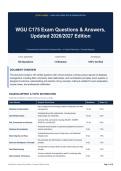
WGU C175 Exam Questions & Answers,
Updated 2026/2027 Edition
Comprehensive Examination Question Bank • In-Depth Rationales • Concept Mapping
TOTAL QUESTIONS EXAM TOPICS RATIONALES
120 Questions 13 Modules 100% Verified
DOCUMENT OVERVIEW
This document contains 120 verified questions with correct answers covering various aspects of database
management, including SQL commands, data relationships, and normalization principles. Each question is
designed to enhance understanding and retention of key concepts, making it suitable for exam preparation,
course review, and professional certification.
EXAM BLUEPRINT & TOPIC DISTRIBUTION
Systematic breakdown of subject domains and exam coverage.
Topic Module Scope & Core Focus Questions Share (%)
Key concepts and terminology related to databases and data
Database Fundamentals management. 10 Qs 8.3%
Understanding entity relationships, including binary
Data Relationships relationships and cardinality. 10 Qs 8.3%
Common SQL commands including SELECT, INSERT,
SQL Commands and Queries UPDATE, and DELETE. 10 Qs 8.3%
Processes and principles of organizing database structures to
Database Normalization reduce redundancy. 9 Qs 7.5%
Understanding primary keys, foreign keys, and referential
Data Integrity and Keys integrity rules. 9 Qs 7.5%
Key principles and techniques for utilizing data for business
Business Intelligence Concepts analysis. 9 Qs 7.5%
Fundamental concepts related to data warehousing and data
Data Warehousing storage. 9 Qs 7.5%
Common methods and algorithms used for analyzing data,
Data Analysis Techniques including clustering and classification. 9 Qs 7.5%
Confidential • Student Study Edition • Practice & Review Guide Page 1 of 30
,STUDENT STUDY & MASTERY EDITION PRACTICE & REVIEW GUIDE
Database Management Systems Various approaches and structures used in managing
(DBMS) databases. 9 Qs 7.5%
Understanding transaction processing and concurrency
Transaction Management issues in databases. 9 Qs 7.5%
Exploring advanced SQL features including JOINs and
Advanced SQL Techniques subqueries. 9 Qs 7.5%
Key steps and considerations in the Extract, Transform, Load
ETL Processes (ETL) process. 9 Qs 7.5%
Principles related to data protection, integrity, and security
Data Security and Compliance measures. 9 Qs 7.5%
Total Exam Coverage 13 Integrated Topic Modules 120 Qs 100.0%
Confidential • Student Study Edition • Practice & Review Guide Page 2 of 30
, STUDENT STUDY & MASTERY EDITION PRACTICE & REVIEW GUIDE
TOPIC 1: DATABASE FUNDAMENTALS
10 Questions • 8.3% of Exam • Key concepts and terminology related to databases and data management.
QUESTION 1
Flat Files
Correct Answer: A file having no internal hierarchy.
QUESTION 2
Hashed Files
Correct Answer: A file that has been encrypted for security purposes.
QUESTION 3
Information
Correct Answer: The transformation of raw data into useful facts.
QUESTION 4
Unstructured Data
Correct Answer: Information that does not have structure (such as text)
QUESTION 5
Modality
Correct Answer: It is a minimum number of entity occurrences that can be involved in a relationship.
QUESTION 6
"A salesperson sells to many customers." What is the name of this relationship?
Confidential • Student Study Edition • Practice & Review Guide Page 3 of 30
WGU C175 Exam Questions & Answers,
Updated 2026/2027 Edition
Comprehensive Examination Question Bank • In-Depth Rationales • Concept Mapping
TOTAL QUESTIONS EXAM TOPICS RATIONALES
120 Questions 13 Modules 100% Verified
DOCUMENT OVERVIEW
This document contains 120 verified questions with correct answers covering various aspects of database
management, including SQL commands, data relationships, and normalization principles. Each question is
designed to enhance understanding and retention of key concepts, making it suitable for exam preparation,
course review, and professional certification.
EXAM BLUEPRINT & TOPIC DISTRIBUTION
Systematic breakdown of subject domains and exam coverage.
Topic Module Scope & Core Focus Questions Share (%)
Key concepts and terminology related to databases and data
Database Fundamentals management. 10 Qs 8.3%
Understanding entity relationships, including binary
Data Relationships relationships and cardinality. 10 Qs 8.3%
Common SQL commands including SELECT, INSERT,
SQL Commands and Queries UPDATE, and DELETE. 10 Qs 8.3%
Processes and principles of organizing database structures to
Database Normalization reduce redundancy. 9 Qs 7.5%
Understanding primary keys, foreign keys, and referential
Data Integrity and Keys integrity rules. 9 Qs 7.5%
Key principles and techniques for utilizing data for business
Business Intelligence Concepts analysis. 9 Qs 7.5%
Fundamental concepts related to data warehousing and data
Data Warehousing storage. 9 Qs 7.5%
Common methods and algorithms used for analyzing data,
Data Analysis Techniques including clustering and classification. 9 Qs 7.5%
Confidential • Student Study Edition • Practice & Review Guide Page 1 of 30
,STUDENT STUDY & MASTERY EDITION PRACTICE & REVIEW GUIDE
Database Management Systems Various approaches and structures used in managing
(DBMS) databases. 9 Qs 7.5%
Understanding transaction processing and concurrency
Transaction Management issues in databases. 9 Qs 7.5%
Exploring advanced SQL features including JOINs and
Advanced SQL Techniques subqueries. 9 Qs 7.5%
Key steps and considerations in the Extract, Transform, Load
ETL Processes (ETL) process. 9 Qs 7.5%
Principles related to data protection, integrity, and security
Data Security and Compliance measures. 9 Qs 7.5%
Total Exam Coverage 13 Integrated Topic Modules 120 Qs 100.0%
Confidential • Student Study Edition • Practice & Review Guide Page 2 of 30
, STUDENT STUDY & MASTERY EDITION PRACTICE & REVIEW GUIDE
TOPIC 1: DATABASE FUNDAMENTALS
10 Questions • 8.3% of Exam • Key concepts and terminology related to databases and data management.
QUESTION 1
Flat Files
Correct Answer: A file having no internal hierarchy.
QUESTION 2
Hashed Files
Correct Answer: A file that has been encrypted for security purposes.
QUESTION 3
Information
Correct Answer: The transformation of raw data into useful facts.
QUESTION 4
Unstructured Data
Correct Answer: Information that does not have structure (such as text)
QUESTION 5
Modality
Correct Answer: It is a minimum number of entity occurrences that can be involved in a relationship.
QUESTION 6
"A salesperson sells to many customers." What is the name of this relationship?
Confidential • Student Study Edition • Practice & Review Guide Page 3 of 30