[STUDY GUIDE] • HIGH-YIELD PRACTICE & REVIEW EDITION
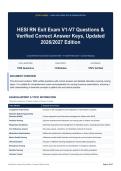
HESI RN Exit Exam V1-V7 Questions &
Verified Correct Answer Keys, Updated
2026/2027 Edition
Comprehensive Examination Question Bank • In-Depth Rationales • Concept Mapping
TOTAL QUESTIONS EXAM TOPICS RATIONALES
1990 Questions 12 Modules 100% Verified
DOCUMENT OVERVIEW
This document contains 1990 verified questions with correct answers and detailed rationales covering nursing
topics. It is suitable for comprehensive review and preparation for nursing licensure examinations, ensuring a
solid understanding of essential concepts in patient care and clinical practice.
EXAM BLUEPRINT & TOPIC DISTRIBUTION
Systematic breakdown of subject domains and exam coverage.
Topic Module Scope & Core Focus
Congestive Heart Failure Focuses on the management and implications of heart failure in patients.
Attention Deficit Hyperactivity
Disorder (ADHD) Covers assessment and intervention strategies for children with ADHD.
Pediatric Nursing Explores developmental milestones and nursing care for infants and children.
Respiratory Conditions Examines assessment and management of respiratory issues, including pulmonary edema.
Iron Deficiency Anemia Discusses causes, symptoms, and treatment protocols for anemia.
Medication Administration Details safe practices for administering medications in various clinical scenarios.
Mental Health Nursing Addresses mental health disorders and therapeutic communication techniques.
Client Education Focuses on effective teaching strategies for diverse patient populations.
Emergency Nursing Covers acute care procedures and prioritization in emergency situations.
Geriatric Nursing Explores health issues and nursing care specific to the elderly population.
Infection Control Examines principles and practices for preventing and controlling infections.
Confidential • Student Study Edition • Practice & Review Guide Page 1 of 517
,STUDENT STUDY & MASTERY EDITION PRACTICE & REVIEW GUIDE
Cardiac Nursing Focuses on assessments, treatments, and nursing considerations for cardiac conditions.
Total Exam Coverage 12 Integrated Topic Modules • 1990 Examination Questions
Confidential • Student Study Edition • Practice & Review Guide Page 2 of 517
,STUDENT STUDY & MASTERY EDITION PRACTICE & REVIEW GUIDE
QUESTION 1
In planning care for a 6 month-old infant, what must the nurse provide to assist in the
development of trust?
Correct Answer: C) Security.
Rationale: Providing a consistent and predictable environment helps establish trust with the infant. A consistent and
predictable environment, in turn, is a key component of security, making it essential for the nurse to provide a secure
environment to assist in the development of trust in the infant.
QUESTION 2
In planning care for a 6 month-old infant, what must the nurse provide to assist in the
development of trust?
Correct Answer: C) Security.
Rationale: Providing a secure environment for the infant is crucial in establishing trust, as a sense of safety allows the child
to feel comfortable and develop a positive relationship with the nurse. A secure environment can be achieved by respecting
the infant's personal space, establishing a predictable routine, and minimizing interruptions, thereby promoting a sense of
trust.
QUESTION 3
A nurse has just received a medication order which is not legible. Which statement best
reflects assertive communication?
Correct Answer: B) "Would you please clarify what you have written so I am sure I am reading it correctly?".
Rationale: This statement reflects assertive communication because it politely yet clearly expresses the nurse's need for
clarification, allowing the prescriber to rectify the issue without undermining their authority. By asking for clarification, the
nurse is prioritizing accurate medication administration and taking an active role in ensuring patient safety.
Confidential • Student Study Edition • Practice & Review Guide Page 3 of 517
, STUDENT STUDY & MASTERY EDITION PRACTICE & REVIEW GUIDE
QUESTION 4
What is the most important consideration when teaching parents how to reduce risks in
the home?
Correct Answer: D) Age of children in the home.
Rationale: The age of children in the home is the most critical consideration because it determines the level of supervision
and safety precautions required to prevent injuries and accidents, such as electrical outlets and hot surfaces that are more
hazardous to young children. As children grow older, their ability to understand and follow safety rules increases, making the
need for tailored safety measures less stringent.
QUESTION 5
A 35 year-old client with sickle cell crisis is talking on the telephone but stops as the
nurse enters the room to request something for pain. The nurse should
Correct Answer: C) Administer the prescribed analgesia.
Rationale: The nurse should administer the prescribed analgesia because the client's pain is severe enough to interrupt
normal activities, indicating the need for immediate pain relief to prevent further distress and promote comfort. Administering
prescribed analgesia is a priority intervention in this situation, as it is essential to alleviate the client's suffering and ensure
their safety.
QUESTION 6
A 35 year-old client with sickle cell crisis is talking on the telephone but stops as the
nurse enters the room to request something for pain. The nurse should
Correct Answer: C) Administer the prescribed analgesia.
Rationale: The nurse should administer the prescribed analgesia because the client's verbal report of pain indicates a need
for pain relief, and the nurse's role is to prioritize the client's comfort and alleviate suffering. By administering the prescribed
analgesia, the nurse is following established protocols and treatment plans to effectively manage the client's pain.
Confidential • Student Study Edition • Practice & Review Guide Page 4 of 517
HESI RN Exit Exam V1-V7 Questions &
Verified Correct Answer Keys, Updated
2026/2027 Edition
Comprehensive Examination Question Bank • In-Depth Rationales • Concept Mapping
TOTAL QUESTIONS EXAM TOPICS RATIONALES
1990 Questions 12 Modules 100% Verified
DOCUMENT OVERVIEW
This document contains 1990 verified questions with correct answers and detailed rationales covering nursing
topics. It is suitable for comprehensive review and preparation for nursing licensure examinations, ensuring a
solid understanding of essential concepts in patient care and clinical practice.
EXAM BLUEPRINT & TOPIC DISTRIBUTION
Systematic breakdown of subject domains and exam coverage.
Topic Module Scope & Core Focus
Congestive Heart Failure Focuses on the management and implications of heart failure in patients.
Attention Deficit Hyperactivity
Disorder (ADHD) Covers assessment and intervention strategies for children with ADHD.
Pediatric Nursing Explores developmental milestones and nursing care for infants and children.
Respiratory Conditions Examines assessment and management of respiratory issues, including pulmonary edema.
Iron Deficiency Anemia Discusses causes, symptoms, and treatment protocols for anemia.
Medication Administration Details safe practices for administering medications in various clinical scenarios.
Mental Health Nursing Addresses mental health disorders and therapeutic communication techniques.
Client Education Focuses on effective teaching strategies for diverse patient populations.
Emergency Nursing Covers acute care procedures and prioritization in emergency situations.
Geriatric Nursing Explores health issues and nursing care specific to the elderly population.
Infection Control Examines principles and practices for preventing and controlling infections.
Confidential • Student Study Edition • Practice & Review Guide Page 1 of 517
,STUDENT STUDY & MASTERY EDITION PRACTICE & REVIEW GUIDE
Cardiac Nursing Focuses on assessments, treatments, and nursing considerations for cardiac conditions.
Total Exam Coverage 12 Integrated Topic Modules • 1990 Examination Questions
Confidential • Student Study Edition • Practice & Review Guide Page 2 of 517
,STUDENT STUDY & MASTERY EDITION PRACTICE & REVIEW GUIDE
QUESTION 1
In planning care for a 6 month-old infant, what must the nurse provide to assist in the
development of trust?
Correct Answer: C) Security.
Rationale: Providing a consistent and predictable environment helps establish trust with the infant. A consistent and
predictable environment, in turn, is a key component of security, making it essential for the nurse to provide a secure
environment to assist in the development of trust in the infant.
QUESTION 2
In planning care for a 6 month-old infant, what must the nurse provide to assist in the
development of trust?
Correct Answer: C) Security.
Rationale: Providing a secure environment for the infant is crucial in establishing trust, as a sense of safety allows the child
to feel comfortable and develop a positive relationship with the nurse. A secure environment can be achieved by respecting
the infant's personal space, establishing a predictable routine, and minimizing interruptions, thereby promoting a sense of
trust.
QUESTION 3
A nurse has just received a medication order which is not legible. Which statement best
reflects assertive communication?
Correct Answer: B) "Would you please clarify what you have written so I am sure I am reading it correctly?".
Rationale: This statement reflects assertive communication because it politely yet clearly expresses the nurse's need for
clarification, allowing the prescriber to rectify the issue without undermining their authority. By asking for clarification, the
nurse is prioritizing accurate medication administration and taking an active role in ensuring patient safety.
Confidential • Student Study Edition • Practice & Review Guide Page 3 of 517
, STUDENT STUDY & MASTERY EDITION PRACTICE & REVIEW GUIDE
QUESTION 4
What is the most important consideration when teaching parents how to reduce risks in
the home?
Correct Answer: D) Age of children in the home.
Rationale: The age of children in the home is the most critical consideration because it determines the level of supervision
and safety precautions required to prevent injuries and accidents, such as electrical outlets and hot surfaces that are more
hazardous to young children. As children grow older, their ability to understand and follow safety rules increases, making the
need for tailored safety measures less stringent.
QUESTION 5
A 35 year-old client with sickle cell crisis is talking on the telephone but stops as the
nurse enters the room to request something for pain. The nurse should
Correct Answer: C) Administer the prescribed analgesia.
Rationale: The nurse should administer the prescribed analgesia because the client's pain is severe enough to interrupt
normal activities, indicating the need for immediate pain relief to prevent further distress and promote comfort. Administering
prescribed analgesia is a priority intervention in this situation, as it is essential to alleviate the client's suffering and ensure
their safety.
QUESTION 6
A 35 year-old client with sickle cell crisis is talking on the telephone but stops as the
nurse enters the room to request something for pain. The nurse should
Correct Answer: C) Administer the prescribed analgesia.
Rationale: The nurse should administer the prescribed analgesia because the client's verbal report of pain indicates a need
for pain relief, and the nurse's role is to prioritize the client's comfort and alleviate suffering. By administering the prescribed
analgesia, the nurse is following established protocols and treatment plans to effectively manage the client's pain.
Confidential • Student Study Edition • Practice & Review Guide Page 4 of 517