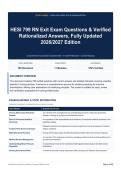
[STUDY GUIDE] • HIGH-YIELD PRACTICE & REVIEW EDITION
HESI 799 RN Exit Exam Questions & Verified
Rationalized Answers, Fully Updated
2026/2027 Edition
Comprehensive Examination Question Bank • In-Depth Rationales • Concept Mapping
TOTAL QUESTIONS EXAM TOPICS RATIONALES
798 Questions 11 Modules 100% Verified
DOCUMENT OVERVIEW
This document contains 798 verified questions with correct answers and detailed rationales covering essential
aspects of nursing practice. It serves as a comprehensive resource for students preparing for licensure
examinations, offering clear explanations of underlying principles. The content is suitable for study, review,
and certification preparation for nursing professionals.
EXAM BLUEPRINT & TOPIC DISTRIBUTION
Systematic breakdown of subject domains and exam coverage.
Topic Module Scope & Core Focus
Chronic Obstructive Pulmonary An overview of the management and understanding of chronic obstructive pulmonary
Disease disease, including its symptoms and treatment options.
Role of Unlicensed Assistive An exploration of the responsibilities and limitations of unlicensed assistive personnel in the
Personnel healthcare setting.
Detailed instructions and importance of proper surgical hand scrub techniques to maintain
Surgical Hand Scrub Techniques aseptic conditions.
White Blood Cell Function A study of the various types of white blood cells and their roles in the immune response.
An overview of the processes involved in managing medical records and the significance of
Medical Records Management accurate documentation.
Understanding Blood Pressure A comprehensive look at the mechanisms that regulate blood pressure and their clinical
Regulation implications.
Nursing Assessment Skills A review of essential nursing assessment skills necessary for effective clinical practice.
Confidential • Student Study Edition • Practice & Review Guide Page 1 of 329
,STUDENT STUDY & MASTERY EDITION PRACTICE & REVIEW GUIDE
An introduction to pharmacological principles, including medication administration and patient
Pharmacology in Nursing safety.
Techniques and best practices for educating patients about their health conditions and
Patient Education Strategies treatment plans.
An overview of mental health nursing principles, including assessment and intervention
Mental Health Nursing strategies.
Infection Control Practices A focus on infection control measures and their application in various healthcare settings.
Total Exam Coverage 11 Integrated Topic Modules • 798 Examination Questions
Confidential • Student Study Edition • Practice & Review Guide Page 2 of 329
,STUDENT STUDY & MASTERY EDITION PRACTICE & REVIEW GUIDE
QUESTION 1
Following discharge teaching, a male client with duodenal ulcer tells the nurse the he
will drink plenty of dairy products, such as milk, to help coat and protect his ulcer.
What is the best follow-up action by the nurse?
[a] Remind the client that it is also important to switch to decaffeinated coffee and tea.
[b] Suggest that the client also plan to eat frequent small meals to reduce discomfort
[c] Review with the client the need to avoid foods that are rich in milk and cream.
[d] Reinforce this teaching by asking the client to list a dairy food that he might select.
Correct Answer: Review with the client the need to avoid foods that are rich in milk and cream.
Rationale: Diets rich in milk and cream stimulate gastric acid secretion and should be avoided.
QUESTION 2
A male client with hypertension, who received new antihypertensive prescriptions at
his last visit returns to the clinic two weeks later to evaluate his blood pressure (BP).
His BP is 158/106 and he admits that he has not been taking the prescribed medication
because the drugs make him "feel bad". In explaining the need for hypertension
control, the nurse should stress that an elevated BP places the client at risk for which
pathophysiological condition?
[a] Blindness secondary to cataracts
[b] Acute kidney injury due to glomerular damage
[c] Stroke secondary to hemorrhage
[d] Heart block due to myocardial damage
Correct Answer: Stroke secondary to hemorrhage.
Rationale: Stroke related to cerebral hemorrhage is major risk for uncontrolled hypertension.
Confidential • Student Study Edition • Practice & Review Guide Page 3 of 329
, STUDENT STUDY & MASTERY EDITION PRACTICE & REVIEW GUIDE
QUESTION 3
The nurse observes an unlicensed assistive personnel (UAP) positioning a newly
admitted client who has a seizure disorder. The client is supine and the UAP is placing
soft pillows along the side rails. What action should the nurse implement?
[a] Ensure that the UAP has placed the pillows effectively to protect the client.
[b] Instruct the UAP to obtain soft blankets to secure to the side rails instead of pillows.
[c] Assume responsibility for placing the pillows while the UAP completes another task.
[d] Ask the UAP to use some of the pillows to prop the client in a side lying position.
Correct Answer: Instruct the UAP to obtain soft blankets to secure to the side rails instead of pillows.
Rationale: The nurse should instruct the UAP to pad the side rails with soft blankest because the use of pillows could result
in suffocation and would need to be removed at the onset of the seizure. The nurse can delegate paddling the side rails to
the UAP.
QUESTION 4
An adolescent with major depressive disorder has been taking duloxetine (Cymbalta)
for the past 12 days. Which assessment finding requires immediate follow-up
[a] Describes life without purpose
[b] Complains of nausea and loss of appetite
[c] States is often fatigued and drowsy
[d] Exhibits an increase in sweating.
Correct Answer: Describes life without purpose.
Rationale: Cymbalta is a selective serotonin and norepinephrine reuptake inhibitor that is known to increase the risk of
suicidal thinking in adolescents and young adults with major depressive disorder. B, C and D are side effects.
Confidential • Student Study Edition • Practice & Review Guide Page 4 of 329
HESI 799 RN Exit Exam Questions & Verified
Rationalized Answers, Fully Updated
2026/2027 Edition
Comprehensive Examination Question Bank • In-Depth Rationales • Concept Mapping
TOTAL QUESTIONS EXAM TOPICS RATIONALES
798 Questions 11 Modules 100% Verified
DOCUMENT OVERVIEW
This document contains 798 verified questions with correct answers and detailed rationales covering essential
aspects of nursing practice. It serves as a comprehensive resource for students preparing for licensure
examinations, offering clear explanations of underlying principles. The content is suitable for study, review,
and certification preparation for nursing professionals.
EXAM BLUEPRINT & TOPIC DISTRIBUTION
Systematic breakdown of subject domains and exam coverage.
Topic Module Scope & Core Focus
Chronic Obstructive Pulmonary An overview of the management and understanding of chronic obstructive pulmonary
Disease disease, including its symptoms and treatment options.
Role of Unlicensed Assistive An exploration of the responsibilities and limitations of unlicensed assistive personnel in the
Personnel healthcare setting.
Detailed instructions and importance of proper surgical hand scrub techniques to maintain
Surgical Hand Scrub Techniques aseptic conditions.
White Blood Cell Function A study of the various types of white blood cells and their roles in the immune response.
An overview of the processes involved in managing medical records and the significance of
Medical Records Management accurate documentation.
Understanding Blood Pressure A comprehensive look at the mechanisms that regulate blood pressure and their clinical
Regulation implications.
Nursing Assessment Skills A review of essential nursing assessment skills necessary for effective clinical practice.
Confidential • Student Study Edition • Practice & Review Guide Page 1 of 329
,STUDENT STUDY & MASTERY EDITION PRACTICE & REVIEW GUIDE
An introduction to pharmacological principles, including medication administration and patient
Pharmacology in Nursing safety.
Techniques and best practices for educating patients about their health conditions and
Patient Education Strategies treatment plans.
An overview of mental health nursing principles, including assessment and intervention
Mental Health Nursing strategies.
Infection Control Practices A focus on infection control measures and their application in various healthcare settings.
Total Exam Coverage 11 Integrated Topic Modules • 798 Examination Questions
Confidential • Student Study Edition • Practice & Review Guide Page 2 of 329
,STUDENT STUDY & MASTERY EDITION PRACTICE & REVIEW GUIDE
QUESTION 1
Following discharge teaching, a male client with duodenal ulcer tells the nurse the he
will drink plenty of dairy products, such as milk, to help coat and protect his ulcer.
What is the best follow-up action by the nurse?
[a] Remind the client that it is also important to switch to decaffeinated coffee and tea.
[b] Suggest that the client also plan to eat frequent small meals to reduce discomfort
[c] Review with the client the need to avoid foods that are rich in milk and cream.
[d] Reinforce this teaching by asking the client to list a dairy food that he might select.
Correct Answer: Review with the client the need to avoid foods that are rich in milk and cream.
Rationale: Diets rich in milk and cream stimulate gastric acid secretion and should be avoided.
QUESTION 2
A male client with hypertension, who received new antihypertensive prescriptions at
his last visit returns to the clinic two weeks later to evaluate his blood pressure (BP).
His BP is 158/106 and he admits that he has not been taking the prescribed medication
because the drugs make him "feel bad". In explaining the need for hypertension
control, the nurse should stress that an elevated BP places the client at risk for which
pathophysiological condition?
[a] Blindness secondary to cataracts
[b] Acute kidney injury due to glomerular damage
[c] Stroke secondary to hemorrhage
[d] Heart block due to myocardial damage
Correct Answer: Stroke secondary to hemorrhage.
Rationale: Stroke related to cerebral hemorrhage is major risk for uncontrolled hypertension.
Confidential • Student Study Edition • Practice & Review Guide Page 3 of 329
, STUDENT STUDY & MASTERY EDITION PRACTICE & REVIEW GUIDE
QUESTION 3
The nurse observes an unlicensed assistive personnel (UAP) positioning a newly
admitted client who has a seizure disorder. The client is supine and the UAP is placing
soft pillows along the side rails. What action should the nurse implement?
[a] Ensure that the UAP has placed the pillows effectively to protect the client.
[b] Instruct the UAP to obtain soft blankets to secure to the side rails instead of pillows.
[c] Assume responsibility for placing the pillows while the UAP completes another task.
[d] Ask the UAP to use some of the pillows to prop the client in a side lying position.
Correct Answer: Instruct the UAP to obtain soft blankets to secure to the side rails instead of pillows.
Rationale: The nurse should instruct the UAP to pad the side rails with soft blankest because the use of pillows could result
in suffocation and would need to be removed at the onset of the seizure. The nurse can delegate paddling the side rails to
the UAP.
QUESTION 4
An adolescent with major depressive disorder has been taking duloxetine (Cymbalta)
for the past 12 days. Which assessment finding requires immediate follow-up
[a] Describes life without purpose
[b] Complains of nausea and loss of appetite
[c] States is often fatigued and drowsy
[d] Exhibits an increase in sweating.
Correct Answer: Describes life without purpose.
Rationale: Cymbalta is a selective serotonin and norepinephrine reuptake inhibitor that is known to increase the risk of
suicidal thinking in adolescents and young adults with major depressive disorder. B, C and D are side effects.
Confidential • Student Study Edition • Practice & Review Guide Page 4 of 329