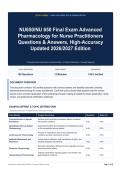
[STUDY GUIDE] • HIGH-YIELD PRACTICE & REVIEW EDITION
NU650/NU 650 Final Exam Advanced
Pharmacology for Nurse Practitioners
Questions & Answers, High-Accuracy
Updated 2026/2027 Edition
Comprehensive Examination Question Bank • In-Depth Rationales • Concept Mapping
TOTAL QUESTIONS EXAM TOPICS RATIONALES
100 Questions 12 Modules 100% Verified
DOCUMENT OVERVIEW
This document contains 100 verified questions with correct answers and detailed rationales covering
advanced pharmacology for nurse practitioners. Each item pairs a board-style question with the correct
answer and a concise explanation of the underlying principle, making it suitable for exam preparation, study
review, and professional certification readiness.
EXAM BLUEPRINT & TOPIC DISTRIBUTION
Systematic breakdown of subject domains and exam coverage.
Topic Module Scope & Core Focus Questions Share (%)
Pharmacokinetics in Special Explores pharmacokinetic parameters affected in patients
Populations with specific conditions. 9 Qs 9.0%
Sympathetic Nervous System Examines the effects and mechanisms of medications acting
Pharmacology on the sympathetic nervous system. 9 Qs 9.0%
Focuses on medications used to treat cardiovascular
Cardiovascular Pharmacology conditions and their mechanisms of action. 9 Qs 9.0%
Antibiotic Mechanisms and Covers various antibiotics, their mechanisms of action, and
Resistance bacterial resistance mechanisms. 9 Qs 9.0%
Discusses medications affecting hormone regulation and their
Endocrine Pharmacology pharmacodynamic effects. 8 Qs 8.0%
Analyzes medications impacting gastric acid secretion and
Gastrointestinal Pharmacology gastrointestinal conditions. 8 Qs 8.0%
Confidential • Student Study Edition • Practice & Review Guide Page 1 of 48
,STUDENT STUDY & MASTERY EDITION PRACTICE & REVIEW GUIDE
Examines medications used in respiratory conditions and their
Respiratory Pharmacology mechanisms on bronchial smooth muscle. 8 Qs 8.0%
Explores mechanisms of action and side effects of
Psychotropic Medications medications used in psychiatric disorders. 8 Qs 8.0%
Covers various classes of medications used to manage acute
Pain Management Pharmacology and chronic pain. 8 Qs 8.0%
Discusses medications used in managing women's health
Women's Health Pharmacology conditions and hormonal therapies. 8 Qs 8.0%
General Pharmacology Covers basic pharmacological principles, including drug
Concepts interactions and therapeutic indices. 8 Qs 8.0%
Focuses on ethical considerations and principles related to
Ethics in Pharmacology medication management. 8 Qs 8.0%
Total Exam Coverage 12 Integrated Topic Modules 100 Qs 100.0%
Confidential • Student Study Edition • Practice & Review Guide Page 2 of 48
,STUDENT STUDY & MASTERY EDITION PRACTICE & REVIEW GUIDE
TOPIC 1: PHARMACOKINETICS IN SPECIAL POPULATIONS
9 Questions • 9.0% of Exam • Explores pharmacokinetic parameters affected in patients with specific conditions.
QUESTION 1
A patient with kidney disease is receiving hemodialysis. Which pharmacokinetic
parameter is most affected in this patient?
[A] Volume of distribution (Vd)
[B] Clearance (Cl)
[C] Half-life (t1/2)
[D] Bioavailability (F)
Correct Answer: B.
Rationale: In patients with kidney disease, clearance is significantly reduced due to impaired renal function, leading to
accumulation of toxins and drugs.
QUESTION 2
A medication has a narrow therapeutic index. Which pharmacokinetic parameter is
most important to monitor in this patient?
[A] Peak concentration (Cmax)
[B] Trough concentration (Cmin)
[C] Area under the curve (AUC)
[D] Volume of distribution (Vd)
Correct Answer: B.
Rationale: Monitoring trough concentrations is critical for patients with narrow therapeutic indices to prevent toxicity and
ensure efficacy.
Confidential • Student Study Edition • Practice & Review Guide Page 3 of 48
, STUDENT STUDY & MASTERY EDITION PRACTICE & REVIEW GUIDE
QUESTION 3
A patient is taking a medication that is highly bound to plasma proteins. Which
pharmacokinetic parameter is affected?
[A] Clearance (Cl)
[B] Volume of distribution (Vd)
[C] Bioavailability (F)
[D] Protein binding
Correct Answer: B.
Rationale: Highly bound medications have a larger volume of distribution, which can affect their pharmacokinetics and
pharmacodynamics.
QUESTION 4
A medication has a long half-life. What is the implication of this pharmacokinetic
parameter?
[A] The medication requires frequent dosing.
[B] The medication has a rapid onset of action.
[C] The medication can be administered once a day.
[D] The medication has a short duration of action.
Correct Answer: C.
Rationale: A long half-life allows for less frequent dosing, making it easier to maintain adherence and reduce the risk of
toxicity.
Confidential • Student Study Edition • Practice & Review Guide Page 4 of 48
NU650/NU 650 Final Exam Advanced
Pharmacology for Nurse Practitioners
Questions & Answers, High-Accuracy
Updated 2026/2027 Edition
Comprehensive Examination Question Bank • In-Depth Rationales • Concept Mapping
TOTAL QUESTIONS EXAM TOPICS RATIONALES
100 Questions 12 Modules 100% Verified
DOCUMENT OVERVIEW
This document contains 100 verified questions with correct answers and detailed rationales covering
advanced pharmacology for nurse practitioners. Each item pairs a board-style question with the correct
answer and a concise explanation of the underlying principle, making it suitable for exam preparation, study
review, and professional certification readiness.
EXAM BLUEPRINT & TOPIC DISTRIBUTION
Systematic breakdown of subject domains and exam coverage.
Topic Module Scope & Core Focus Questions Share (%)
Pharmacokinetics in Special Explores pharmacokinetic parameters affected in patients
Populations with specific conditions. 9 Qs 9.0%
Sympathetic Nervous System Examines the effects and mechanisms of medications acting
Pharmacology on the sympathetic nervous system. 9 Qs 9.0%
Focuses on medications used to treat cardiovascular
Cardiovascular Pharmacology conditions and their mechanisms of action. 9 Qs 9.0%
Antibiotic Mechanisms and Covers various antibiotics, their mechanisms of action, and
Resistance bacterial resistance mechanisms. 9 Qs 9.0%
Discusses medications affecting hormone regulation and their
Endocrine Pharmacology pharmacodynamic effects. 8 Qs 8.0%
Analyzes medications impacting gastric acid secretion and
Gastrointestinal Pharmacology gastrointestinal conditions. 8 Qs 8.0%
Confidential • Student Study Edition • Practice & Review Guide Page 1 of 48
,STUDENT STUDY & MASTERY EDITION PRACTICE & REVIEW GUIDE
Examines medications used in respiratory conditions and their
Respiratory Pharmacology mechanisms on bronchial smooth muscle. 8 Qs 8.0%
Explores mechanisms of action and side effects of
Psychotropic Medications medications used in psychiatric disorders. 8 Qs 8.0%
Covers various classes of medications used to manage acute
Pain Management Pharmacology and chronic pain. 8 Qs 8.0%
Discusses medications used in managing women's health
Women's Health Pharmacology conditions and hormonal therapies. 8 Qs 8.0%
General Pharmacology Covers basic pharmacological principles, including drug
Concepts interactions and therapeutic indices. 8 Qs 8.0%
Focuses on ethical considerations and principles related to
Ethics in Pharmacology medication management. 8 Qs 8.0%
Total Exam Coverage 12 Integrated Topic Modules 100 Qs 100.0%
Confidential • Student Study Edition • Practice & Review Guide Page 2 of 48
,STUDENT STUDY & MASTERY EDITION PRACTICE & REVIEW GUIDE
TOPIC 1: PHARMACOKINETICS IN SPECIAL POPULATIONS
9 Questions • 9.0% of Exam • Explores pharmacokinetic parameters affected in patients with specific conditions.
QUESTION 1
A patient with kidney disease is receiving hemodialysis. Which pharmacokinetic
parameter is most affected in this patient?
[A] Volume of distribution (Vd)
[B] Clearance (Cl)
[C] Half-life (t1/2)
[D] Bioavailability (F)
Correct Answer: B.
Rationale: In patients with kidney disease, clearance is significantly reduced due to impaired renal function, leading to
accumulation of toxins and drugs.
QUESTION 2
A medication has a narrow therapeutic index. Which pharmacokinetic parameter is
most important to monitor in this patient?
[A] Peak concentration (Cmax)
[B] Trough concentration (Cmin)
[C] Area under the curve (AUC)
[D] Volume of distribution (Vd)
Correct Answer: B.
Rationale: Monitoring trough concentrations is critical for patients with narrow therapeutic indices to prevent toxicity and
ensure efficacy.
Confidential • Student Study Edition • Practice & Review Guide Page 3 of 48
, STUDENT STUDY & MASTERY EDITION PRACTICE & REVIEW GUIDE
QUESTION 3
A patient is taking a medication that is highly bound to plasma proteins. Which
pharmacokinetic parameter is affected?
[A] Clearance (Cl)
[B] Volume of distribution (Vd)
[C] Bioavailability (F)
[D] Protein binding
Correct Answer: B.
Rationale: Highly bound medications have a larger volume of distribution, which can affect their pharmacokinetics and
pharmacodynamics.
QUESTION 4
A medication has a long half-life. What is the implication of this pharmacokinetic
parameter?
[A] The medication requires frequent dosing.
[B] The medication has a rapid onset of action.
[C] The medication can be administered once a day.
[D] The medication has a short duration of action.
Correct Answer: C.
Rationale: A long half-life allows for less frequent dosing, making it easier to maintain adherence and reduce the risk of
toxicity.
Confidential • Student Study Edition • Practice & Review Guide Page 4 of 48