[STUDY GUIDE] • HIGH-YIELD PRACTICE & REVIEW EDITION
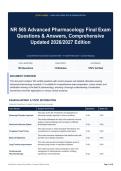
NR 565 Advanced Pharmacology Final Exam
Questions & Answers, Comprehensive
Updated 2026/2027 Edition
Comprehensive Examination Question Bank • In-Depth Rationales • Concept Mapping
TOTAL QUESTIONS EXAM TOPICS RATIONALES
100 Questions 12 Modules 100% Verified
DOCUMENT OVERVIEW
This document contains 100 verified questions with correct answers and detailed rationales covering
advanced pharmacology concepts. It is suitable for comprehensive exam preparation, course review, and
certification training in the field of pharmacology, ensuring a thorough understanding of medication
mechanisms and their applications in various clinical scenarios.
EXAM BLUEPRINT & TOPIC DISTRIBUTION
Systematic breakdown of subject domains and exam coverage.
Topic Module Scope & Core Focus Questions Share (%)
This topic covers the mechanisms and applications of
Adrenergic Receptor Agonism adrenergic receptor agonists in various conditions. 9 Qs 9.0%
This section addresses the roles of the autonomic nervous
system in pharmacotherapy and its impact on different
Autonomic Nervous System physiological responses. 9 Qs 9.0%
This topic focuses on pharmacological interventions and
Congestive Heart Failure considerations in managing congestive heart failure. 9 Qs 9.0%
This section examines medications that stabilize mast cells
Mast Cell Stabilizers and their role in allergic responses. 9 Qs 9.0%
This topic explores pharmacological strategies aimed at
Lung Function Improvement enhancing lung function in respiratory diseases. 8 Qs 8.0%
This section discusses various medications used in the
Cardiovascular management of cardiovascular conditions, including
Pharmacotherapy hypertension and arrhythmias. 8 Qs 8.0%
Confidential • Student Study Edition • Practice & Review Guide Page 1 of 46
,STUDENT STUDY & MASTERY EDITION PRACTICE & REVIEW GUIDE
This topic covers the pharmacological treatments for diabetes
Diabetes Management and their mechanisms of action. 8 Qs 8.0%
This section reviews the different classes of antihypertensive
Antihypertensive Agents medications and their clinical implications. 8 Qs 8.0%
This topic investigates various antibiotics and their
Antimicrobial Therapy mechanisms of action against specific infections. 8 Qs 8.0%
This section focuses on pharmacological approaches to
Pain Management managing acute and chronic pain. 8 Qs 8.0%
Antidepressants and This topic covers the mechanisms and uses of various
Psychotropic Medications psychotropic medications, including antidepressants. 8 Qs 8.0%
This section addresses medications affecting the endocrine
Endocrine Pharmacology system, including those for thyroid and adrenal disorders. 8 Qs 8.0%
Total Exam Coverage 12 Integrated Topic Modules 100 Qs 100.0%
Confidential • Student Study Edition • Practice & Review Guide Page 2 of 46
,STUDENT STUDY & MASTERY EDITION PRACTICE & REVIEW GUIDE
TOPIC 1: ADRENERGIC RECEPTOR AGONISM
9 Questions • 9.0% of Exam • This topic covers the mechanisms and applications of adrenergic receptor agonists in various
conditions.
QUESTION 1
A 60-year-old patient with hypertension and heart failure is prescribed a beta-blocker.
Which autonomic nervous system (ANS) pathway is primarily responsible for the
therapeutic effect of this medication?
[A] Sympathetic nervous system (SNS) pathway
[B] Parasympathetic nervous system (PNS) pathway
[C] Vagus nerve stimulation
[D] Baroreceptor reflex
Correct Answer: B. Parasympathetic nervous system (PNS) pathway.
Rationale: Beta-blockers work by stimulating the parasympathetic nervous system pathway, which decreases heart rate
and blood pressure.
QUESTION 2
A patient with autonomic dysfunction is prescribed a medication to increase heart rate.
Which type of receptor agonist would be most appropriate?
[A] Adrenergic receptor agonist
[B] Cholinergic receptor agonist
[C] Vasopressin receptor agonist
[D] Dopamine receptor agonist
Correct Answer: A. Adrenergic receptor agonist.
Rationale: Adrenergic receptor agonists increase heart rate and blood pressure by stimulating the sympathetic nervous
system pathway.
Confidential • Student Study Edition • Practice & Review Guide Page 3 of 46
, STUDENT STUDY & MASTERY EDITION PRACTICE & REVIEW GUIDE
QUESTION 3
A patient with orthostatic hypotension is prescribed a medication to increase blood
pressure. Which autonomic nervous system (ANS) pathway is primarily responsible for
the therapeutic effect of this medication?
[A] Sympathetic nervous system (SNS) pathway
[B] Parasympathetic nervous system (PNS) pathway
[C] Vagus nerve stimulation
[D] Baroreceptor reflex
Correct Answer: A. Sympathetic nervous system (SNS) pathway.
Rationale: Medications used to treat orthostatic hypotension often work by stimulating the sympathetic nervous system
pathway, which helps to increase blood pressure.
QUESTION 4
What is the primary mechanism of action of clonidine in the treatment of hypertension?
[A] Central alpha-2 adrenergic receptor agonism
[B] Central beta-1 adrenergic receptor agonism
[C] Central beta-2 adrenergic receptor agonism
[D] Central muscarinic receptor agonism
Correct Answer: Central alpha-2 adrenergic receptor agonism.
Rationale: Clonidine is a central alpha-2 adrenergic receptor agonist that is used to treat hypertension.
QUESTION 5
What is the primary side effect of glucocorticoid therapy?
[A] Hypoglycemia
[B] Hyperglycemia
[C] Hypertension
[D] Hirsutism
Correct Answer: B. Hyperglycemia.
Rationale: Glucocorticoids can cause hyperglycemia as a side effect.
Confidential • Student Study Edition • Practice & Review Guide Page 4 of 46
NR 565 Advanced Pharmacology Final Exam
Questions & Answers, Comprehensive
Updated 2026/2027 Edition
Comprehensive Examination Question Bank • In-Depth Rationales • Concept Mapping
TOTAL QUESTIONS EXAM TOPICS RATIONALES
100 Questions 12 Modules 100% Verified
DOCUMENT OVERVIEW
This document contains 100 verified questions with correct answers and detailed rationales covering
advanced pharmacology concepts. It is suitable for comprehensive exam preparation, course review, and
certification training in the field of pharmacology, ensuring a thorough understanding of medication
mechanisms and their applications in various clinical scenarios.
EXAM BLUEPRINT & TOPIC DISTRIBUTION
Systematic breakdown of subject domains and exam coverage.
Topic Module Scope & Core Focus Questions Share (%)
This topic covers the mechanisms and applications of
Adrenergic Receptor Agonism adrenergic receptor agonists in various conditions. 9 Qs 9.0%
This section addresses the roles of the autonomic nervous
system in pharmacotherapy and its impact on different
Autonomic Nervous System physiological responses. 9 Qs 9.0%
This topic focuses on pharmacological interventions and
Congestive Heart Failure considerations in managing congestive heart failure. 9 Qs 9.0%
This section examines medications that stabilize mast cells
Mast Cell Stabilizers and their role in allergic responses. 9 Qs 9.0%
This topic explores pharmacological strategies aimed at
Lung Function Improvement enhancing lung function in respiratory diseases. 8 Qs 8.0%
This section discusses various medications used in the
Cardiovascular management of cardiovascular conditions, including
Pharmacotherapy hypertension and arrhythmias. 8 Qs 8.0%
Confidential • Student Study Edition • Practice & Review Guide Page 1 of 46
,STUDENT STUDY & MASTERY EDITION PRACTICE & REVIEW GUIDE
This topic covers the pharmacological treatments for diabetes
Diabetes Management and their mechanisms of action. 8 Qs 8.0%
This section reviews the different classes of antihypertensive
Antihypertensive Agents medications and their clinical implications. 8 Qs 8.0%
This topic investigates various antibiotics and their
Antimicrobial Therapy mechanisms of action against specific infections. 8 Qs 8.0%
This section focuses on pharmacological approaches to
Pain Management managing acute and chronic pain. 8 Qs 8.0%
Antidepressants and This topic covers the mechanisms and uses of various
Psychotropic Medications psychotropic medications, including antidepressants. 8 Qs 8.0%
This section addresses medications affecting the endocrine
Endocrine Pharmacology system, including those for thyroid and adrenal disorders. 8 Qs 8.0%
Total Exam Coverage 12 Integrated Topic Modules 100 Qs 100.0%
Confidential • Student Study Edition • Practice & Review Guide Page 2 of 46
,STUDENT STUDY & MASTERY EDITION PRACTICE & REVIEW GUIDE
TOPIC 1: ADRENERGIC RECEPTOR AGONISM
9 Questions • 9.0% of Exam • This topic covers the mechanisms and applications of adrenergic receptor agonists in various
conditions.
QUESTION 1
A 60-year-old patient with hypertension and heart failure is prescribed a beta-blocker.
Which autonomic nervous system (ANS) pathway is primarily responsible for the
therapeutic effect of this medication?
[A] Sympathetic nervous system (SNS) pathway
[B] Parasympathetic nervous system (PNS) pathway
[C] Vagus nerve stimulation
[D] Baroreceptor reflex
Correct Answer: B. Parasympathetic nervous system (PNS) pathway.
Rationale: Beta-blockers work by stimulating the parasympathetic nervous system pathway, which decreases heart rate
and blood pressure.
QUESTION 2
A patient with autonomic dysfunction is prescribed a medication to increase heart rate.
Which type of receptor agonist would be most appropriate?
[A] Adrenergic receptor agonist
[B] Cholinergic receptor agonist
[C] Vasopressin receptor agonist
[D] Dopamine receptor agonist
Correct Answer: A. Adrenergic receptor agonist.
Rationale: Adrenergic receptor agonists increase heart rate and blood pressure by stimulating the sympathetic nervous
system pathway.
Confidential • Student Study Edition • Practice & Review Guide Page 3 of 46
, STUDENT STUDY & MASTERY EDITION PRACTICE & REVIEW GUIDE
QUESTION 3
A patient with orthostatic hypotension is prescribed a medication to increase blood
pressure. Which autonomic nervous system (ANS) pathway is primarily responsible for
the therapeutic effect of this medication?
[A] Sympathetic nervous system (SNS) pathway
[B] Parasympathetic nervous system (PNS) pathway
[C] Vagus nerve stimulation
[D] Baroreceptor reflex
Correct Answer: A. Sympathetic nervous system (SNS) pathway.
Rationale: Medications used to treat orthostatic hypotension often work by stimulating the sympathetic nervous system
pathway, which helps to increase blood pressure.
QUESTION 4
What is the primary mechanism of action of clonidine in the treatment of hypertension?
[A] Central alpha-2 adrenergic receptor agonism
[B] Central beta-1 adrenergic receptor agonism
[C] Central beta-2 adrenergic receptor agonism
[D] Central muscarinic receptor agonism
Correct Answer: Central alpha-2 adrenergic receptor agonism.
Rationale: Clonidine is a central alpha-2 adrenergic receptor agonist that is used to treat hypertension.
QUESTION 5
What is the primary side effect of glucocorticoid therapy?
[A] Hypoglycemia
[B] Hyperglycemia
[C] Hypertension
[D] Hirsutism
Correct Answer: B. Hyperglycemia.
Rationale: Glucocorticoids can cause hyperglycemia as a side effect.
Confidential • Student Study Edition • Practice & Review Guide Page 4 of 46